





Talent management is the system for how you find, grow, and keep the people who build your company.
It's the operational discipline that connects your hiring plan directly to your business goals. For a startup, this is not a theoretical HR exercise. It's a core business function.
Why Talent Management Matters for Startups
In a fast-growing company, every hire is a high-stakes bet. Get it right and you add fuel to your growth. Get it wrong and you burn cash, kill momentum, and spend weeks fixing a problem you created.
A deliberate talent management strategy is your best defence against this chaos. It gives you a repeatable system for getting the right people into the right roles at the right time.
Without a plan, you make reactive, gut-feel decisions that rarely scale. With one, you build a machine that boosts team performance, clarifies career paths, and creates a culture people want to join. This directly impacts your ability to hit product milestones and revenue targets.
The Real Cost of Neglecting Talent
Ignoring your people strategy is expensive. A single bad hire can cost over £132,000 when you add up the wasted salary, recruitment fees, training time, and lost productivity.
That’s a painful wound most startups can’t afford.
This is why a strong system for finding and keeping talent is non-negotiable. It’s how you avoid these mistakes and protect your most valuable asset. Your team.
The Core Goal of Talent Management
The goal is to build a seamless employee lifecycle. Every touchpoint, from the first job description a candidate sees to their exit interview, should feel connected and intentional. It’s the shift from simply filling seats to strategically building a team that can win.
The key components work together.
- Attraction: Craft a compelling reason for top talent to choose you. This is tied to your mission and how you communicate it. Learn how to build a strong employer brand.
- Development: Give your team the skills and opportunities they need to grow with the company, not out of it. If their learning stalls, they’ll leave.
- Retention: Build an environment where your best people feel valued, challenged, and can see a future for themselves at your company.
-
Talent management is about treating your people strategy with the same rigor you give your product roadmap or sales pipeline. The people build everything else.
The Core Components of a Modern Talent Strategy
Effective talent management is a connected system. Every part strengthens the others, creating a seamless journey for every person on your team. For a startup, this system must be practical and focused on impact.
It’s the operating system for your people. Each component is a core app that keeps the business moving. When they work together, you build a powerful engine for growth.
At its heart, talent management is a simple, continuous cycle.
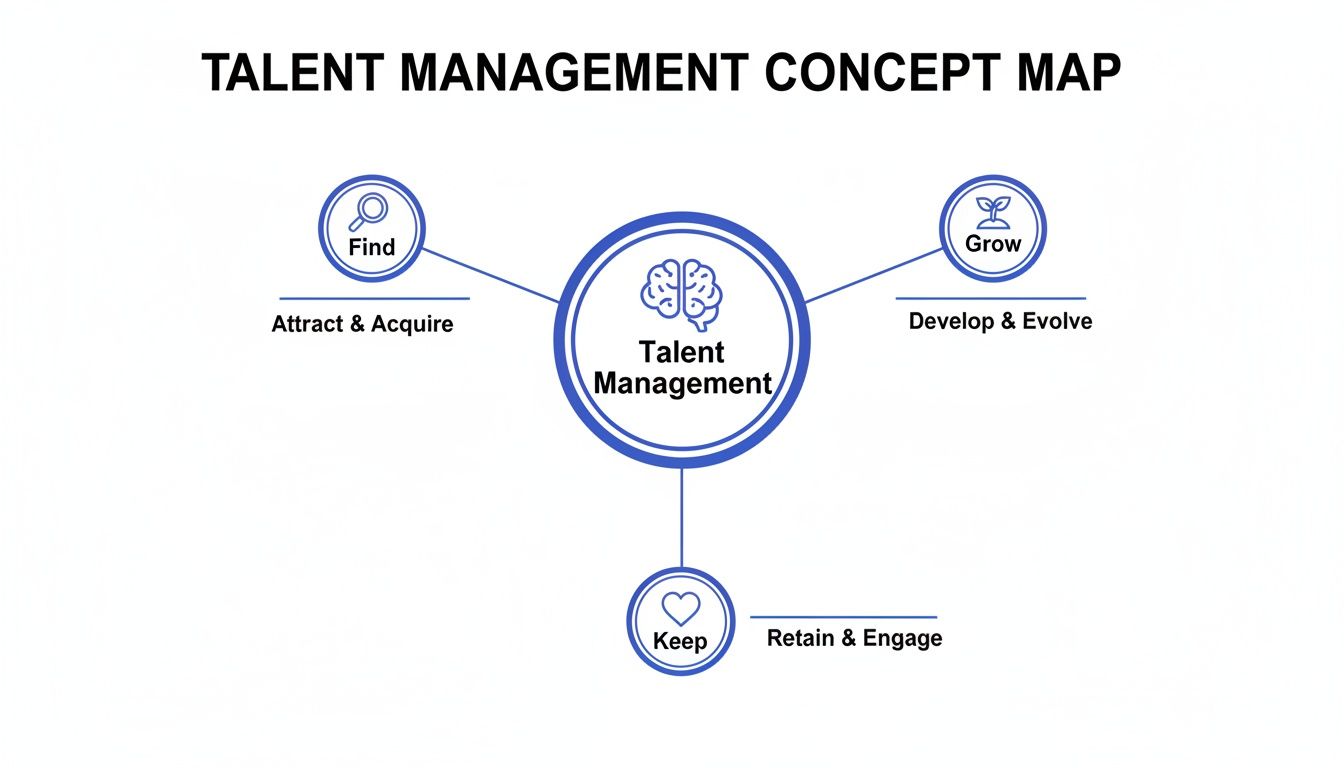
This illustrates the loop of finding, growing, and keeping the people who will build your company. Let’s break down what that looks like in practice.
Planning and Attracting Talent
This is your foundation. Before writing a job description, you need clarity on the skills your business needs to hit its next milestone. Look at your product roadmap and revenue goals, then work backwards to figure out who to hire.
What good looks like.
- Simple role scorecards. Ditch long, generic job descriptions. Create a one-pager for each role that defines its core mission, key outcomes for the first 6-12 months, and essential skills.
- A structured hiring process. Everyone involved in interviewing knows what they’re assessing. This stops candidates from being asked the same questions repeatedly and ensures you make decisions based on evidence, not just gut feelings.
Onboarding New Hires
A great onboarding experience is your best chance to prove to a new hire they made the right decision. It sets the tone for their time with your company. The goal is to get them productive fast and make them feel they belong.
This means having a clear 30-60-90 day plan ready. This document should map out specific goals, learning objectives, and key people they need to connect with in their first three months. It removes ambiguity and gives them a clear path to making an impact.
Development and Performance
In a fast-growing company, roles are always changing. Your approach to development needs to reflect that. Forget stiff annual reviews. The focus should be on continuous feedback loops and forward-looking conversations about growth.
Performance chats should happen regularly and focus on the future, not just past mistakes. Ask simple questions like, "What skills do you need to develop to hit your goals?" and "How can I best support you?". This makes performance management a tool for development, not a chore.
Retention and Engagement
Keeping your best people is the ultimate measure of your talent strategy. High retention is the outcome of getting the other pieces right. It means people feel challenged, see a path forward, and believe in the mission. A key aspect is implementing proven employee retention strategies that can reduce turnover.
Off-boarding and Succession Planning
How someone leaves is as important as how they join. A respectful off-boarding process protects your employer brand and gives you valuable feedback through a structured exit interview.
Succession planning in a startup is practical. Look at your most critical roles and ask, "If this person left tomorrow, who could step up?". This question forces you to be proactive about developing your next leaders. Use a practical succession planning template to get started.
Building Your First Talent Management Playbook
Knowing the theory is one thing. Building a system that works is what matters. This is your roadmap for creating a talent management playbook from scratch. It is designed for action.
You don’t need a huge budget or a massive team. You need a clear, step-by-step plan that focuses on the highest-impact activities first.
Step 1: Audit Your Current State
First, get an honest look at where you are now. You can’t fix what you don’t acknowledge.
Get your leadership team together and ask direct questions to find your biggest pain points.
- Hiring. How confident are we that we’re hiring the right people? Is our interview process consistent or a free-for-all?
- Onboarding. Do new hires have a clear path to productivity in their first 90 days, or are they left to figure things out?
- Performance. Are our managers having regular, meaningful chats about growth with their teams?
- Retention. Are our best people staying? If not, do we know why they’re leaving?
-
Your answers will reveal the biggest fires. This is about finding a solid starting point.
Step 2: Define Your Talent Philosophy
Your talent philosophy is a short, clear statement on what you believe about your people. It's the foundation for every decision you’ll make about hiring, development, and performance. Getting this right creates consistency.
It should answer tough questions like.
- Do we hire for raw potential or proven, hands-on experience?
- Do we prefer internal promotions or bringing in external leaders for senior roles?
- What's our stance on performance? Do we manage out poor performers quickly or invest heavily in turning them around?
A clear philosophy acts as a guardrail. It ensures every people-related process you build is aligned.
Step 3: Prioritize Your First Initiative
You cannot fix everything at once. Trying to will guarantee you fail at everything.
Look back at your audit and pick the one single area causing the most pain or risk.
Is it chaotic hiring? Start there. Build a simple, structured interview process. Are new hires getting lost in their first month? Focus on creating a solid 30-60-90 day onboarding plan.
Your goal is to secure a quick, meaningful win. This builds momentum and earns you the trust to tackle bigger challenges later. Choose one problem and solve it well.
Step 4: Implement and Measure
Once you've chosen your initiative, roll it out and track its impact.
If you improved your onboarding plan, measure new hire performance at the 90-day mark. If you fixed your hiring process, track your offer acceptance rate.
Measurement is what separates a real strategy from wishful thinking. It shows you what’s working and tells you where to focus next. This iterative approach is key to building a comprehensive talent system over time.
How To Measure Talent Management Success
You can’t improve what you don’t measure. Track the numbers that signal the health of your people strategy. These KPIs tell a story about your ability to attract, develop, and keep the right people.
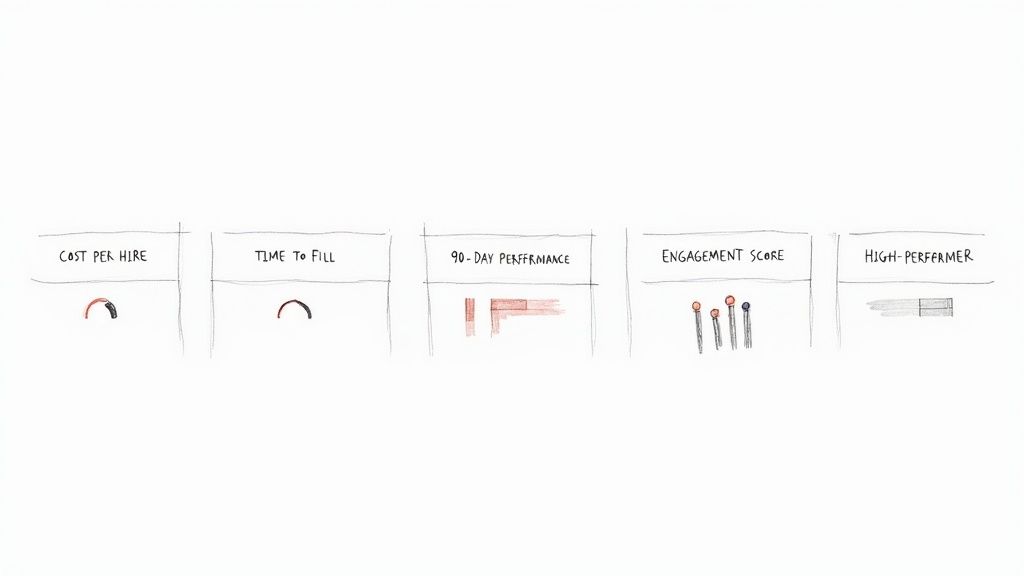
You don't need a complex system. A simple spreadsheet is often enough to build a basic dashboard. The goal is an at-a-glance view of your talent pipeline's effectiveness.
Key Talent Management KPIs
Start with a handful of high-impact metrics. These give you the clearest picture of what’s working.
- Cost per Hire. Total recruitment spend divided by the number of hires. This is a direct measure of your hiring efficiency. Keeping this number lean is critical for a startup.
- Time to Fill. How many days from opening a job to a candidate accepting the offer. A long Time to Fill is a warning sign that you’re losing top candidates to faster competitors.
- New Hire Performance at 90 Days. A qualitative but vital metric. After three months, is the new hire meeting expectations? A simple 'yes' or 'no' from their manager indicates hiring quality.
- High-Performer Turnover Rate. What percentage of your top performers are leaving voluntarily? If this is high, it's a massive red flag. It means your best people don't see a future with you. This is arguably the most important retention metric.
Why This Data Matters More Than Ever
In the current climate, a data-driven approach to talent is non-negotiable. With recent UK hiring plans dropping, employers are shifting focus from expanding headcount to boosting productivity. Every business is asking how to get the most from their existing team.
This shift makes tracking internal development more important. You can learn more about how the economic climate is shaping talent priorities.
Startups often ignore talent metrics until it's too late. Tracking these numbers early helps you spot problems while they’re small and fixable.
Building a simple dashboard to track these KPIs is a foundational step. It moves you from gut-feel decisions to data-informed conversations. To dive deeper, check out our guide on proving the ROI on your people initiatives.
Common Startup Talent Pitfalls to Avoid
Knowing what to do is half the battle. Knowing which traps to avoid is just as crucial. Startups often fall into the same predictable holes. You can sidestep them with a bit of foresight.
These are the issues that kill momentum, burn cash, and lead to your best people leaving. Dodging them is one of the smartest things a People Leader can do.
Hiring Too Fast and Lowering the Bar
This is a classic error. You’ve landed a new client or funding, and the pressure is on to hire fast. In the rush, you compromise on quality just to get people in seats. You will always regret this.
- Red Flag. You hear hiring managers say, “They’re not perfect, but they’re good enough for now.” This phrase is a direct path to a mediocre team.
-
- Preventative Action. Stick to your structured hiring process, no matter the pressure. A bad hire is always more expensive than waiting for the right one. A single great hire can outperform five average ones.
Promoting Top Performers into Bad Managers
Your best software engineer isn’t automatically your best engineering manager. The skills that make someone a brilliant individual contributor are often the opposite of what makes a great leader. Promoting without training sets up the new manager and their team for failure.
- Red Flag. You promote someone on a Friday and expect them to lead their former peers on Monday with zero support.
- Preventative Action. Create a simple “manager track” conversation. Before promoting, ask if they genuinely want to lead people. If yes, invest in basic management training before they take the role.
Great management is a distinct skill, not a reward for technical excellence.
Lacking a Clear Compensation Philosophy
Without a clear approach to compensation, every salary conversation becomes a chaotic negotiation. This creates pay inequity, breeds resentment, and makes budgeting impossible. It’s a surefire way to lose great people over something preventable.
- Red Flag. Two people in the same role with similar experience have wildly different salaries, and you can’t explain why.
-
- Preventative Action. Document your compensation philosophy. A simple one-pager that outlines how you benchmark salaries, your approach to equity, and how performance influences pay brings fairness and predictability.
The Right Tech Stack for Lean Talent Management
You don't need a clunky, enterprise system to manage talent well. For a startup, that's overkill. The smarter play is a lean, flexible tech stack with modern tools that work together. The goal is speed and impact, not creating an administrative nightmare.
Your tech should support your processes, not dictate them. A lightweight stack gives you the agility to adapt as you grow.
Core Tools for Your Stack
When starting out, prioritize tools that solve your most immediate headaches. This usually means four key areas.
- Applicant Tracking Systems (ATS). Your command center for hiring. A good ATS like Ashby, Teamtailor or Lever helps you manage your candidate pipeline and schedule interviews. It brings structure to a chaotic process.
-
- HR Information Systems (HRIS). Your single source of truth for all people data. Platforms like Shapes, Humaans, HiBob or Personio handle essentials like employee records and time off. Getting this right early saves you from spreadsheet hell later.
-
- Performance Management Platforms. Forget annual reviews. Tools like Lattice or 15Five help you systematise feedback and goal-setting. They move these activities into a structured, continuous process that helps people grow.
-
- Engagement Tools. Get a real pulse on how your team is feeling. Platforms such as Culture Amp or Peakon let you run employee surveys to get a clear picture of morale. They give you the data to understand what's working long before it shows up in turnover stats.
A Note on Diversity and Inclusion
Your tech stack can play a role in building a more inclusive team. When picking tools, consider how they support your diversity goals. This is vital.
Data from the UK shows the talent management industry is overwhelmingly led by women (73%), yet leadership is 87% white. You can read more about the UK's talent management diversity gap. Your tools should help you build fair processes that identify and develop diverse talent, not reinforce biases.
As you consider your tech, explore the best tools for recruiters to make your team more efficient.
Frequently Asked Questions
We hear these questions all the time from founders and People leaders. Here are some quick answers.
When Should a Startup Start Talent Management?
From your first hire. You don’t need a complex system from day one, but establishing good habits around how you hire, onboard, and give feedback is non-negotiable.
Once you hit 15-20 employees, it’s time to formalise things. At that size, informal chats break down and you need consistency to keep the culture healthy.
What Is the Most Critical Part for an Early-Stage Company?
Recruiting and selection. Nothing else comes close.
In the early days, every person you bring on board has an outsized impact on your culture and product. A single bad hire can be a genuine threat to the company's survival. Getting the right people in the door is the highest-leverage activity you can focus on.
How Can I Manage Talent with No Budget or HR Team?
Focus on low-cost, high-impact habits. The key is being intentional and consistent. As a founder, you have to own this process at the start.
Here’s what that looks like.
- Structured Interviews. Create a simple interview process using Google Docs. Define what you’re testing for at each stage and stick to the plan for every candidate.
- Onboarding Checklists. Build a basic checklist for every new hire. This ensures everyone gets the same core information and is set up for success.
- Regular One-on-Ones. Schedule weekly or bi-weekly one-on-ones for feedback. It's the simplest and most powerful management tool.
- Simple Surveys. Use free tools like Google Forms or Typeform to get a quick pulse check on team morale. It doesn't have to be complicated to be insightful.
Talent management doesn't have to be a monster project. With the right frameworks and tools, you can build a system that attracts and keeps the people you need to win. At Open Org, we give you the playbooks and resources to do just that, but faster.
