





Here's a simple succession planning template to get you started. The real value is in the thinking behind it. It’s about building resilience so your startup doesn't grind to a halt when a key person leaves.
Why Your Startup Needs a Succession Plan Now
Ignoring succession planning feels fine until it isn't. In a startup, losing one critical person can throw an entire quarter off course.
Think about your key engineer who holds all the context on your legacy codebase. Or the sales lead with all the major client relationships. When they leave unexpectedly, you’re left scrambling.
This is a practical, lightweight exercise in managing risk and nurturing your best people. For a fast-growing company, it’s a system that absorbs shocks and keeps momentum going.
The Real Cost of Leadership Gaps
A vacant leadership role creates a vacuum. Decisions stall, team morale dives, and your top performers quietly wonder if their own growth is capped. When your team sees no clear path for progression, they start looking for it somewhere else.
Succession planning is your most powerful, and often overlooked, retention tool. It signals to your best people that you’re invested in their future here, not just their output this week.
Without a plan, you're forced into reactive, expensive, and often panicked external hiring. This is a common failure point. In the UK's top companies, poor succession planning has led to a heavy reliance on outside hires, with 52% of new FTSE 100 chief executives being recruited externally because of weak internal pipelines.
This lack of a structured plan demotivates staff who see limited opportunities, spiking turnover and draining essential institutional knowledge. Learn more about succession planning trends from this analysis.
For a startup, this brain drain is fatal. You lose context, culture carriers, and the people who just know how to make things happen in your unique environment.
Building Resilience, Not Bureaucracy
Your first succession plan doesn't need to be an elaborate masterpiece. It can be a simple spreadsheet. The goal is to start answering a few critical questions.
- Which roles would cripple us if they were empty tomorrow? Think beyond the C-suite. Consider single points of failure hiding in plain sight.
- Who on our current team shows the potential to step into these roles? Look for learning agility and resilience, not just current performance. Who are the problem-solvers?
- What skills or experiences do they need to be ready? This becomes the foundation for their personal development plan.
A lightweight succession planning template gives you the structure to have these conversations regularly. It transforms a vague worry into an actionable talent strategy, ensuring you’re building your next generation of leaders before you desperately need them.
This proactive approach is what separates the companies that scale smoothly from those that stumble.
Your Succession Planning Template Explained
Let's get straight to the tool.
Our succession planning template is built for speed and action. It’s a simple, high-impact framework designed to be a living document, not a static file you create once and bury. You can use it today to start the right conversations about your team's future.
The point is to shift from a reactive mindset to a proactive one. We'll walk through each part of the template.
Identifying Your Critical Roles
The first step is knowing which roles are truly business-critical. This isn't just about your leadership team. A critical role is any position that would cause significant disruption if left empty.
Think about the single points of failure in your organisation. Who holds immense, undocumented institutional knowledge?
- The Senior Backend Engineer who’s the only one that understands your original payment gateway integration?
- The Head of Community who has personally nurtured all your key user relationships?
- The Finance Manager who single-handedly runs payroll and forecasting?
These are the roles that need to be on your radar. The template prompts you to list these positions first, forcing you to look beyond the org chart to see the real operational risks. Start with the top 5-10 roles that keep you up at night.
This process immediately shines a light on the risks of talent loss before you build a plan to fix them.
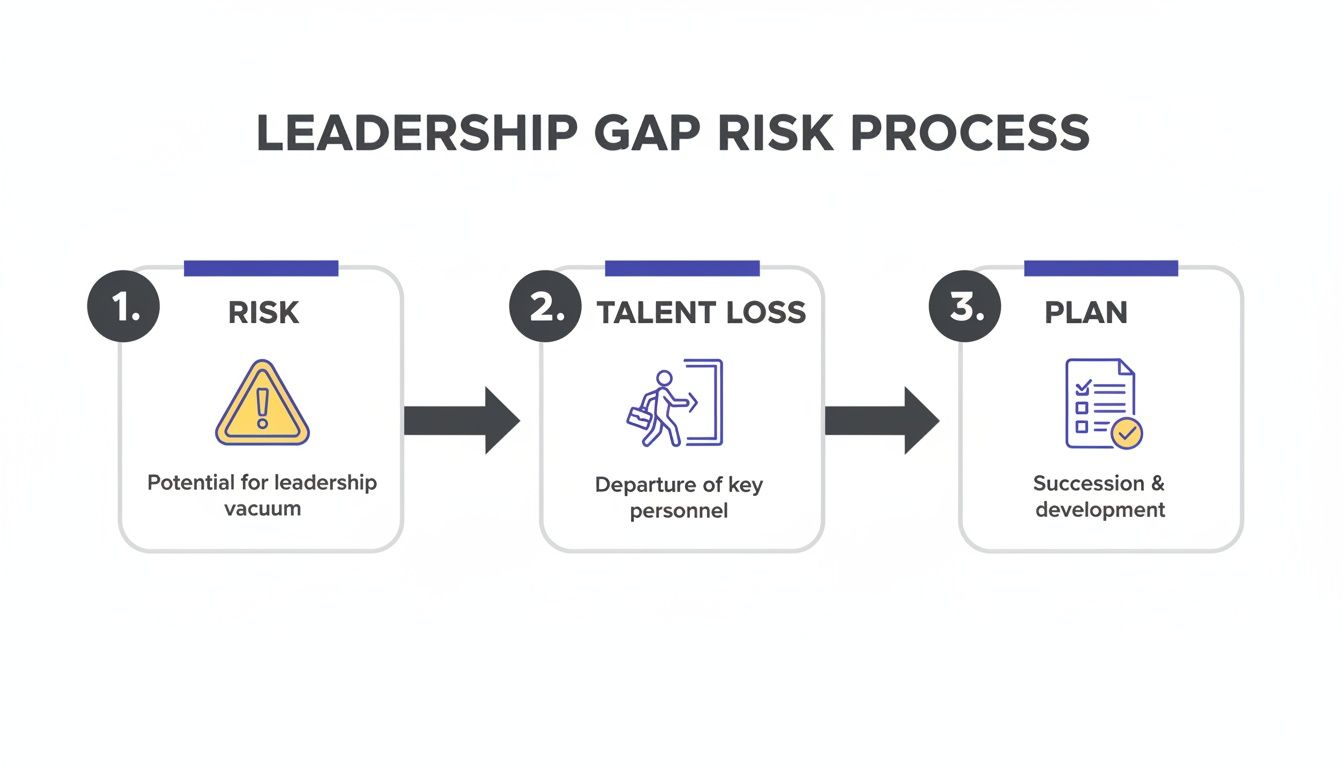
Visualising this flow shows how quickly an unmanaged risk can lead to talent churn and operational gaps.
Key Components of the Succession Planning Template
Here is a quick breakdown of what you'll find in the template.
- Critical Role Identification: This section prompts you to list roles whose vacancy would cause significant disruption. Startups often have key knowledge concentrated in a few individuals. This highlights your biggest risks first.
- Talent Assessment: It provides a simple scoring system for Potential and Readiness. This moves you beyond "gut feel" to a consistent way of evaluating internal candidates, keeping things fair and focused.
- Development Planning: It guides you to create specific, on-the-job growth actions for each successor. This avoids wasting money on generic courses and builds real-world skills your business needs while engaging top talent.
- Implementation Tracker: This is a space to monitor progress on development plans and readiness levels. It turns your plan from a static document into an active talent-building programme.
Each section is designed to be practical and directly applicable to a startup or scale-up.
Assessing Your Internal Talent
Once you know your critical roles, you need a simple way to assess potential internal successors. Our template uses a straightforward scoring system for Potential and Readiness.
Potential is about an individual's capacity to grow and take on more complexity. Look for markers like learning agility, resilience, and a knack for solving unstructured problems. Are they consistently seeking new challenges?
Readiness is about timing. It assesses how prepared someone is to step into the role right now. We use a simple scale.
- Ready Now: Could step into the role tomorrow with minimal disruption.
- Ready in 12-18 Months: Has strong potential but needs targeted development in a few specific areas.
- Ready in 2+ Years: A longer-term bet who shows promising signs but needs significant experience.
This isn’t perfect science. It’s about creating a shared language for your leadership team to discuss talent objectively. The scoring forces you to justify assessments and move beyond vague feelings.
Creating Actionable Development Plans
This is where the template becomes a tool for growth, not just risk management. For each identified successor, there’s a section to build a simple, actionable development plan. Identifying a name is useless without a concrete plan to get them ready.
A succession plan without a development component is just a list. Actionable development turns your plan into a real talent-building engine.
Forget sending people on expensive, generic training courses. The best development happens on the job. The template guides you to think about practical growth opportunities.
- Stretch Assignments: What project can they lead that will force them to build a missing skill? Can your potential Head of Marketing take the lead on the next big product launch?
- Mentorship: Who in the business can offer guidance? Pair a high-potential engineer with your CTO for regular coaching sessions.
- Exposure: How can you give them a taste of the future role? Invite your potential Head of Sales to sit in on leadership meetings.
These actions are specific, low-cost, and directly linked to closing the readiness gap. This approach aligns individual growth with the company’s long-term health. It also ties directly into a broader strategic framework, which you can map out using our People Roadmap Template.
Identifying Critical Roles and High-Potential Talent
Succession planning starts with an honest look at your organisation. You need to figure out which roles would cause chaos if they were suddenly empty, and who on your team has the raw ingredients to eventually fill them.
First, pinpoint your critical roles. This goes beyond your leadership team. A critical role is defined by its impact, not its seniority.
Ask yourself: If this person left tomorrow, where would the business feel the most pain?
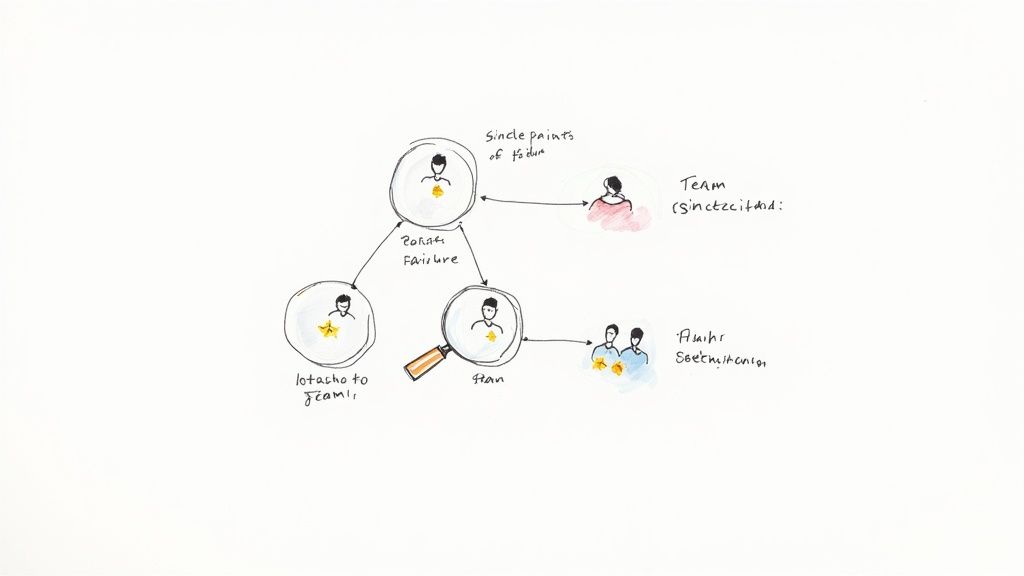
Often, these are the individual contributors who are single points of failure. They hold huge amounts of institutional knowledge that isn't written down anywhere. Losing them means losing a huge chunk of your operational memory.
Pinpointing Your Single Points of Failure
Let's get practical. You're looking for roles with a unique combination of skills, knowledge, and relationships that are hard to replicate quickly.
- High Impact: The role directly affects revenue, product stability, or key customer relationships.
- Specialised Knowledge: The person has deep, specific knowledge of a system, process, or market that few others possess.
- Low Bench Strength: No one else on the team could realistically step in and perform even 60% of the role's duties.
Start a list, but be ruthless. This list should cover no more than 10-15% of your total roles. If you're a 100-person company with a list of 50 "critical" roles, you’ve missed the point. Prioritise.
Spotting Your High-Potential Talent
Once you know the what, it's time to find the who. Identifying high-potential individuals isn't just about rewarding your top performers. High performance in a current role doesn't guarantee success in a future, more complex one.
You are looking for a different set of signals. The people who show an incredible capacity to grow and adapt are your future leaders. They might not be the most obvious ones right now.
You're betting on learning agility, not just current expertise.
Look for these observable behaviours during talent reviews or one-to-ones.
- Learning Agility: Do they actively seek out feedback and do something with it? When they hit a problem they've never seen, do they get energised or frustrated?
- Resilience: How do they handle setbacks? High-potentials bounce back from failure, extract the lesson, and move forward without pointing fingers.
- Ownership Mindset: They consistently think beyond their job description. They spot problems or opportunities in other parts of the business and try to help solve them.
To make this sustainable, you need to be intentional about building a talent pipeline that delivers results. This proactive approach ensures you always have a pool of talent ready for development.
The lack of this structured approach is a major downfall for many businesses. While two-thirds of UK family business owners hope to pass the company to relatives, only 34% have a formal succession plan. This is where a simple template becomes invaluable for structuring the process and preventing the disputes that cause 70% of business transitions to fail.
Filling out your succession planning template with this lens helps you move beyond bias and gut feelings. It gives you a structured way to assess your team's potential.
Building Actionable Development Plans for Your Team
Pinpointing a potential successor is just the first step. A succession planning template filled with names but no follow-through is just a list. The real work is closing the gap between where your high-potential talent is today and where they need to be.
This is about building targeted, meaningful development plans. Forget pulling people out of their day jobs for generic courses that have little connection to their actual work. In a startup, the most powerful development is woven into the job itself.
The aim is to prepare your future leaders for real-world challenges by letting them practise in a supportive environment. This is how you build genuine capability and confidence.
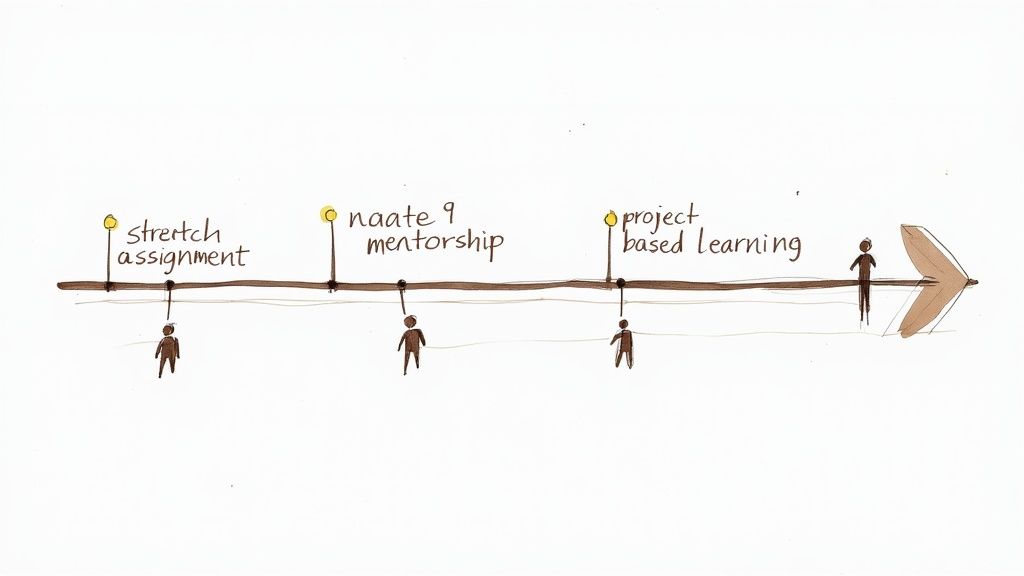
Experience-Based Learning in a Startup
The best development plans are built on practical, hands-on experience. Your template should have a dedicated section for this, focusing on three core areas.
- Stretch Assignments: Give them a project that forces them to learn a new skill. It needs to be challenging but not impossible. This is the single most effective way to build new professional muscles.
- Project-Based Learning: Assign them to a cross-functional project outside their usual domain. This builds their strategic perspective and helps them see how different parts of the business connect.
- Mentorship and Exposure: Pair them with a senior leader who can offer guidance and exposure. This could be as simple as inviting them to leadership meetings or having them shadow a key decision-making process.
Development isn't an event; it's a process. Your plan should focus on creating a steady stream of learning experiences woven directly into the flow of work.
This approach ensures that every development activity is relevant and contributes to business goals. If you want to dig deeper into modern learning models, our guide on why cohort-based learning is the a future of leadership development offers some great insights.
What Good Looks Like
A strong development plan is specific and tailored. A generic goal like "improve communication skills" is useless. You need to define what that actually means in the context of the future role. A great way to pinpoint these development areas is by gathering broad feedback. Using a comprehensive set of 100+ essential 360-degree feedback questions can give you invaluable insights.
Here are a couple of real-world examples.
Future Head of Engineering
- Identified Gap: Technically brilliant, but lacks experience managing a budget and communicating complex technical decisions to non-technical stakeholders.
- Development Action 1 (Stretch): Lead the technical vendor selection for our new data warehouse. This includes owning the budget and presenting the final recommendation to the leadership team.
- Development Action 2 (Mentorship): Set up bi-weekly sessions with the CFO to get a handle on financial modelling for the engineering department.
- Success Metric: Successfully delivers the vendor recommendation on budget and gets positive feedback from the exec team on the clarity of their presentation.
Future Head of Sales
- Identified Gap: An excellent individual contributor and team lead, but has never built a compensation plan from scratch or hired a senior account executive.
- Development Action 1 (Project): Work directly with the Head of People to design the new sales commission structure for the next financial year.
- Development Action 2 (Exposure): Take the lead on the full hiring cycle for the next Enterprise AE, from writing the job description to making the final offer.
- Success Metric: The new commission plan is approved by leadership, and the new AE hire ramps to 100% of quota within six months.
Each action is a real business task, not a theoretical exercise. You're solving a genuine business need while developing your person. This is how you build a resilient leadership pipeline without slowing momentum.
How to Roll Out Your Succession Plan
Creating the plan is strategic. The rollout needs to be tactical and human.
How you introduce and manage the plan is just as critical as the names on your list. A clumsy rollout can stir up anxiety and distrust. People get weird when they hear "succession plan."
Your goal is to build confidence, not panic. Communicate the why before you touch on the who or the what. It's a delicate process that requires different conversations for three audiences: your leadership team, your identified successors, and everyone else.
Get this right, and you turn a planning document into a powerful cultural tool that proves you’re serious about internal growth.
Getting Your Leadership Team On Board
Your first conversation is with your leadership team. If they aren't fully bought in, your succession plan is dead on arrival. Frame it in the language they understand: risk mitigation and business stability.
Position the plan as a core part of your risk management strategy. This isn't a fluffy HR exercise. It's a practical way to de-risk the business from key person dependency.
Think of succession planning as an insurance policy for your company’s intellectual capital. It ensures the business can survive unexpected departures without losing momentum.
Bring data to the table. Most businesses are woefully unprepared for leadership transitions. A recent Armstrong Watson survey found that a shocking 16% of UK privately-owned businesses haven't even thought about their exit strategy. For family-run businesses, it's worse—61% haven't discussed succession. Highlighting stats like these drives home the urgency. You can dig into the details in their 2025 business succession survey.
Your key messages for the leadership team need to be sharp.
- This reduces risk: We’re identifying and closing critical talent gaps before they become crises.
- This drives performance: By flagging high-potentials, we focus our L&D budget where it will have the biggest impact.
- This is your plan: Stress that this is a collective leadership responsibility, not just an HR process. They own the talent development in their teams.
Talking to Your Successors
This is where things get personal. The golden rule is simple: frame it as a development opportunity, not a promotion guarantee.
Telling someone they're the 'chosen one' creates immense pressure and can backfire if business needs pivot.
The conversation should be about their potential and the company's desire to invest in their growth. It's a healthier and more honest approach.
Here’s a simple framework for that chat.
- Acknowledge their contribution: "We've been really impressed with your work on [specific project] and the impact you're having."
- Signal their potential: "Because of that, we've identified you as someone with high potential who we believe could take on greater leadership responsibility in the future."
- Frame the next steps: "We want to invest in your development. Let's work together on a plan to build your skills in areas like [mention a specific skill gap, e.g., budget management]."
This approach is motivating without making promises you might not be able to keep. It tells them they're valued and manages expectations.
Communicating to the Wider Company
Finally, what do you tell everyone else? The nuts and bolts of your succession plan should remain confidential, but the process itself should be transparent. You want your team to know that the company is serious about promoting from within.
Your communication here should be broad, focusing on the company’s commitment to internal mobility and employee development.
Keep your message focused on these key points.
- We are committed to providing growth opportunities for our people.
- We have a process to identify and develop future leaders from within the company.
- Career paths here are real, and we are actively investing in our team.
Structuring this through a proper comms plan is a great way to ensure consistency. For a deeper dive, check out our internal comms blueprint for practical templates and strategies.
This builds trust and reinforces a culture where people can see a long-term future for themselves.
Got Questions About Succession Planning?
When People Leaders start thinking about succession planning in a startup, the same practical questions always pop up.
Here are the most common ones, with straightforward answers.
How Often Should We Update Our Succession Plan?
In a high-growth company, a rigid, annual review cycle is irrelevant. Your business and team can look completely different in twelve months.
Review and update your succession plan at least every six months. The best time is right after your performance or talent review cycles, when you have fresh data on your people.
Some events should trigger an immediate review. Things like closing a funding round, a significant pivot, or the departure of a key leader are all huge moments. Treat your succession plan as a living document that reflects today's reality.
What's the Biggest Mistake People Make?
The single biggest mistake is creating the plan in a People Ops silo. This cannot be just an "HR thing." Your senior leadership team must own it for it to have any impact.
Your CEO, CTO, and other execs need to be in the room, debating critical roles and potential successors. Their insights into where the business is heading and the strengths of their team members are non-negotiable. Without their buy-in, the plan is a theoretical exercise.
Another classic pitfall is being overly secretive. While you shouldn’t broadcast the names on your list, be transparent about the process. Let people know the company is actively investing in developing future leaders. This builds trust.
Should We Tell an Employee They're on the Succession Plan?
This is the one that trips everyone up. The answer is simple once you reframe it.
You should never say, "Congratulations, you're the named successor for Jane's job." That creates intense pressure, sets unrealistic expectations, and can backfire if plans change.
Instead, tell them they’ve been identified as a high-potential employee that the company wants to invest in. The conversation needs to be framed around their growth, not a specific future job title.
Here’s what that sounds like.
- Focus on potential: "We see a really strong future for you here and are excited about your trajectory."
- Link to investment: "Because of that, we want to be more intentional about investing in your development."
- Define the goal: "Let's work together on a plan to prepare you for larger, more complex leadership responsibilities."
This approach is incredibly motivating. It manages expectations and keeps the focus on their personal and professional growth.
Is Our 50-Person Startup Too Small for This?
Absolutely not. It’s the perfect time to start building the muscle.
At 50 people, you probably have a handful of roles—maybe just three to five—that would cause serious disruption if they became vacant. Identifying those is your first step.
Your initial plan can be incredibly simple. It might be a single tab in a spreadsheet listing those critical roles, identifying one or two potential internal people, and jotting down a few bullet points on their development needs. That's your V1 succession plan.
Starting this process early embeds proactive talent thinking deep into your company's DNA. It ensures that as you scale from 50 to 500, you’re scaling your leadership capability alongside your headcount.
Ready to stop reacting and start building your future leaders? The Open Org Content Pass gives you access to our complete library of playbooks, templates, and an AI-powered coach to help you execute faster. Get the tools you need.
