





Your employer brand is your company's reputation as a place to work. It’s the story people tell about you, shaped by everything from your careers page to your interview process.
The problem is, traditional employer branding is broken.
Why Most Employer Branding is Broken
Let's be direct. Most employer branding is a heavily filtered social media profile. It’s a polished highlights reel of pizza parties and inspiring mission statements, crafted to sell a perfect version of company culture.
This old playbook doesn’t work. Especially for startups.
The Problem with Traditional Employer Branding
The issue starts when companies try to attract everyone. They use formulaic, off-the-shelf recruitment tactics to win the "war for talent" but end up mis-selling the day-to-day reality of the job.
The data shows how wide this gap is. A staggering 40% of hiring managers admit to lying to candidates in interviews. As a result, 33% of new hires leave within 90 days, citing culture fit as the main reason.
When a new hire walks in expecting one thing and gets another, they walk right back out. This rapid churn isn't just a financial drain. It damages your reputation, burns out your team, and wastes everyone's time.
Transparency is Your Competitive Advantage
The best employer brands don't just attract. They attract AND repel.
The goal is to find the right people, not just any people. This means showing your whole Employee Value Proposition (EVP), not just the good parts. Be upfront about who thrives in your environment versus who struggles.
Radical honesty isn't just a nice-to-have. It's your sharpest competitive tool. It empowers people to make fully-formed decisions and self-select, saving you time, money, and future pain.
What good looks like:
- PostHog has a "Why you should NOT apply" section on its careers page. They are direct about startup realities, filtering out anyone looking for a predictable 9-to-5.
- Plain.com outlines clear trade-offs. They explain what you gain (impact, autonomy) and what you give up (structure, established processes).
This approach ensures that people who apply are resilient, aligned, and prepared. It minimizes culture shock and those expensive early exits.
Think Like a Product Marketer
Treat your EVP as a product and your candidates as customers. Your job is to help them make an informed buying decision.
Your product is the complete experience of working at your company. This includes the culture, ways of work, pay, progression, and flexibility. When you set accurate expectations, you minimize churn and build a team that sticks.
Your employer brand isn't what you say it is. It's the sum of all the experiences people have with your company. The gap between your marketing and their reality is where trust dies.
By presenting the full picture, warts and all, you stop selling a fantasy and start an honest conversation.
A Three-Stage Framework For Your Real Employer Brand
Knowing you need an honest employer brand is one thing. Building it is another.
Here’s a simple, three-stage framework to define, activate, and manage your real employer brand. This is a repeatable system for turning your culture into your biggest hiring asset.
The point is to make your brand a filter. It should attract the right people and help the wrong people screen themselves out.
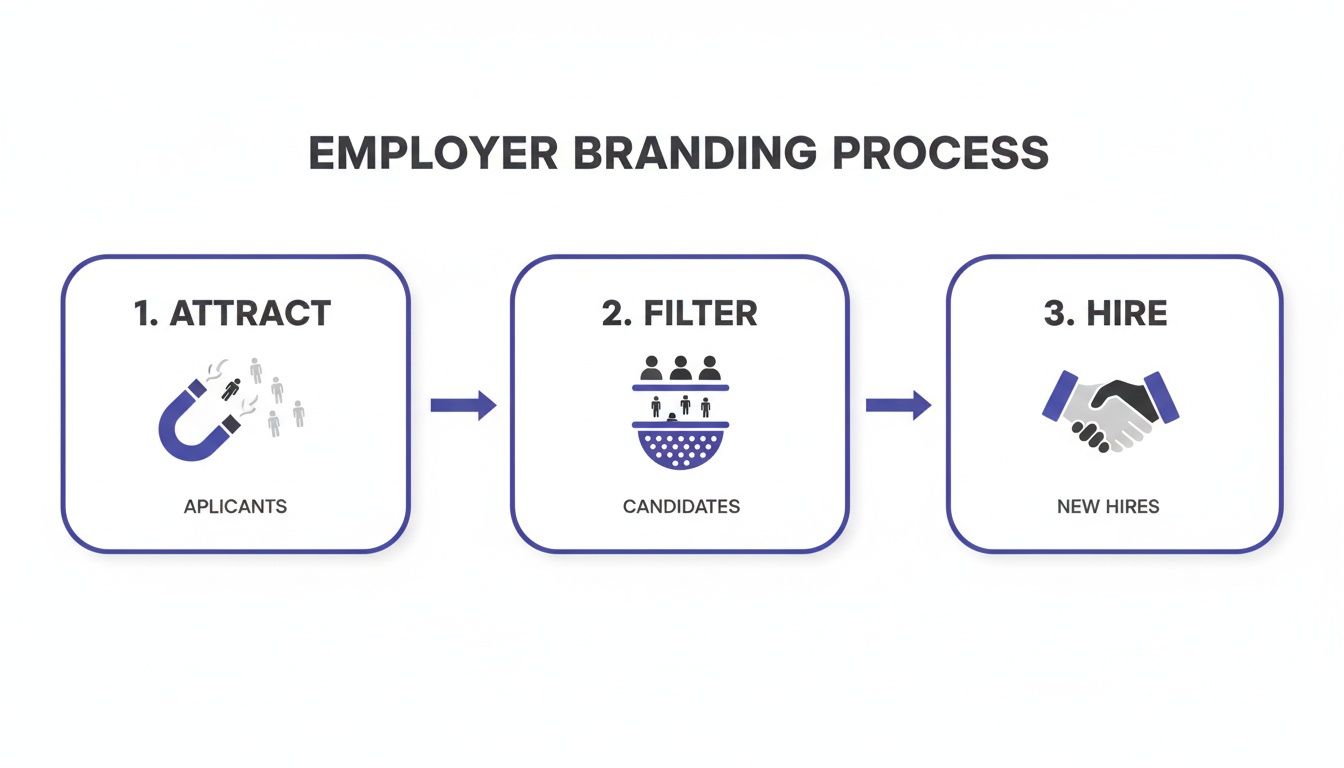
This process ensures that when you make a hire, it's a genuine match.
Stage 1: Discover Your True EVP
First, you need to understand what it’s really like to work at your company. Your mission is to uncover the raw, unfiltered truth about your Employee Value Proposition (EVP).
Gather data using org-wide surveys with tools like Typeform and follow up with 1:1 interviews. The goal is to find the top 3-5 things people genuinely value and identify who thrives versus who struggles, and why.
Here are a few questions that cut through the noise:
- "What's the hardest day you've had here, and what made it so tough?"
- "If you had a magic wand, what's the one thing you'd change about how we work?"
- "What type of person tends to struggle here or leave quickly?"
The answers will give you the unvarnished reality of your actual EVP.
Stage 2: Embed & Activate
Once you have your truth, align your messaging with it. Start internally. Make sure your leadership team communicates the same core EVP messages.
Next, review your external assets. Go through your career site, job ads, and employee handbook. Do they reflect what you discovered in Stage 1? Or are they selling a fantasy?
Refresh these assets to reflect reality, including the trade-offs. Train your interviewers to communicate both the benefits and the challenges of a role. This sets accurate expectations from day one.
Stage 3: Build, Manage & Improve
Your culture isn't static, so your employer brand can't be either. This stage is about continuous improvement.
Treat your People Experience (PX) like a product. Create an open PX roadmap using a tool like Notion or Asana to show your team what you're working on. This builds trust.
Then, implement a "reality check" feedback loop with every new hire. Survey them at 30, 60, and 90 days with one critical question: "How well did your experience so far match the expectations we set during hiring?"
Look for patterns. If multiple new hires are surprised by the pace of work, that’s a signal to adjust your messaging.
Building in Public as Your Content Strategy
Your most powerful employer branding content already exists. You just need to share it. Instead of sinking money into polished recruitment videos, start "building in public."
This means sharing your sawdust. Document the real, unfiltered journey of building your company. Share wins, tough lessons, and messy moments. This raw honesty builds authentic connections.
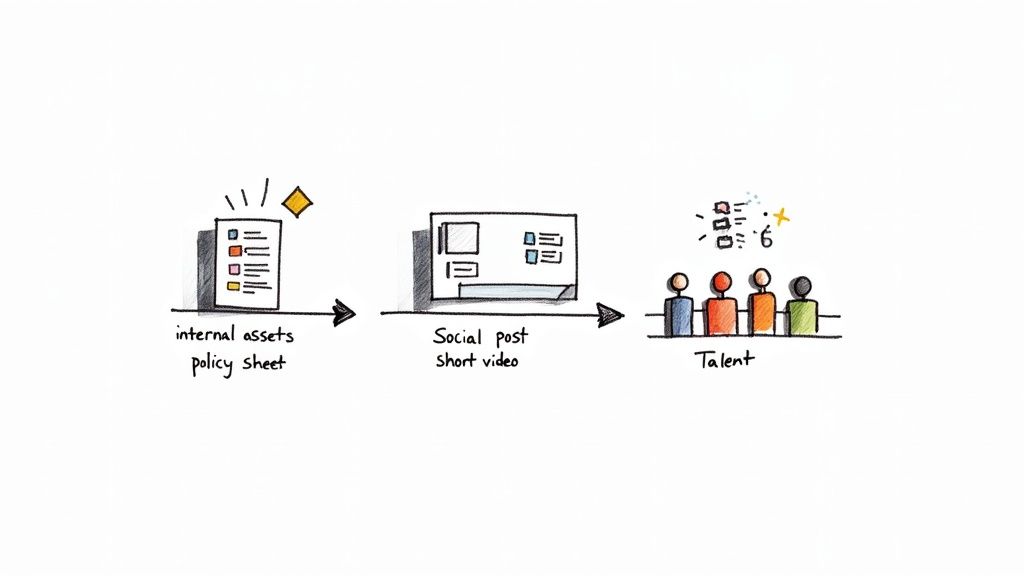
The Open Culture Content Loop
This is a simple 3-step process.
- Design & Manage: Create internal documents like handbooks, policies, and frameworks.
- Build in Public: Share the challenges, wins, and learnings from your work.
- Open Source: Make the finished products public. Your handbook isn't a secret document.
This approach creates a low-cost recruitment engine that attracts aligned candidates. It also reinforces your culture internally. Sharing how you tackle real challenges is more powerful than a generic mission statement.
By documenting your journey, you build a library of authentic content that works 24/7.
The Reality Check Feedback Loop
Your company culture is a living thing. Your employer brand has to evolve with it.
A "set it and forget it" mindset for your EVP is dangerous. The honest trade-offs you defined six months ago could be ancient history. You need a system to stay in sync.
The Reality Check Feedback Loop is a simple process to measure the gap between the promises you make during hiring and the actual new hire experience. It's your early warning system for misalignment.
Closing The Expectation Gap
Systematically survey your new hires at the 30, 60, and 90-day marks.
The goal is to get a straight answer to one critical question:
"On a scale of 1-10, how well did your day-to-day experience so far match the expectations we set during the hiring process?"
Always follow up with an open-text box to understand their score. You are hunting for patterns, not individual complaints.
Turning Feedback Into Action
When you spot a pattern, do two things. First, immediately adjust your external messaging on career pages and in interview scripts. Second, add the root problem to your internal People Experience (PX) roadmap. You can use tools like the 5 Whys Method or Fishbone Diagrams to find the real issue.
This system turns your employer brand into a dynamic machine that prevents misalignment and reduces churn.
Your First Steps And Actionable Playbook
Right, you have the framework. Stop selling a fantasy and start an honest conversation about what it's really like to work with you.
This is about putting your energy where it counts. Here are three high-impact things you can do this week.
Your Quick-Start Checklist
- Kick off discovery. Send a short, anonymous survey using the questions from Stage 1 to get a baseline of your actual EVP.
- Add one honest trade-off. Pick a live job description and add one brutally honest sentence about a challenge in that role. Watch how it changes the quality of applicants.
- Make one document public. Choose one internal guide, like your parental leave policy, and share it openly.
These small steps start the shift towards radical transparency. You build trust and attract people ready for the reality of startup life.
This is just the beginning. For a full, step-by-step guide with templates and frameworks, grab our playbook on how to build a startup employer brand (available to Content Passholders). It’s the essential tool for turning these ideas into action.
Got Questions? We've Got Answers
Let's tackle some tough questions that come up when you get real about your employer brand.
"Won't Being Too Honest Scare Good People Away?"
This is the number one fear. But the goal isn't to attract everyone. It’s to attract the right people and filter out those who won't thrive.
If a frank description of your fast-paced environment makes someone run, were they ever the right fit? No. You haven't lost a great candidate. You've dodged an expensive hiring mistake.
Real honesty doesn't scare off the best candidates. It pulls in the ones genuinely up for the challenge.
"How Do I Get Leadership On Board With This?"
Use data. Frame the conversation around business outcomes. The cost of a bad hire is a number any leader understands.
Show them your early churn rate. Position transparent employer branding as a direct strategy to slash that number by getting the fit right from the start. It’s a risk mitigation strategy that saves money.
"What's The Easiest First Step I Can Take?"
Make your employee handbook public. Seriously. It's the single most comprehensive document explaining how your company actually works.
Publishing it is a massive signal of transparency. Candidates can see exactly what they’re signing up for. It forces you to ensure your internal policies are clear, fair, and something you're proud of. Stop treating it like a secret document.
Ready to move beyond theory and start building an employer brand that connects? Open Org's Content Pass gives you access to our complete playbook, "How to build a startup employer brand," packed with templates, checklists, and step-by-step guidance. Get the tools you need to execute.
