





To get a grip on employee turnover, you have to do one thing first. Diagnose the real problem before you try to fix it. This means digging in to understand why your best people are leaving and hitting those root causes with targeted solutions.
Why Your Best People Are Quietly Quitting
High employee turnover is a silent killer for startups. It's a direct threat to your growth and momentum. Every time a valued team member walks out the door, a piece of your company's institutional knowledge walks out with them.
The real damage is often invisible. The true cost of losing an employee goes far beyond recruitment fees. It’s a cascade of hidden costs that disrupt your flow and drain resources.
What are you actually paying for when someone leaves?
- Lost Productivity: It takes months for a new hire to get up to speed. For a startup, that means delayed projects, missed targets, and a drag on progress. According to Gallup, this lost productivity is a multi-billion pound problem.
- Team Disruption: When a colleague leaves, the remaining team members have to pick up the slack. This leads to overwork, stress, and a dip in morale. This can trigger a domino effect of more people leaving.
- Hiring Costs: This is the most visible cost. Think advertising, agency fees, and the countless hours your team spends interviewing. All that is time your team could be spending building your product.
This infographic lays out the core financial and operational drains that turnover creates.
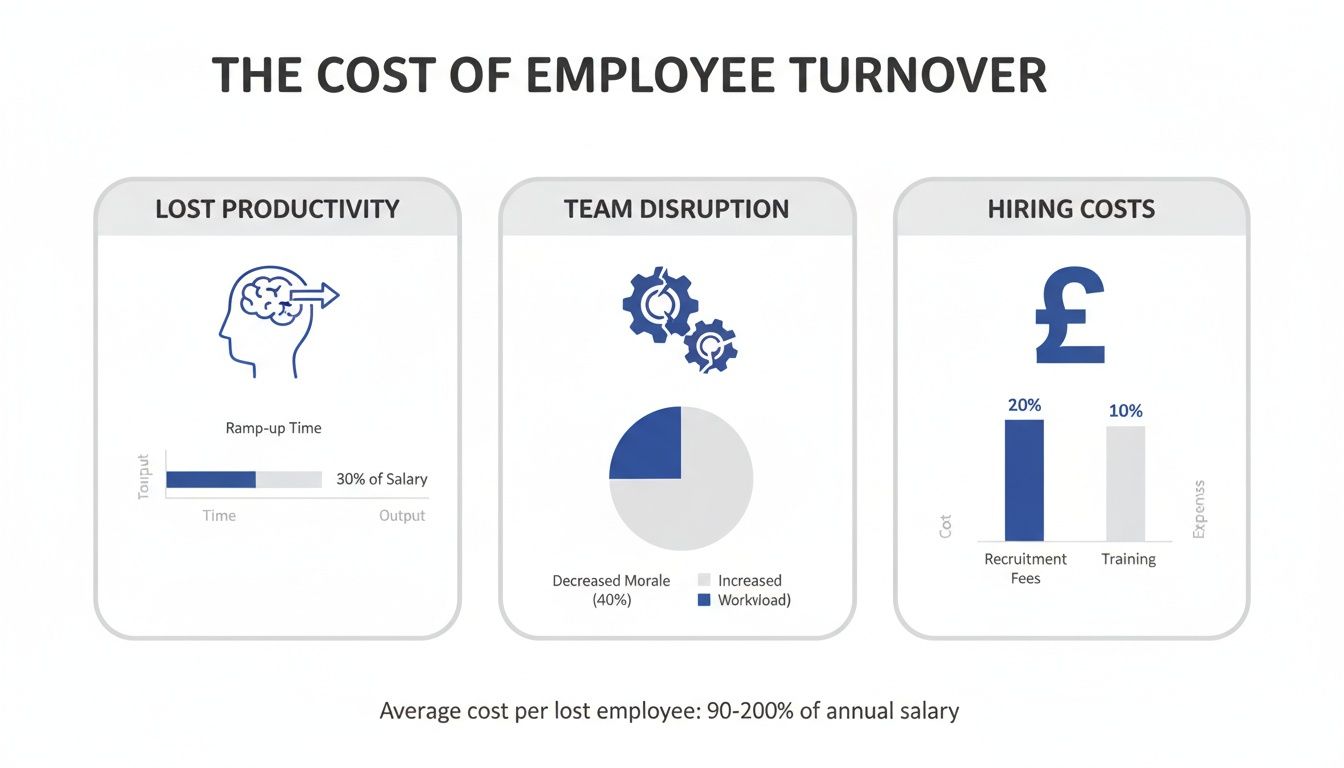
These three costs combine to create a massive financial and cultural burden on a growing company.
The Real Cost of Employee Turnover
When you start adding it all up, the numbers can be shocking. Here's a quick breakdown of where the money goes.
- Recruitment Fees. Agency costs, job board listings, advertising. Estimated Impact: £5,000 - £15,000+
- Lost Productivity. Ramp-up time for the new hire and the output gap left by the departing employee. Estimated Impact: £10,000 - £25,000
- Onboarding & Training. Time spent by managers and peers training the new person. Estimated Impact: £2,000 - £5,000
- Team Disruption. Overburdened colleagues, lower morale, potential for more departures. Estimated Impact: £3,000 - £8,000
- Admin & HR Time. Time spent on exit interviews, paperwork, and the hiring process. Estimated Impact: £1,000 - £2,500
This is a slow, steady drain on your startup's most precious resources: time, money, and morale.
Diagnosing the Real Reasons People Leave
To fix your turnover problem, you have to stop guessing why people are walking away. Assumptions are your worst enemy. You might think it’s about salary, but the real culprits are often a poor manager, a dead-end career path, or a toxic culture.
The only way to get to the truth is by collecting honest data. Stop reacting to resignations and start building a system to understand them. Create feedback loops that capture the real, unfiltered employee experience.
Your best diagnostic tool is the exit interview. Most startups do them poorly. They’re treated as a formality, a box-ticking exercise. A well-run exit interview is a goldmine of feedback that can tell you exactly what’s broken.
Create a safe space for honesty. The person leaving has little to lose by telling you the truth. Your job is to ask the right questions and listen to the answers.
By using a simple, consistent process, you'll quickly spot patterns. Are multiple people mentioning the same manager? Is "no room for growth" a recurring theme? These patterns are your roadmap for action.
Build an Onboarding Process That Hooks New Hires
A shaky onboarding experience is a fast track to early turnover. If new hires feel lost or disconnected in their first 90 days, they've already started thinking about their next move. Those first few weeks are your only chance to prove their decision to join you was the right one.
Effective onboarding is a structured journey designed to connect new hires to the company, their team, and their role with clarity. It lays the groundwork for how they'll perform and how long they'll stick around.
A great process shows you’re organised and that you value their time. It's about building momentum from day one.

Pre-Boarding Communication That Builds Excitement
Onboarding starts the second a candidate accepts your offer. The gap between signing and starting is a critical window where excitement can turn to anxiety. Your job is to keep the energy high.
A simple, automated email sequence can make a world of difference.
- Welcome Email (Immediately after signing): Fire off a genuine welcome from their manager and the CEO. Include a quick note on what to expect next.
- Logistics Email (1 week before start): Get the practical info out of the way. This means their first-day schedule, where to go, and who they'll be meeting.
- Team Intro Email (2-3 days before start): Send a brief intro to their immediate team with links to their LinkedIn profiles. This helps put faces to names.
This pre-boarding phase shows your new hire you're a professional, organised company that's thrilled to have them.
The First Week Is All About Connection and Clarity
That first week needs to be meticulously planned. The goal is to immerse them in the company culture and give them a clear roadmap. A new hire should wrap up their first week knowing exactly what success looks like.
Here's what a solid first week involves:
- A Structured Schedule: Give them a written schedule for their first five days. This should be a mix of introductions, training, and small, achievable tasks.
- The Right Tools: All their hardware and software access should be ready and waiting. Nothing screams "we weren't ready for you" like spending half of day one chasing IT.
- An Onboarding Buddy: Assign them a peer from another team. This buddy is a friendly guide for all the "silly questions" about culture and communication norms.
The single biggest mistake startups make is unstructured onboarding. Throwing someone in at the deep end is a sign of chaos. A structured first week builds confidence and speeds up their time to productivity.
Implement a Clear 30-60-90 Day Plan
A 30-60-90 day plan is the most powerful tool for setting expectations and tracking progress. This document outlines clear goals and priorities for their first three months.
This plan gives a new hire a sense of purpose. It answers their biggest question: "How do I win in this role?" For templates and checklists, check out our free Open Onboarding Cookbook.
Here’s a simple framework:
- First 30 Days (Learning): The focus is on learning the ropes. This means understanding the product, meeting key people, and getting familiar with processes. Goals should be about learning, not output.
- Next 30 Days (Contributing): The new hire should start applying what they've learned. Goals become more task-focused, like completing a small project.
- Final 30 Days (Owning): They should be operating more independently. Goals should reflect ownership of their core responsibilities.
This plan, combined with regular manager check-ins, provides the clarity and support that makes new hires feel valued. It transforms onboarding from a chaotic scramble into a strategic process.
Turn Your Managers Into Retention Magnets
You’ve heard it before: people leave managers, not companies. It’s a cliché for a reason. A single bad manager can poison a team and trigger a wave of resignations.
Your managers are your most powerful lever for retention. Investing in them is a core business strategy. Good management is a set of observable, coachable behaviours that directly impact how long your people stay.

Ditch the Theory, Focus on Core Skills
Most manager training is a waste of time. It’s full of abstract theories that don’t help a manager handle a difficult conversation. Focus on the three skills that actually move the needle.
- Running Productive 1-to-1s: This is the most important meeting of the week. It’s a dedicated space for coaching, feedback, and building psychological safety.
- Giving Effective Feedback: Your managers must be able to deliver positive and constructive feedback clearly and kindly. A culture where feedback is feared is where problems fester.
- Recognising Contributions: People need to know their work matters. This isn't about grand gestures. It's about consistent, specific acknowledgement.
These are the fundamental mechanics of good management that directly determine how to reduce employee turnover.
A Practical Framework for Manager Training
You don't need a huge budget to upskill your managers. A simple, repeatable framework is incredibly effective. The goal is to build habits, not just run a one-off workshop.
Give new managers a plan. Their first 90 days are as crucial as a new hire's. Give them a clear roadmap that prioritises their team over tasks.
- First 30 Days (Listen and Learn): The manager’s job is to understand their team. They should hold 1-to-1s with every team member, focusing on career goals, what they love, and what drives them crazy. No big changes, just listening.
- Next 30 Days (Identify Quick Wins): The manager should identify and fix small, annoying problems. This builds immediate trust and shows the team they were heard. It could be as simple as killing a pointless meeting.
- Final 30 Days (Set a Vision): Now the manager can co-create a team vision. With trust established, they can work with the team to set ambitious goals.
For a ready-to-use guide packed with checklists and templates, check out The Open People Manager Handbook. It breaks down these core skills into actionable steps.
Don’t promote your best engineer to a management role without training and expect them to succeed. You are setting them, and their team, up for failure. Intentional training is your best defence.
The impact of strong leadership is backed by data. In the UK, robust management practices can dramatically slash employee turnover. One study found it boosts retention commitment up to 94%. With a poor manager, that plummets to just 19%.
Measure What Matters: Manager Effectiveness
You can’t improve what you don’t measure. To understand if your manager training is working, you need a simple way to track their effectiveness. Start with lightweight pulse surveys to get a regular read on team health.
Ask a few simple questions quarterly, using a 1-5 scale from Strongly Disagree to Strongly Agree:
- My manager provides me with regular, helpful feedback.
- I feel my manager genuinely cares about my wellbeing.
- My manager helps me understand how my work contributes to our goals.
- I feel recognised and appreciated for my contributions.
- I would recommend my manager to others.
Track the scores for each manager over time. This isn’t about creating a leaderboard. It’s about identifying where your support and coaching are needed most. This data-driven approach turns manager development from a guessing game into a targeted strategy.
Create Career Paths People Actually Want to Follow
Ambitious people join startups for growth. If they can’t see a clear future for themselves at your company, they'll start looking for one somewhere else. A lack of development opportunities is a massive, avoidable driver of turnover.
This isn’t about creating a complex, corporate ladder. It's about building straightforward, transparent pathways that show your team how they can grow with you.
Build a Lightweight Career Framework
First, map out what growth looks like at your company. A career framework is a simple tool that defines the skills, behaviours, and impact you expect at each level. It gives everyone a shared language for talking about progression.
Keep it simple and focus on two distinct paths:
- Individual Contributor (IC) Track: This is for specialists who want to go deep in their field without managing a team. Think Senior Engineer to Principal Engineer.
- Manager Track: This path is for those who are drawn to leading teams. It’s about building skills like coaching, strategy, and operational excellence.
Good frameworks make career conversations objective. They shift discussions from "I feel like I deserve a promotion" to "Here’s how I've demonstrated the skills and impact required for the next level." It removes ambiguity and empowers employees.
By creating parallel IC and manager tracks, you ensure your most talented technical experts can keep growing without being forced into management roles they don’t want.
Define What Good Looks Like
A framework is useless without clear definitions. For each level on your IC and manager tracks, get specific and outline the expectations across a few key areas.
For an engineering role, this might look like:
- Scope & Impact: What's the scale of their work? (e.g., A single feature vs. an entire system)
- Technical Skill: What level of expertise do they show? (e.g., Follows established patterns vs. creates new ones)
- Collaboration & Leadership: How do they influence those around them? (e.g., Helps their immediate teammates vs. mentors the entire department)
Defining these markers gives your team a clear target. It also hands managers a consistent rubric for performance conversations and promotion decisions, making the process feel fairer.
Implement Personal Development Plans (PDPs)
Once you have a framework, Personal Development Plans (PDPs) are the tool you use to map an individual's journey. A good PDP is a living document, co-created by the employee and manager, that outlines specific growth goals.
It should answer three questions:
- Where do I want to go? (This links to the career framework)
- What skills or experiences do I need to get there?
- How will the company support me? (e.g., training budget, mentorship, specific projects)
This approach turns development into a shared responsibility. It gives employees a structured way to think about their growth while giving managers a clear mandate to support them.
It's vital to understand what drives personal career choices if you want to design internal pathways that resonate. To get more insight, it's helpful to see how individuals choose career paths. This knowledge can help you reduce turnover by aligning opportunities with their aspirations. You can also prepare for future leadership gaps with our succession planning template.
Investing in your team's long-term success is one of the most powerful retention levers you have. It sends a clear signal that you see a future for them at your company.
Nail Your Compensation and Flexibility Strategy
Even with an amazing culture, you're fighting a losing battle if your compensation is off the mark. You can't ignore the fundamentals.
Getting pay right isn't about outbidding Google. It's about being smart, fair, and transparent so compensation is never the reason a great person leaves. The goal is to take money off the table as a point of contention.
Benchmark Salaries the Right Way
To pay people fairly, you need good data. Relying on gut feelings or generic corporate salary surveys is a recipe for disaster. You need to benchmark against companies at a similar size, stage, and location.
- Use Startup-Specific Data: Forget old-school surveys. Tools like Ravio or Pave are built for our world. They give you real-time salary data from other venture-backed companies.
- Define Your Compensation Philosophy: This is a crucial step. Decide where you want to sit in the market. Do you aim for the 50th percentile for all roles, or the 75th for critical engineering hires? Write it down and stick to it.
- Be Transparent About It: You don't have to publish everyone's salary, but you should share your philosophy. Explain how you benchmark roles and what your salary bands look like. This builds a massive amount of trust.
This isn't a one-time thing. Review salaries for your existing team at least once a year. Don't wait for someone to get a better offer before you pay them what they're worth.
Embrace High-Impact, Low-Cost Benefits
Beyond salary, the right benefits show your team you see them as whole people. Forget expensive, flashy perks. Focus on what truly matters.
Flexibility isn't a perk; it's a core expectation. In the UK, with national turnover rates hitting as high as 34% and 22% of people leaving for a better work-life balance, flexibility is non-negotiable.
Your flexibility policy doesn't need to be a 20-page document. A simple one-pager outlining your approach to remote, hybrid, or flexible hours is perfect. The key isn't the policy, but the trust it signals. Trust your team to deliver results, regardless of where or when they work.
Other high-impact benefits that don't break the bank include:
- A Solid Health and Wellness Budget: This can be a flexible stipend employees use for what’s important to them, from a gym membership to a meditation app. Exploring innovative employee wellness program ideas is a great starting point.
- Generous Paid Time Off (PTO): And create a culture where people feel they can actually use it. Burnout is a silent killer of retention. A team that properly disconnects is a team that sticks around.
- A Learning and Development Stipend: Show you're invested in their growth with a budget for books, courses, or conferences.
Communicate the Total Value
Many startups get this wrong. We put together a great package but do a terrible job explaining its full value. Your team needs to see the whole picture, not just the number that hits their bank account.
Create a simple 'Total Rewards Statement' for every person on your team. It can be a one-page document that breaks down:
- Base Salary: The cash component.
- Bonus Potential: Any performance-related bonuses.
- Equity Value: The number of options and their potential value based on a few conservative exit scenarios. Make it tangible.
- Benefits Contribution: Add up the monetary value of health insurance, pension contributions, and other stipends.
When you lay it all out, the total package often looks far more compelling than the base salary alone. By communicating this clearly, you anchor the conversation on total value. This is how you win against bigger companies that might flash more cash but offer far less upside and flexibility.
Your Questions on Employee Turnover Answered
Got questions about turnover? You're not alone. Here are common queries from People Leaders in the trenches.
What Is a Good Employee Turnover Rate for a UK Startup?
There’s no single magic number. A healthy benchmark is below 15% annually, but context is everything.
The national average in the UK can swing from 15% to 34%, varying wildly by industry. If your startup's turnover starts creeping above 20%, that should be a red flag.
The real story isn't the overall number, but who is leaving. Losing top performers is a different problem than losing folks who weren't a great fit.
Your most important metric should be 'regrettable attrition'. This is the percentage of people you genuinely didn't want to lose. It tells you if the problem is hitting you where it hurts most.
Get a handle on this by tracking turnover quarterly. The formula is simple: (Total Leavers in Period / Average Headcount in Period) x 100.
How Can We Compete on Salary With Larger Companies?
You probably can't win a pure cash bidding war with a corporate giant. Don't play that game. Shift the conversation to your total value proposition. You have unique advantages that bigger companies can't match.
First, make sure your base salaries are competitive for your stage. Use reliable startup salary data to get in the right ballpark. Then, lean into your unique strengths.
- Equity: This is your secret weapon. Clearly explain its potential value and how it works. Most people don't intuitively understand stock options.
- Real Growth Opportunities: At a startup, people make a bigger impact and learn at a phenomenal pace. Emphasise this. Show them a clear path to progression.
- Mission & Culture: A compelling 'why' can be more motivating than a few extra quid. If you have a great culture, real flexibility, and a mission people believe in, shout about it.
Bundle all of this into a clear 'Total Rewards Statement'. It's a simple document that shows the full picture of their compensation.
What Is the First Thing I Should Do to Tackle High Turnover?
Before you do anything else, diagnose the problem. You can't fix what you don't understand. Your first step is to stop guessing and start gathering honest data.
The most powerful place to start is with a robust exit interview process. Talk to every person who leaves. Use a consistent set of questions to spot patterns. Are people leaving for better pay, because of their manager, or due to a lack of growth?
Next, supplement this with 'stay interviews'. Don't wait for your best people to hand in their notice. Talk to your current top performers. Ask what keeps them here and what might tempt them to look elsewhere.
Finally, run a simple, anonymous engagement survey focusing on the big drivers: management support, career development, and recognition. Once you have this data, you'll see where the biggest fires are. This allows you to focus your efforts where they'll make a real difference.
Ready to stop guessing and start building a People Ops function that drives retention? Open Org gives you the playbooks, templates, and AI-powered tools to solve your biggest HR challenges, fast. Get the practical resources you need at https://www.openorg.fyi.
