





A development planning template is a simple tool that turns abstract career chats into a concrete roadmap. It connects an employee's ambitions with company goals. It spells out which skills to build, what actions to take, and sets a timeline.
This is a core tool for growing and keeping your best people.
Why Your Startup Needs a Simple Development Plan
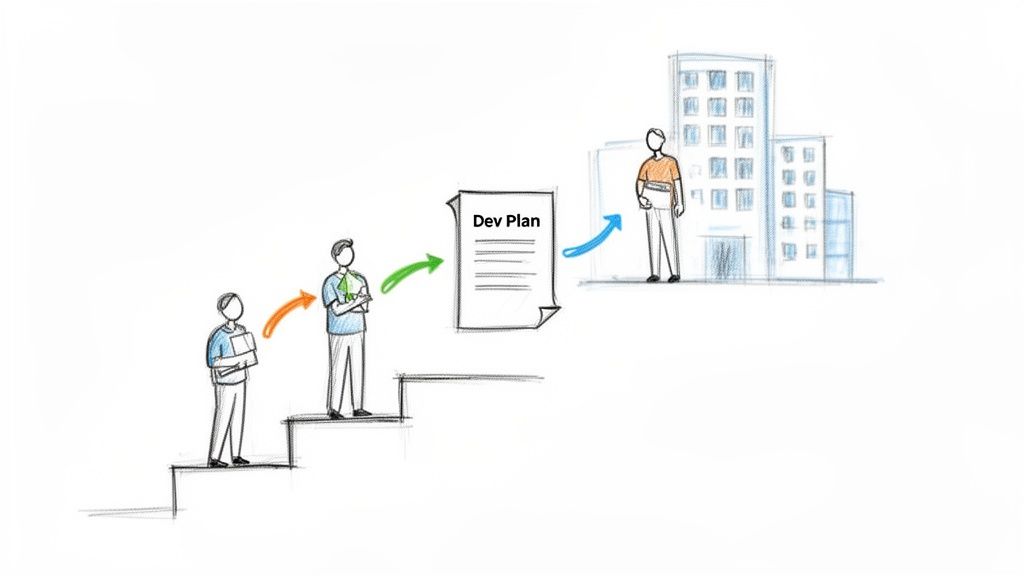
In a startup, your team’s growth is your company’s growth. It's that simple. Ambitious people will not stick around if they don’t see a clear path forward. Without a structured way to guide their development, you are inviting your best talent to leave.
A development planning template is a high-impact tool. It gives you the structure to turn hazy career conversations into an engine for performance and retention.
From Ambition to Action
A template forces the employee and manager to get specific. Vague goals like "I want to get better at leadership" are sharpened into tangible actions and measurable outcomes. Writing things down creates instant accountability and a shared understanding of what good looks like.
For People Leaders, this builds a scalable system for growth. You cannot rely on ad-hoc chats as you scale from 20 to 200 people. A consistent template ensures everyone gets the same opportunity to map out their future. This is fundamental to a fair and transparent culture.
The gap between good intentions and real impact in employee growth often comes down to a lack of structure. A simple plan turns those intentions into measurable progress.
The Real Cost of Neglecting Growth
Ignoring structured development has direct and painful consequences.
When people feel stagnant, their engagement and performance plummet. Eventually, they leave. The cost of replacing them is huge. You lose recruitment fees, institutional knowledge, team momentum, and morale.
A development plan helps you avoid that risk. It shows your team you’re invested in them as individuals. It is a proactive part of your overall talent management strategy. It sends a powerful message: we want you to build your career here.
This document is the foundation for a scalable culture of growth. It helps you keep the people who will help you win.
What Goes Into a High-Impact Development Template?
A great development planning template has a few specific, non-negotiable parts. The best ones force clarity for both the manager and the employee. They turn vague aspirations into a concrete action plan that gets used.
A flimsy template leads to flimsy conversations. A robust one provides the structure needed for meaningful progress. It becomes a living document that guides growth, not a file that gathers digital dust.
To be effective, your development plan needs to connect long-term dreams to short-term actions. It links the 'what' and the 'why' to the 'how'.
Key Components for Your Development Planning Template
So, what should you actually put in it? The best templates create a clear narrative for an individual's growth. Here is a breakdown of the essential fields for a fast-moving startup.
Long-Term Career Aspirations: A simple field for the employee to state their ultimate career goals. This provides the 'north star' for the entire plan. It ensures short-term actions align with a bigger personal vision and keeps people motivated.
Growth Objectives (12-18 Months): The heart of the plan. Outlines 2-3 specific, measurable objectives the employee aims to achieve in the medium term. This focuses on capabilities and impact, not just job titles. This flexibility is crucial when roles and needs change quickly.
Skills & Competencies to Develop: For each objective, a list of the specific skills needed to get there. This makes the goal tangible. For an engineer, this could be "System Design" or "Mentoring Junior Developers."
Action Steps & Learning Activities: This is where the plan becomes real. It includes concrete actions like a course, project, or shadowing. It turns intention into execution and drives progress day-to-day.
Resources & Support Needed: What the employee needs from the company to succeed. This could be a budget for a course, access to a mentor, or dedicated time. It clarifies expectations and ensures the company is actively supporting growth.
Success Measures & Timeline: How you will both know when an objective has been met. This defines what success looks like and sets a realistic timeline. It creates accountability and a clear finish line for measuring real progress.
Manager & Employee Comments: A shared space for ongoing notes from check-ins. This turns a static document into a dynamic record of the development journey. It tracks progress and pivots over time.
This structure connects high-level ambition to day-to-day execution. It also provides a clear framework for your broader people strategy, which you can map out using our People Roadmap Template.
What Good Looks Like
Let's make this tangible. Imagine a Junior Marketer, Sarah, whose long-term goal is to become a Head of Marketing. Her template would break this down into actionable pieces.
Growth Objective: Lead our next product launch campaign from strategy to execution within 12 months.
Skills to Develop: Project Management, Budgeting, Cross-Functional Communication.
Action Steps:
Complete the Google Project Management Certificate (by Q3).
Shadow the current marketing lead on the upcoming Q2 launch.
Create and present a mock campaign budget to her manager for feedback (by end of Q2).
Success Measures: Successfully launch the Q4 product campaign, on time and within 5% of the allocated budget.
This level of detail moves the conversation from "I want to grow" to "Here is exactly how I plan to grow." It gives managers a clear role and empowers employees to own their development.
Building Your Development Planning Template
Alright, let's get building. A good development plan is not about clunky HR software or bureaucratic forms. The best ones are clean, simple, and live where your team already works. A shared Google Doc or a Notion page is often all you need.
The point is to build a lightweight framework that sparks conversation and brings clarity. It’s a tool, not a test. The questions you ask and the structure you provide will shape the quality of the plans.
Think of it as a flow, moving from big-picture goals down to specific skills and actions.
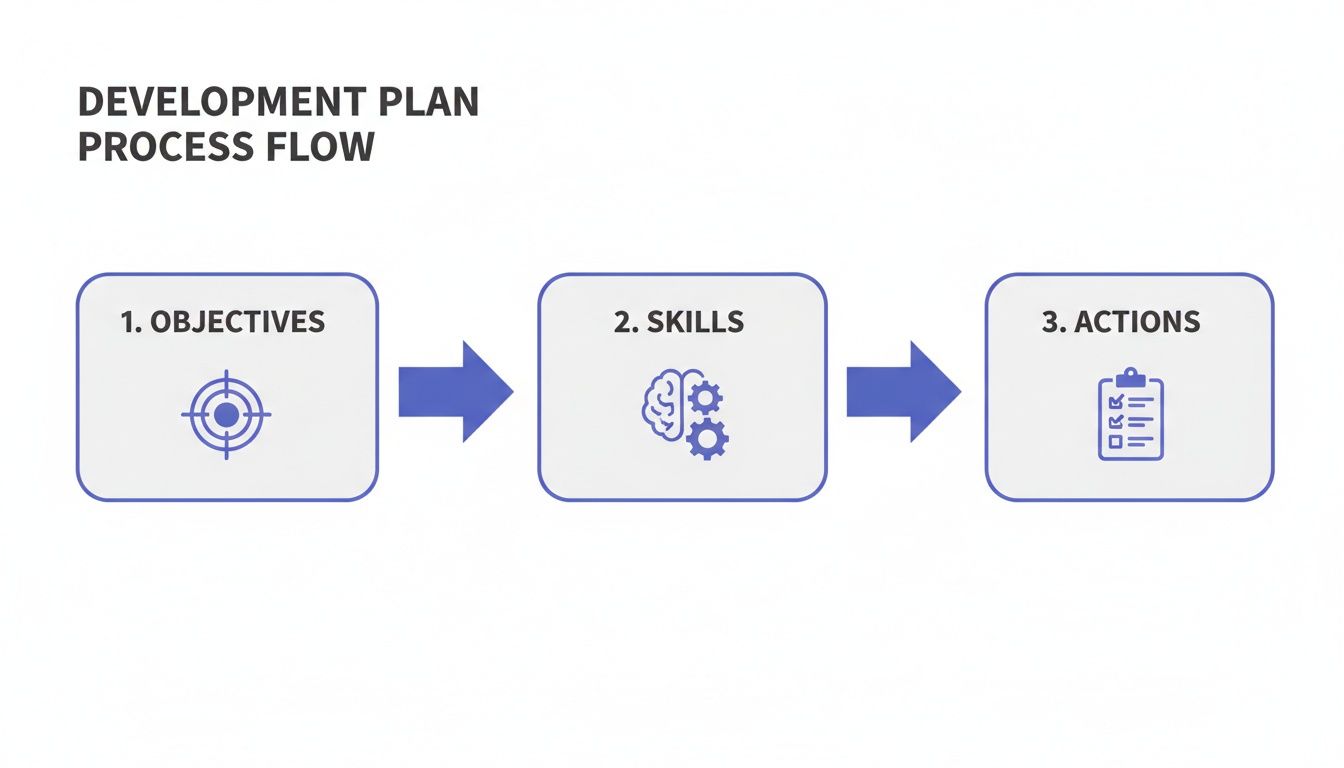
This process makes sure every goal is tied to a tangible skill and concrete actions. It makes tracking progress much more straightforward.
Crafting the Core Sections
Start with a blank document and create these sections. These prompts are designed to get people thinking deeply. Feel free to tweak the language to match your company’s voice.
Career Vision (The North Star): This sets the long-term context.
- Prompt: "Looking ahead 3-5 years, what kind of impact do you want to be making? Don't focus on job titles. Focus on the work you'd find most energising and the skills you'd love to have."
Key Development Objectives (The Next 12 Months): This is the core of the plan. Focus on just 2-3 high-impact goals to avoid spreading focus too thin.
- Prompt: "What are the 2-3 most important things you can achieve in the next year to move towards that vision? These should feel like a challenging but achievable stretch."
Skills & Competencies to Build: For each objective, break it down into the actual skills required.
- Prompt: "For each goal above, what specific skills or knowledge do you need to develop? This could be 'public speaking', 'SQL for data analysis', or 'coaching junior teammates'."
Action Plan & Resources: This is the 'how'. It is the most important part of the template.
- Prompt: "What specific actions will you take to build these skills? List courses, projects, books, or people to learn from. What support do you need from your manager or the company (e.g. , budget, time, mentorship)?"
A great development planning template forces a conversation about how someone will achieve their goals and what support they need. This creates immediate accountability for both the employee and the business.
Putting It All Together
Your final template should be clean and easy to scan. Use simple headings and lots of white space. The goal is utility.
If you're building from scratch, a structured tool like a free capacity planning template in Excel can be a time-saver. It provides a solid foundation for tracking actions and timelines.
This template also becomes a powerful input for your wider talent strategy. The insights are invaluable for looking at your internal talent pipeline. It helps you see who is building capabilities for future leadership roles, which is a key part of any good succession planning template.
The best template is the one your team uses. Start simple. Get feedback after the first cycle, then refine it. This document should evolve as your company grows.
How to Roll Out Development Plans That Stick
A perfectly designed development planning template is worthless if it sits in a folder. The real work is rolling it out. Success is about weaving development conversations into the fabric of your business.
Getting this right means shifting to a culture where people feel ownership over their growth. It starts with your managers. If they see this as another box-ticking exercise, the initiative will fall flat.
Getting Manager Buy-in
Your managers are the linchpin. They need to understand the ‘why’ behind the plan and feel equipped to have meaningful conversations. Your job is to make it easy for them.
Start by training them on the art of coaching, not the template itself. Run a short, practical workshop focused on real skills.
Asking powerful questions: Instead of "What do you want to do next?" teach them to ask, "What work gets you into a state of flow?" or "If you could change one thing about your role, what would it be?"
Giving constructive feedback: The focus should be on behaviour and its impact, not personality.
Connecting individual goals to team objectives: Show them how an employee’s growth directly helps the team hit its targets.
Give them a simple manager's guide. This should include conversation starters, example goals, and a clear timeline. The goal is to build their confidence so these chats feel natural.
Your rollout's success hinges on your managers' capability. Invest time in coaching them on how to have a great development conversation. You'll see a massive difference in adoption.
Setting a Realistic Cadence
Annual reviews are dead. In a startup, a year is an eternity. A development plan needs to be a living document that’s reviewed regularly.
A quarterly check-in is the sweet spot. It’s frequent enough to maintain momentum without creating overwhelming admin.
Here’s a simple rhythm to follow.
Q1 Kick-off: The employee fills out their template and has a dedicated planning session with their manager to set goals for the year.
Q2 & Q3 Check-ins: These are shorter, 30-minute conversations. The focus is on progress, roadblocks, and any pivots needed.
Q4 Review: A deeper look back at the year's progress, which tees up planning for the year ahead.
This rhythm transforms development into an ongoing process. It also helps separate growth conversations from performance reviews, which is vital for psychological safety.
Measuring What Matters
Finally, you have to prove this is working. To get continued buy-in from leadership, you need to connect development efforts to tangible business outcomes.
Track a few key metrics that tell a story.
Internal Mobility Rate: What percentage of open roles are filled by internal candidates? A rising number shows you are building a strong internal talent pipeline.
Retention of High-Performers: Are your top talent sticking around? Correlate this directly with their participation in the development program.
Employee Engagement Scores: Look for improvements in survey questions related to career growth and development opportunities.
Structured processes deliver clear results. Look at the UK's planning system. Listed Building Consent applications, which follow a strict template, had a 92% grant rate in 2023/24. That outpaced the 86% for general permissions. Imagine achieving a similar success rate with your development plans. You can read more on Historic England's website.
Common Development Planning Mistakes to Avoid
Even the slickest template can fall flat if it’s rolled out badly. Let’s talk about where things go wrong. These are real, in-the-trenches mistakes that trip up even well-intentioned People Leaders.
Getting this right means sidestepping the traps that turn a growth tool into more admin clutter.
Treating It as a One-Time Event
The biggest mistake is treating development planning like a New Year's resolution. A plan is made with enthusiasm in January, only to be gathering dust by March. Growth is a continuous process.
If the plan isn't a living document reviewed in regular one-to-ones, it loses all momentum. It needs to be a constant reference point for conversations about progress and roadblocks.
A development plan that isn't revisited at least quarterly is already dead. It becomes a snapshot of old intentions rather than a dynamic guide.
Overcomplicating the Template
Another classic pitfall is a template that feels like a tax return. A five-page document with dozens of fields creates resistance. If it takes a manager an hour to prepare, it will be constantly pushed to the bottom of their to-do list.
Keep it simple. Your template should be a one-pager that sparks a conversation, not a form that kills it. It's easy to get stuck in endless planning. Explore strategies for overcoming analysis paralysis to keep the process moving.
Tying Development Directly to Promotion
This one is subtle but critical. When a development plan is seen as a checklist for the next promotion, it kills genuine skill-building. People focus on gaming the system, not acquiring new capabilities.
Separate development conversations from performance reviews and compensation talks. This creates psychological safety for honest discussions about real growth areas.
Development talks are for growth: They are forward-looking and exploratory.
Performance reviews are for evaluation: They are backward-looking, assessing past contributions.
Mixing the two undermines the trust needed for real development. In a scale-up, speed is everything. UK government data shows 86% of planning decisions were made on time. A slow, bureaucratic development plan hinders growth. You can see more on these UK planning insights here.
Your Top Development Planning Questions, Answered
Here are straight answers to the questions we hear most often about getting development plans to stick.
How Often Should We Actually Review These Plans?
Aim for quarterly check-ins, minimum. In a startup, a year is an eternity. An annual review makes a plan irrelevant quickly. Quarterly conversations are the perfect cadence to keep the plan alive and maintain momentum.
This approach stops the plan from becoming a dusty document. It also avoids creating a massive admin headache for managers. A quick, focused chat each quarter is all it takes.
How Do We Adapt The Template For Different Roles, Like Sales and Engineering?
The key is to keep the core structure of your development planning template the same for everyone. This ensures consistency and fairness. The real customisation happens in the details.
For different functions, adapt two key areas.
Skills & Competencies: A software engineer’s plan will focus on things like learning a new coding language or system design.
Action Steps: A salesperson’s plan might prioritise mastering a negotiation technique or a new CRM feature.
The framework stays consistent. The content inside becomes hyper-relevant to the person and their role.
What if an Employee Just Isn't Engaging With Their Plan?
If someone seems disengaged, their manager needs to find out what’s going on. Don’t jump to conclusions. There's often a deeper reason for the lack of enthusiasm.
The manager needs to dig a bit. Is the plan uninspiring? Are they unsure about their long-term career goals? The conversation has to be framed around their personal ambitions, not just a company checklist.
Connect their personal goals back to real opportunities within the business. Make it clear that this is their plan to own and drive. When people feel that sense of ownership, engagement usually follows.
Ready to build a culture of growth that keeps your best people? The Open Org Content Pass gives you the playbooks, templates, and AI-powered tools you need to execute faster. Get the practical resources you need to accelerate your work.
