





For a startup, it's about building a company that doesn't fall apart when a key person walks out the door. It’s about knowing which roles are critical and having a plan B ready to go.
What Is Succession Planning in a Startup Context
Succession planning is an agile talent strategy designed to de-risk your growth.
It’s your system for spotting high-potential people on your team and actively helping them grow into bigger roles down the line.
The goal is to make sure essential knowledge isn't locked away in one person's head.
When your only senior backend engineer leaves, you don't want the product roadmap to grind to a halt. A solid plan means someone is already being mentored, cross-trained, and prepared to step up.
The goal is to build operational resilience. You need a system that ensures the business can withstand the inevitable shocks of people leaving, planned or not.
Core Components for Startups
For a fast-moving company, this isn’t about complicated charts. It’s about focusing on a few key activities that deliver immediate value.
Your plan should focus on:
- Identifying Critical Roles: Pinpoint the 3–5 positions that, if left empty, would cause the most disruption.
- Spotting High-Potential Talent: Look for people with drive, learning agility, and strong values alignment. Their current skills might not be a perfect match (yet).
- Lightweight Development Plans: Create practical growth opportunities like stretch projects or mentorship.
Succession Planning: Startup vs Corporate
It’s easy to dismiss succession planning as “big company stuff.” The startup approach is fundamentally different.
It’s less about rigid promotion ladders and more about building a flexible, resilient talent pool.
Startup Approach: Agile & Dynamic
- Focus: Building adaptable talent for future needs and mitigating risk.
- Process: Informal, continuous, and integrated into regular performance conversations.
- Talent Pool: Identifies potential across all levels.
- Development: On-the-job learning, mentorship, and stretch projects.
Corporate Approach: Formal & Rigid
- Focus: Filling a specific, pre-defined leadership pipeline.
- Process: Formal annual process with structured assessments.
- Talent Pool: Focuses mostly on senior management.
- Development: Formal training programs and executive coaching.
Why This Matters
- Showing a clear career path: Give people a concrete reason to stay by painting a picture of their next chapter.
- Boosting engagement: People who feel invested in are more motivated and committed.
- Building loyalty: Proactive investment builds a culture where people want to grow, not just clock in and out.
Identify Your Critical Roles
Use these prompts to pinpoint the roles that create the biggest risk if they’re empty.
- Which role, if empty for a month, would halt a core business function (product, sales, finance)?
- Where is critical knowledge concentrated in one person (technical guru, long-tenured ops leader)?
- Which roles are essential for the next 12–18 months of growth (the roles that unlock scale)?
Define What “Ready” Looks Like
Use these categories to define what great looks like in a critical role:
- Technical Skills: The non-negotiable hard skills (e.g., specific language proficiency, financial modelling).
- Leadership Behaviours: How they get work done through others (e.g., gives direct feedback, coaches juniors).
- Company Values: How they embody your culture (e.g., moves with urgency, customer obsession).
Lightweight Talent Mapping
You can map people simply using:
- Y-Axis: Current performance (Low / Medium / High)
- X-Axis: Future potential (Low / Medium / High)
Performance = how they’re doing in their current role.
Potential = their capacity to grow into bigger roles.
Lightweight Development Options
Keep development practical and on-the-job:
- Stretch projects: Ownership of a small cross-functional project that pushes them.
- Mentorship: Pair them with a senior leader for guidance and exposure.
- Shadowing: Sit in on leadership meetings or shadow someone in a critical role.
What “High Potential” Looks Like
Look for signals you can observe (not just “good vibes”):
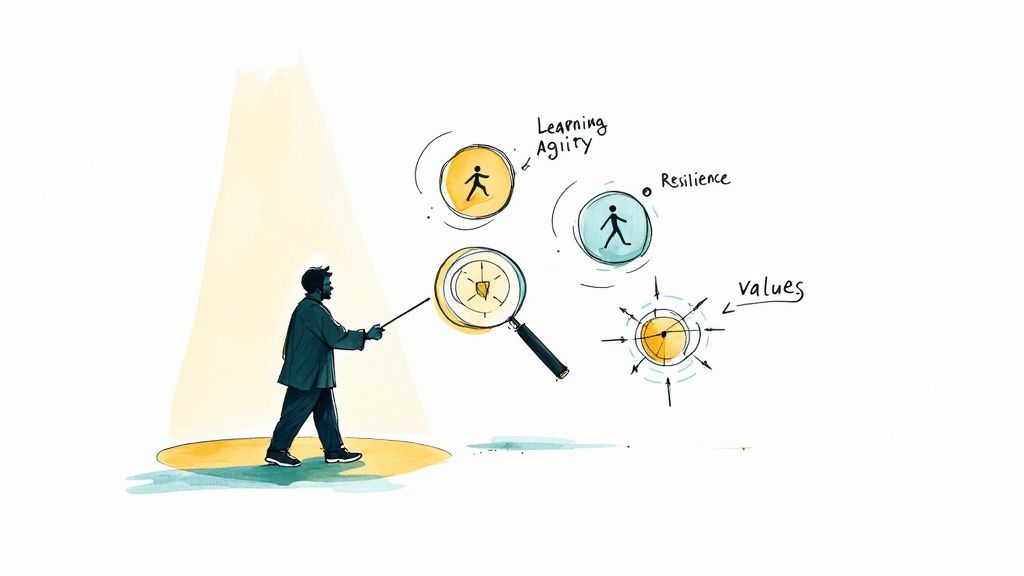
- Learning agility: They learn fast; their instinct is to learn, not panic.
- Resilience: They bounce back; setbacks fuel improvement.
- Values alignment: They consistently live the culture through their behaviour.
Career Conversation Prompts
Use these questions in 1:1s:
- What part of your current role energises you most?
- If you could design your perfect role in two years, what would it look like?
- What skills or experiences do you need to develop to get there?
- Are you drawn to people leadership, or a deep individual contributor track?
Practical “Try-It” Growth Experiments
Low-cost ways to test readiness:
- Lead a small project: Tests influence without authority.
- Shadow a senior leader: Exposes them to high-level decision-making.
- Peer coaching / mentorship: Builds skills and internal networks.
Track What’s Working
Keep metrics lightweight and meaningful:
- Internal mobility rate (north star): What % of senior roles are filled from within?
- Bench strength: For your top 5 critical roles, do you have at least one “ready now” or “ready in 12 months” person?
- High-potential retention rate: Are your identified future leaders staying and growing?
Why This Is Not Just Big Company Stuff
In a startup, every person has a massive impact.
Losing one key team member can feel like losing 10% of your institutional knowledge overnight. This makes succession planning even more critical.
It’s an essential part of your company's operating system. The way you approach it will directly influence your ability to scale without chaos.
Getting this right is a fundamental piece of good organisational design. You can learn more about how to set up your company to win in our guide on what is organizational design.
It’s about ensuring stability, retaining your best people, and building a company bigger than any single individual.
Why You Need a Succession Plan Sooner Than You Think
Your to-do list is endless.
Shoving “succession planning” onto that list probably feels like a problem for ‘future you’. But in a startup, things never calm down.
Ignoring succession planning doesn’t save you time. It just kicks a crisis down the road.
It’s the single biggest lever you can pull to solve painful headaches like key person risk and retaining top talent.
Mitigate Your Key Person Risk
In any small company, knowledge gets concentrated.
You know who I’m talking about. The lead engineer who built the monolith. The solo finance person who knows where all the skeletons are buried. The product manager with every key customer relationship stored in their head.
These people are your single points of failure.
What happens if they burn out or get an offer they can't refuse? It's chaos. Projects grind to a halt and knowledge walks out the door.
You wouldn't run your production servers without backups. A succession plan is your people backup. It’s the deliberate process of making sure someone else is getting ready to step in for every critical role.
This isn't about finding a clone of your star player.
It's about building redundancy into your team's skills so the departure of one person stings, but doesn't sink the ship.
Stop Your Best Talent from Leaving
Your top performers are ambitious.
If they can’t see a clear path forward with you, they’ll find one somewhere else. A First Round Review article highlights that a lack of growth is a top reason engineers leave.
Succession planning is a powerful retention tool.
It sends a clear signal to your best people: we see you, we believe in you, and we’re investing in your future right here.
When you earmark high-potential employees and build development plans for them, you're doing much more than just plugging a future gap. You are:
Building Confidence with Investors
Investors bet on teams, but they hedge against risk.
They know startups are volatile and that people will move on. A company that has a plan in place is a much safer investment.
Walking into a board meeting with a succession plan shows operational maturity.
It proves you’re not just obsessed with the next product launch. You're building a sustainable organisation for the long haul.
It tells them the company's future can't hang on a few individuals. That foresight can be a deciding factor.
A Practical Framework for Startup Succession Planning
Succession planning does not need to be a year-long project drowning in spreadsheets. For startups, it can’t be.
This is a step-by-step process you can execute immediately. We'll identify critical roles, spot talent, and create simple development plans that work.
The goal is to build your talent pipeline without corporate formalities.
Step 1 Pinpoint Your Critical Roles
First, you can't plan for everything.
Your initial focus should be on the 3-5 roles that pose the biggest risk if they were suddenly vacant.
To find them, ask yourself:
This exercise forces you to prioritise. Once you have your shortlist, you know where to focus your energy.
Step 2 Define What Good Looks Like
Now that you have your critical roles, define what it takes to succeed in them.
Don't just copy the current job description. Think about what that role will demand 12 months from now.
Break it down into three categories:
Keep it simple. A few bullet points for each category is all you need.
This creates a clear benchmark to assess potential successors. This planning is a core part of building a scalable organisation. Our free People Roadmap Template can help you structure this.
Step 3 Use a Simple 9-Box Grid
The 9-box grid is a classic talent tool adapted for startup speed.
It's a simple way to map your team's current performance against their future potential.
The grid plots individuals on two axes:
Your immediate focus should be on people in the top-right quadrant.
These are your high-potential, high-performing employees. They are your most likely internal successors.
But don't ignore the others. This grid helps you understand different talent segments, from solid performers to those who need more coaching.
This infographic shows how this kind of planning helps you prevent gaps, retain top talent, and scale your growth.
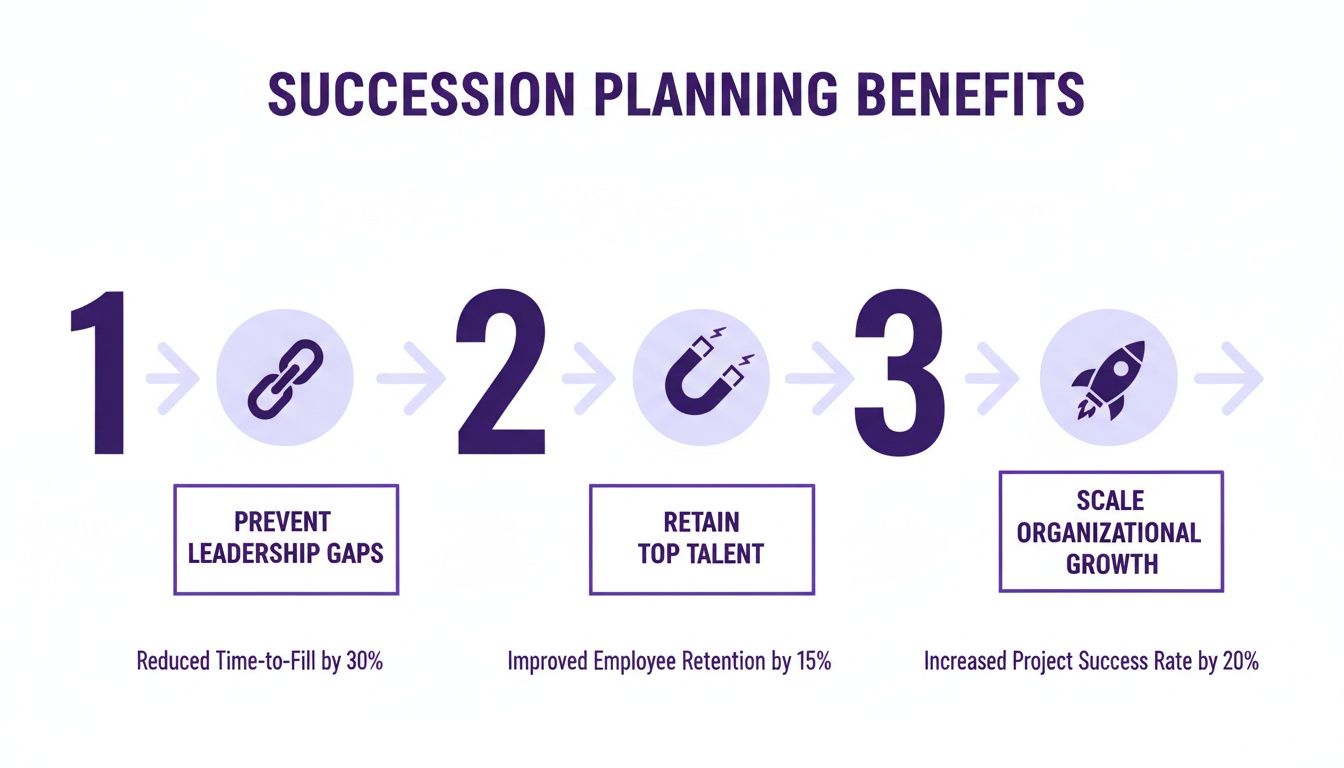
Succession planning is not just a defensive move. It is a proactive strategy that directly supports your business objectives.
Step 4 Create Lightweight Development Plans
This is where the plan becomes action.
For each high-potential person, create a simple, one-page development plan. Focus on high-impact, low-cost experiences.
Your development plans should centre on three things:
The goal is development, not documentation. The plan should be a living guide for growth conversations, designed to build the specific skills they need to be ready for the next step.
A crucial part of any plan is making sure you transfer tacit knowledge before employees retire or move on.
Mentorship and shadowing are fantastic ways to ensure this "unwritten" knowledge gets passed on.
These practical steps help you build a robust succession process without the corporate drag.
How to Identify and Develop Your Future Leaders
Spotting future leaders isn't about rewarding your top performers.
The person who's a rockstar in their current role might not have the skills or desire to lead a team through the chaos of scaling.
You have to look beyond today's output.
You're scouting for qualities that predict success in more demanding roles. Prioritise learning agility, resilience, and a connection to your company values.
Look for Potential, Not Just Performance
High performance is table stakes. High potential is the real prize.
A high-potential employee can grow into bigger roles quickly. They are your future leaders and senior specialists.
What does that look like on the ground?
High potential is not about already having all the answers. It's about having the drive and capacity to find them. These people will thrive when the company doubles and their job description is rewritten.
Run Candid Career Conversations
Once you've identified your high-potential people, talk to them.
Don’t assume you know their career goals. The aim is to map their personal aspirations to the company's future needs.
This is not a performance review. It's a forward-looking chat about their ambitions.
Try using these questions to guide the discussion:
This conversation builds trust. It shows you’re invested in their growth, making them far more likely to see a long-term future with you.
Use Cost-Effective Development Tactics
Developing leaders doesn't require a massive training budget.
In a startup, the most effective development happens on the job. Focus on practical, low-cost tactics that deliver real-world experience.
These experiences test their potential and accelerate their growth in a controlled way.
Consider these powerful development tools:
Another great approach is social learning. We dive deeper into this in our guide on why cohort-based learning is the future of leadership development.
Focusing on these hands-on opportunities creates a powerful development program that feels authentic to your environment.
Common Succession Planning Pitfalls and How to Avoid Them
Even with the best intentions, succession planning can go sideways.
A few common missteps can turn a smart strategy into a source of anxiety.
Knowing the traps is the first step to navigating around them. Let’s walk through the most common pitfalls and how to keep your plan on track.
The Secret List Syndrome
This is the number one mistake.
A small group of leaders anoints a few ‘chosen ones’ and keeps the list secret. The intention might be good, but the outcome is toxic.
People can sense when a secret club has formed. This breeds resentment and kills motivation.
How to Fix It?
Ditch the secrecy. Run a transparent talent review process. Frame it as a development initiative for the whole company. Communicate that the goal is to understand everyone’s strengths and aspirations to help them grow. This makes the process feel inclusive and fair.
Creating Carbon Copies
Another trap is trying to find a like-for-like replacement.
You look at your amazing Head of Engineering and think, "We just need to find another Jane." This is short-sighted. It assumes the role and the company’s needs will stay the same.
They won't.
The skills that made Jane successful at 50 people might not be what the role demands at 250. This stifles innovation. Understanding the distinction between employee training vs development is key. Training solves today's skill gaps. Development builds tomorrow's leaders.
How to Fix It?
Focus on future-state competencies. Instead of cloning the person leaving, map out what success in that role will look like in 18 months. Will it need more strategic thinking? Experience scaling a distributed team? Develop people for the role of tomorrow.
Succession planning is not about replicating the past. It’s about building the capabilities your organisation will need to win in the future. Treat it as a strategic forecast of your talent needs.
Planning Without a Plan
It’s easy to talk about succession planning. Without a written plan, it’s just talk.
Many businesses have the intention but lack execution. This is surprisingly common. Research shows that while two-thirds of UK family business owners intend for family succession, only 34% have formalised their plans. You can find more insights on this over at smetoday.co.uk.
How to Fix ItKeep it simple but make it real. Your plan doesn't need to be a 50-page document. Start with a simple grid listing critical roles, potential internal candidates (Ready Now, Ready in 12 Months), and their key development actions. The act of writing it down forces clarity and creates accountability.
Confusing Performance with Potential
This mistake is subtle but costly.
You promote your best individual contributor into a leadership role, only to watch them fail. High performance in a current role does not automatically equal high potential for a different role.
The skills that make someone a brilliant coder are worlds apart from the skills needed to lead a team of them.
How to Fix ItAssess for potential using a clear framework. Look for specific indicators beyond their day-to-day performance:
By sidestepping these pitfalls, you can build a process that feels fair, forward-looking, and motivating for your team.
Frequently Asked Questions
People Leaders in startups always have a few pressing questions about succession planning.
Let's get straight to the practical answers.
At What Stage Should a Startup Start Succession Planning?
The sweet spot is usually around the 30-50 employee mark.
That's when losing one key person can really throw a spanner in the works.
Another trigger is when you realise that if a specific person left, a critical part of the business would halt.
Don't overthink it. Just start the conversation. A simple "what if?" chat with the leadership team is a perfect first step.
Start small. Pinpoint your 2-3 most critical roles. What breaks if that person leaves? What knowledge walks out with them? That conversation is often enough to highlight the immediate need for cross-training and mentorship.
How Do We Plan for Succession Without Creating Unhealthy Competition?
Nobody wants a Game of Thrones culture where everyone is plotting for someone else's job.
The antidote is transparency.
Frame this as a leadership development program that benefits everyone, not a secret contest. It's about growing capability across the board to make the company stronger.
How you communicate this is everything. Make it clear the goal is to give people new skills and opportunities. When your team sees it as a genuine investment in their growth, the paranoia melts away.
Frame it as building capability, not crowning successors. The process should feel like an investment in everyone's growth, ensuring the company is resilient and that top talent has clear pathways to develop.
When you're running talent reviews, be open about the criteria.
Focus on potential, how quickly people learn, and whether they live your values. This shifts the conversation from a secretive list to a fair process for nurturing future leaders.
What Simple Metrics Can We Use to Track Success?
You don't need a sprawling dashboard.
In a startup, the simpler the metric, the more likely you are to track it. Focus on a few indicators that give you a real signal.
Here are three you can start tracking this quarter:
These metrics are easy to measure and give you an honest picture of your progress.
They turn succession planning from a theoretical exercise into a measurable strategy.
Ready to stop reacting and start building a resilient team? The Open Org Content Pass gives you the playbooks, templates, and AI-powered tools to build your people strategy with confidence. Get the practical resources you need to accelerate your work today.
