






Organizational design is how you set up your company to win. It’s not about complex charts or theory. It’s about making sure your people, processes, and structure all pull in the same direction. For a fast-growing startup, this isn't a ‘nice-to-have’. It’s your operating system for avoiding chaos.
Why Your Org Design Matters More Than You Think
In the early days, you don't really have an org design. You have a small, scrappy team doing whatever it takes. Communication is instant. Decisions are quick. Everyone knows what everyone else is doing. It works.
But as you scale, that informal system breaks. Fast.
Suddenly, two teams are building the same feature. Critical customer feedback gets lost between sales and product. Your best people become bottlenecks because every decision runs through them. This is the moment your lack of intentional design starts to cost you in speed, morale, and money.
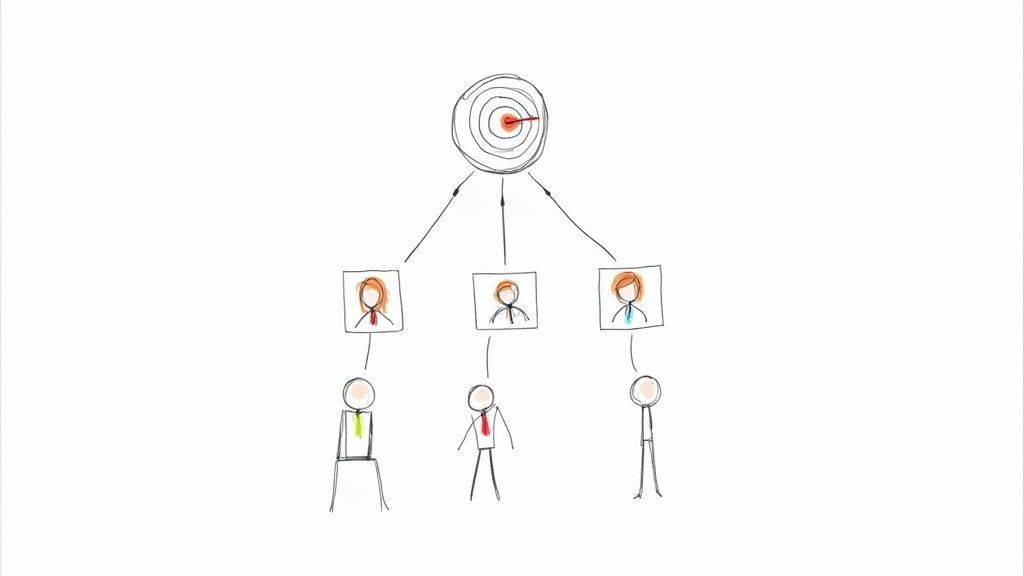
The Core Components You Can Actually Control
Thinking about your org design doesn’t need to be a huge, academic exercise. It boils down to a few core components you can shape.
Here’s a quick summary of the key levers. Think of them as the building blocks for a company that can scale without falling apart.
Structure
The formal hierarchy. It’s how you group people into teams, departments, and reporting lines.Determines how information flows and who makes which decisions. A poor structure creates silos and slows everything down.RolesThe definition of who is accountable for what work, the decisions they can make, and the outcomes they own.Clear roles eliminate confusion and duplicate work. They empower people to act without constant approval.
Processes
The pathways for how work gets done. This includes everything from your hiring process to your product development lifecycle.Well-defined processes create consistency and efficiency. Without them, you rely on individual heroics, which isn't scalable.
Governance
The rules of the game. These are the systems and policies that guide how teams operate and make decisions.Good governance provides the guardrails that allow for autonomy. It ensures teams are aligned even when working independently.
Incentives
The financial and non-financial rewards that motivate behaviour. This covers salaries, bonuses, recognition, and career progression.What you reward is what gets done. Your incentives must be directly aligned with the outcomes you want to achieve.
Metrics
The key performance indicators (KPIs) you use to measure success and track progress against your goals.Metrics tell you if the design is working. They provide the objective feedback needed to adapt and improve your operating model.
Each of these components is a tool. Adjusting one will affect the others, so think about them as an interconnected system.
Good org design isn't about creating a perfect, rigid hierarchy. It's about building a system that helps your team execute your strategy with the least amount of friction. It’s the bridge between your ambition and your team's ability to deliver.
A strong design clarifies who does what, how work gets done, and how people communicate. It's the architecture that allows your company to operate with speed and clarity, even as you double in size.
Thinking about this connects directly to concepts like workforce optimization, which is all about getting the most from your people. You're not just drawing an org chart; you're building a high-performance engine.
Pain Points That Signal a Broken Org Design
Rapid growth is a great problem to have, but it exposes every crack in your setup. The scrappy way you operated at 20 people starts to buckle around the 70-person mark. So, how do you know if your org design is failing?
It’s rarely a single event. It’s a slow creep of friction that grinds your momentum to a halt. You feel the pain long before you can name the problem.
This is your diagnostic checklist. These are the real-world symptoms you’re likely experiencing if your design is broken.
Slow Decisions and Constant Bottlenecks
Does it feel like every small decision has to go through a founder or senior leader? This is a classic symptom. When roles and decision rights aren't clear, your most experienced people become permanent bottlenecks.
Work queues up waiting for their approval, frustrating teams and slowing progress. If one person’s holiday grinds an entire department to a halt, your design is too centralised. A good design empowers teams with the autonomy to make decisions and move forward.
A common sign of a broken org design is when you have more meetings about the work than time spent doing the work. This happens when no one is sure who owns the final decision.
Confusion and Overlapping Work
Are two of your teams unknowingly building a similar feature? Does your sales team promise something your product team has no idea about? This is a direct result of unclear roles and poor communication channels.
When people don’t know what they are uniquely accountable for, they either duplicate efforts or critical tasks get dropped. You'll hear phrases like, “I thought marketing was handling that,” or, “Isn't that engineering’s job?” This role confusion wastes time, money, and creates internal friction.
Declining Morale and High-Performer Frustration
Your best people want to make an impact, not navigate internal politics. When they spend more time fighting for resources than executing, they get frustrated. Fast.
A broken design creates a high-effort, low-impact environment. That’s a recipe for losing your A-players. They didn’t join a startup to get bogged down in bureaucracy. Knowing the signs it's time to hire a Head of People is crucial for founders. This decline in morale is often the loudest alarm bell you’ll get.
Common Org Design Models for Scale-Ups
You don't need a textbook to find a structure that works. Theory is useless in a high-growth environment. You need battle-tested models that other startups use to ship products and win customers.
Most companies follow a predictable path. They evolve from simple structures into more specialised models. The key is knowing when to make the jump and what model fits your next stage of growth.
The Flat Model: Everyone Starts Here
In the beginning, everyone reports to the founder. The structure is flat because the team is small, maybe under 20 people. Communication is instant, roles are fluid, and everyone does a bit of everything.
This is perfect for the early stages when speed and flexibility matter most.
What good looks like: Decisions are lightning-fast. The team is tightly aligned. Everyone is close to the customer and the mission. A quick chat across the desk solves problems.
But this model always breaks. The founder becomes a bottleneck, and things grind to a halt. That’s your signal to evolve.
The Functional Model: Building Expertise
Once you grow past 30-50 people, you need specialisation. This is where the functional model comes in. You group people by expertise into departments like Engineering, Marketing, Sales, and Product.
This structure builds deep domain knowledge and creates clear career paths. It’s a necessary step up from the chaotic, flat model.
This is a good point to pause and diagnose if your current design has started to break down.
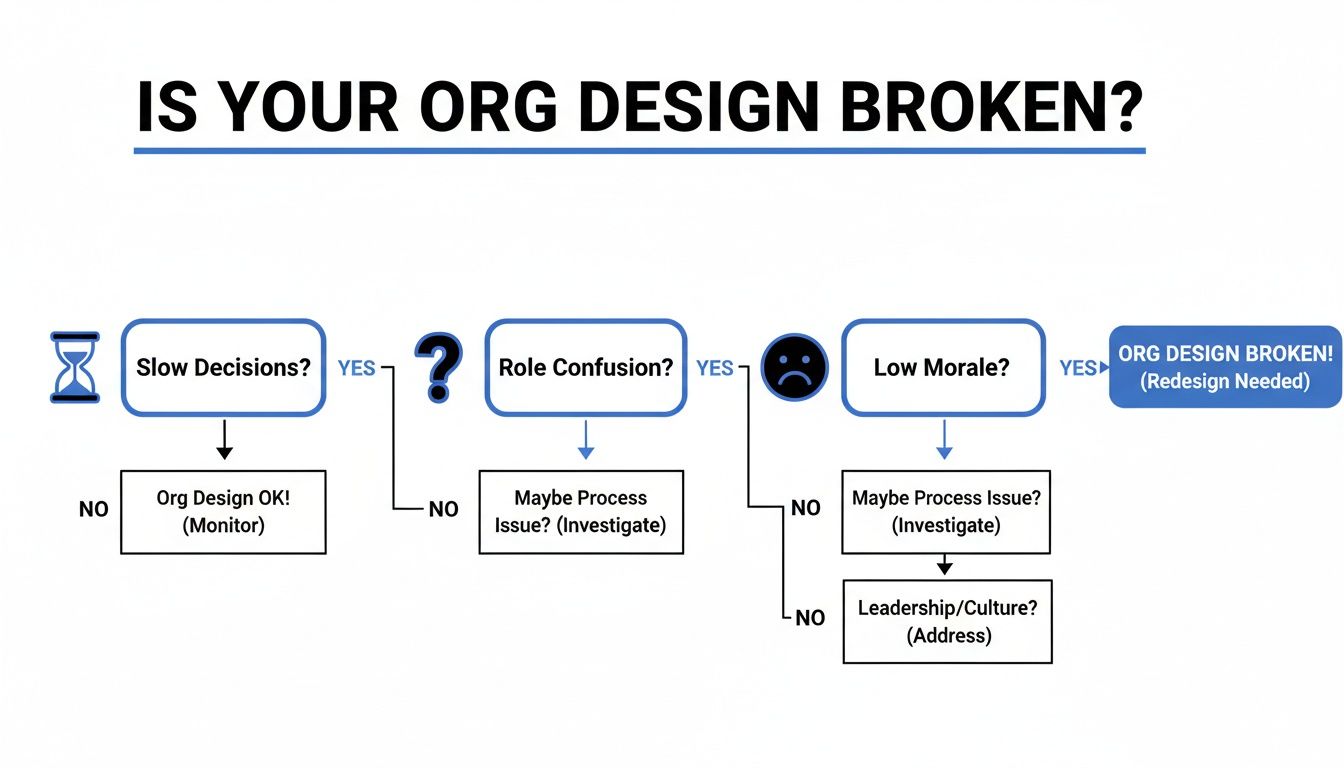
If you're seeing slow decisions or role confusion, it’s a strong sign your current model isn't scaling. Looking at how different functions are set up, like a marketing department organizational structure, can offer concrete examples of design in practice.
The Matrix Model: For Complex Projects
As companies get bigger, a purely functional model can create silos. Engineering stops talking to Marketing, and everyone focuses only on their department's goals. The matrix model tries to solve this by creating dual reporting lines.
An engineer might report to a Head of Engineering (their functional manager) and also to a Product Lead for a specific project. The point is to force collaboration across those functional divides.
Individuals become accountable to both their functional department and a project team, which pushes cross-team alignment.
Be warned: A matrix structure can add a ton of complexity. It demands crystal-clear roles, strong managers, and a culture of high trust. Get it wrong, and you just create more meetings and slower decisions.
Running an Organisational Design Diagnostic
Trying to redesign your org based on gut feelings is a recipe for disaster. A proper redesign starts with data, not drama. You need an honest look at how things actually work today to solve the right problems.
This isn’t a six-month investigation. Think of it as a focused effort to gather real evidence about what's working and what's broken. The goal is to build a picture of reality based on both hard numbers and human experience.
Start with Strategy and Workflows
Before talking to anyone, get sharp on the business strategy. What are the one or two most critical company goals for the next 12 months? Every single thing you investigate should be viewed through this lens.
With that clarity, map the most important workflows that deliver on that strategy. Don't try to map everything. Just focus on core value-delivery processes.
- Product Development: How does an idea turn into a shipped feature?
- Go-to-Market: How does a lead become a paying customer?
- Hiring: How does a role opening become a successful new hire?
-
Map these out visually. Simple flowcharts work perfectly. Show the key steps, who is involved, and where handoffs happen. This exercise will immediately highlight friction points, redundancies, and bottlenecks. You’ll see where work gets stuck.
Gather Qualitative and Quantitative Data
Your workflow maps give you the skeleton. Now add the meat by talking to people and digging into the numbers. You need both to get the full story.
Qualitative Data (The 'Why')
This comes from short, structured interviews with a cross-section of your team, from the C-suite to individual contributors. Don't just talk to the loudest voices. You're trying to understand the lived experience of working in your company.
Don't ask, "Is the structure working?" It's too abstract. Ask grounded questions like, "Tell me about a recent project that felt slow. Where did it get stuck?" or "What's one thing that makes it hard to do your best work here?"
These conversations will reveal hidden friction and communication gaps that no spreadsheet can capture.
Quantitative Data (The 'What')
Numbers provide objective proof of the problems people are feeling. Look for metrics that point to inefficiency or strain.
- Project Cycle Times: How long does it really take to get key things done?
- Employee Turnover: Are specific teams or departments bleeding talent?
- Decision Speed: How many sign-offs does a typical decision need?
-
The numbers tell you what is broken, and the interviews tell you why. This combination is crucial for building a case for change. For a deeper dive, our operational excellence audit offers a structured template to guide this process.
Recent ONS data shows how much design matters. The top 10% of productive UK firms generate 3.5 times more output per worker than the median firm. Effective org design is a massive performance multiplier. You can explore the full findings on UK business dynamism.
Your Practical Framework for Redesigning the Org
This is where theory stops and the real work begins. Forget expensive consultants and fancy slide decks. You can start making real progress on your org design today with a simple, iterative framework built for clarity and speed.
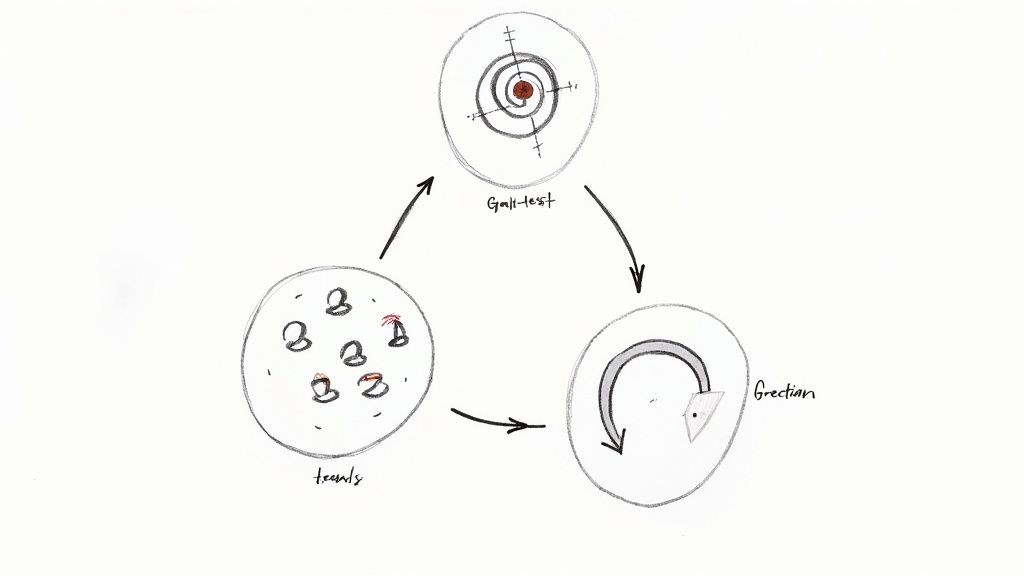
This isn’t about creating a perfect, final org chart. It’s about making deliberate, small changes, learning from them quickly, and building a stronger organisation one step at a time.
Phase 1: Clarify Strategic Goals
Your org structure must serve your business strategy, not the other way around. Before moving a single box on a chart, you need absolute clarity on what you’re trying to achieve.
Get your leadership team in a room. What are the 1-2 most critical outcomes you need to hit in the next 12 months? Are you pushing into a new market or driving for profitability? Every design decision must be tested against these goals.
Phase 2: Define the Critical Work
Once you know where you're going, map out the essential work required to get there. Think in terms of outcomes, not tasks.
For example, if your top goal is entering a new market, the critical work isn't just "do marketing." It’s tangible outcomes like "generate qualified leads," "close anchor customers," and "deliver an exceptional onboarding." This step forces you to define what actually creates value.
Phase 3: Group Work into Roles and Teams
Now you can start bundling that critical work into logical roles and teams. The golden rule is to design the roles first, then find the right people to fill them. A classic mistake is designing roles around the strengths of the people you already have. It feels convenient but creates a brittle structure that breaks the moment someone leaves.
Aim for roles with crystal-clear accountability and minimal overlap. For each one, ask:
- Does this role have a clear, primary objective?
- Can one person realistically own this work?
- Where does this role's responsibility end and another’s begin?
-
This methodical approach is vital in the UK, where small businesses are the economy's backbone. Around 99.2% of the 5.7 million private sector businesses are small enterprises. Their success hinges on agile, scalable structures. You can discover more insights on the UK business landscape to see how much this matters.
Phase 4: Test and Iterate
Don't roll out a massive reorg overnight. Start small. Pick one team to pilot the new structure. Set clear success metrics, run the test for a defined period, like one quarter, and gather feedback relentlessly.
The goal is to create a tight feedback loop. What’s working? What’s creating unforeseen friction? This iterative approach de-risks the entire process and builds momentum. It allows you to learn and adapt without disrupting the entire company.
This is the kind of hands-on approach we break down in our Transformation Playbook, which gives you the templates and step-by-step guidance for leading this change. By testing small, you can build a more resilient, effective organisation.
Your Org Design Questions, Answered
We've heard the same questions crop up again and again from founders and People leaders. Here are straight-talking answers to the most common queries.
How Often Should We Look at Our Org Design?
Forget the annual calendar reminder. The right time to review your org design is when your business hits a major inflection point.
This could be closing a funding round, launching a new product, or doubling your headcount. A quick health check once a year is fine, but you need to be ready for a proper redesign whenever the business fundamentally changes. The aim is to get ahead of the growing pains. Don't let a structure that worked for 30 people cripple a company of 100.
What’s the Single Biggest Mistake Founders Make?
Designing the organisation around specific people, rather than the work that needs to be done. It’s tempting to carve out roles for talented individuals, but it almost always leads to a confusing structure where no one truly owns anything.
Always start with the strategy. Define the work required to make it happen. Group that work into logical roles. Only then should you fit the right people into those roles. If a brilliant person doesn’t quite fit the ideal structure, that’s a separate conversation. Don’t let it derail your entire design.
How Can We Announce a Reorg Without Causing Panic?
It all comes down to clear, honest, and direct communication. Kick things off by explaining the ‘why’ behind the change. What’s the business problem you're trying to solve? Be transparent about what’s changing and what’s staying the same.
You need to provide absolute clarity on new roles, responsibilities, and reporting lines. Most crucially, you have to equip your managers with the information and confidence they need to answer their teams' questions.
People are more resilient to change than you think. What they can't stand is uncertainty. Your job is to stamp out that uncertainty by over-communicating. A single all-hands won’t cut it. Follow up with team-level discussions and detailed written FAQs.
Designing an organisation that can scale is one of the toughest challenges a leader will face. With Open Org, you get the playbooks, templates, and AI-powered support to stop guessing and start building a high-performance company.
