





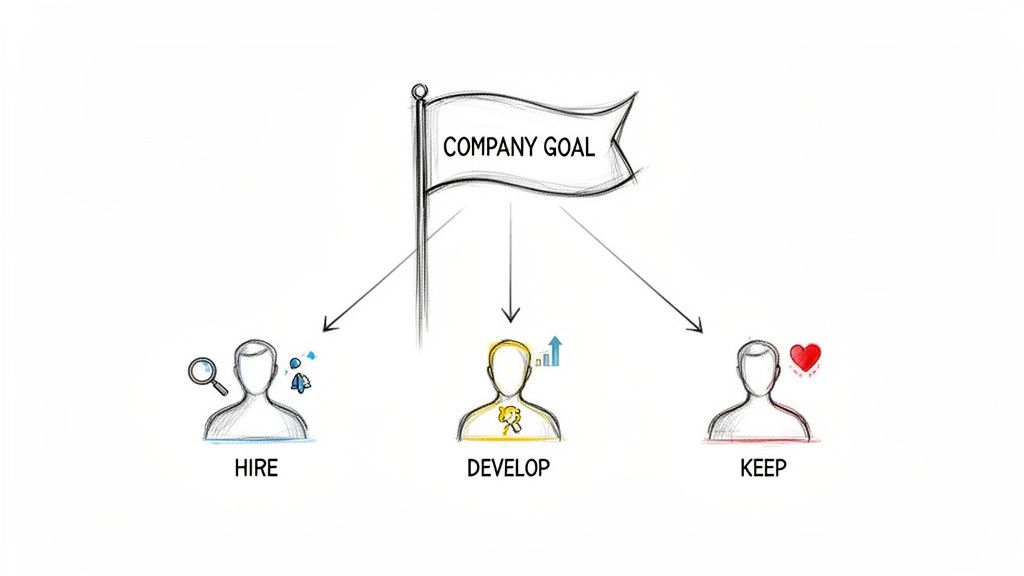
A people strategy is your startup's plan for hiring, developing, and keeping the team you need to win. Think of it as the human operating system connecting your company goals to your team's daily actions. It’s about making deliberate choices to build the organisation you want, instead of letting it happen by accident.
What Is People Strategy Really?
Let's be clear. A people strategy isn't a dusty HR document that sits on a shelf. It is the living answer to a critical business question: Do we have the people and culture needed to achieve our mission?
For a fast-growing startup, winging it on people decisions is a recipe for chaos. You hire the wrong people, lose your best talent, and watch your culture crumble as you scale. A clear plan stops this. It forces you to be intentional about who you hire, how you grow them, and what it actually feels like to work at your company.
The Human Operating System
Your business strategy is the destination. Your people strategy is the engine that gets you there. It ensures every single people-related activity pushes the business forward.
This means making conscious, connected decisions across a few key areas:
- Hiring: Defining the exact skills and mindsets you need not just for today, but for where you'll be 18 months from now.
- Development: Building real career paths that keep your best people engaged and growing with the company, not out of it.
- Performance: Creating a system that clarifies expectations and rewards high-impact work, not just activity.
- Culture: Being deliberate about the behaviours you reward and, just as importantly, the ones you won't tolerate.
A people strategy provides the framework for all these decisions. It ensures you’re not just reacting to people problems but proactively building the organisation required for your next stage of growth. This connects directly to how you structure your teams, something we explore further in our guide to what is organisational design.
People Strategy At A Glance
Here is a simple breakdown of what a people strategy solves.
Talent Acquisition
- Problem it solves: Hiring reactively, leading to costly mis-hires and slow progress.
- What good looks like: A proactive hiring plan that attracts people with the right skills and cultural fit for future goals.
Employee Development
- Problem it solves: Losing top talent because they can't see a future at the company.
- What good looks like: Clear career paths and learning opportunities that help people grow as the company scales.
Performance Management
- Problem it solves: Unclear expectations, low accountability, and inconsistent results.
- What good looks like: A fair and transparent system that aligns individual performance with business objectives.
Culture & Engagement
- Problem it solves: A weak or toxic culture that harms morale and productivity.
- What good looks like: An intentional culture where people feel valued, connected, and motivated to do their best work.
Compensation & Rewards
- Problem it solves: Losing talent to competitors over pay; unfair compensation practices.
- What good looks like: A competitive and equitable rewards system that motivates high performance and retention.
Talent Acquisition & Management
- What It Is: The system for attracting, hiring, and retaining the right people to hit your goals over the next 18-24 months.
- The Core Question It Answers: How do we get and keep the team we need to win?
Performance & Development
- What It Is: The framework for setting clear expectations, driving accountability, and fuelling continuous employee growth.
- The Core Question It Answers: How do we ensure our team is performing at a high level and growing with us?
Engagement & Culture
- What It Is: The environment you intentionally create to keep your team motivated, connected, and committed to the company's mission.
- The Core Question It Answers: How do we create a place where people genuinely want to do their best work?
Org Design & Effectiveness
- What It Is: The structure of your teams, reporting lines, and processes, all designed to help you scale without descending into chaos.
- The Core Question It Answers: Is our company structured to execute our strategy as we grow?
- Proactive Sourcing: You aren't just posting jobs when someone leaves. You're building talent pipelines before you have urgent roles to fill, especially for critical engineering or sales positions.
- Structured Interviewing: Every candidate gets a consistent, fair, and challenging interview experience. You're testing for the skills and values that actually matter, not just "good vibes."
- Strategic Onboarding: New hires are set up for success from day one. They get a clear 30-60-90 day plan that shortens their time to making a real impact.
- Clear Accountability: Everyone knows exactly what they own and what success looks like. There are no fuzzy grey areas.
- Efficient Communication: Information flows quickly to the right people. Decisions are made at the right level without creating bottlenecks.
- Scalable Structure: Your team structure isn't just built for today. It's designed to handle 2x your current headcount, which prevents constant, disruptive reorganisations.
- Talent: Who do we need to hire? Do we need a Country Manager with a network in Germany? How many native-speaking Account Executives will it take to hit our revenue target?
- Onboarding: How will we get our new German team up to speed quickly? Our current onboarding is UK-centric, so we’ll need to adapt it for the local market and employment law.
- Leadership: Does our current leadership team have the skills to manage an international team? Maybe we need to roll out training on cross-cultural communication.
- Compensation: What does a competitive salary look like in Berlin versus London? We've got to benchmark this properly to attract the right people without blowing the budget.
- What’s the single biggest business goal we must hit in the next six months?
- What's the main thing stopping our teams from executing faster?
- If we could only hire three people this quarter, which roles would unlock the most growth?
- What's one thing we do that frustrates our best people?
- Problem: What specific business pain point does this solve?
- Outcome: What will be different in six months if we nail this?
- Key Actions: What are the first three practical steps we need to take?
- Owner: Who is accountable for driving this forward?
Regrettable Turnover: This is the percentage of high-performers who choose to leave. Not all turnover is bad. But losing your best people is a direct hit to your future. Track this quarterly to spot trends before they become a crisis.
Employee Net Promoter Score (eNPS): This measures how likely your employees are to recommend your company as a great place to work. It’s a simple but powerful indicator of engagement and morale, gathered with a quick, two-question survey.
Time to Fill Critical Roles: How long does it take you to hire for the roles most essential to hitting business goals? A long lag time here is a massive drag on growth. It’s a huge red flag, signalling issues in your hiring process.
- Start with the business goals. Your strategy must solve real commercial problems, not just HR ones.
- Involve leaders early and often. Get their input from day one to ensure the plan aligns with their needs and gives them a sense of ownership.
- Keep it simple. Focus on three to five high-impact priorities you can nail in the next six months. It's all about building momentum with early wins.
Ultimately, a people strategy aligns your people practices with your company's core objectives. It’s the difference between building a team by chance and building a high-performing organisation on purpose. Without it, you’re leaving your most important asset to luck.
The Core Components Of A Modern People Strategy
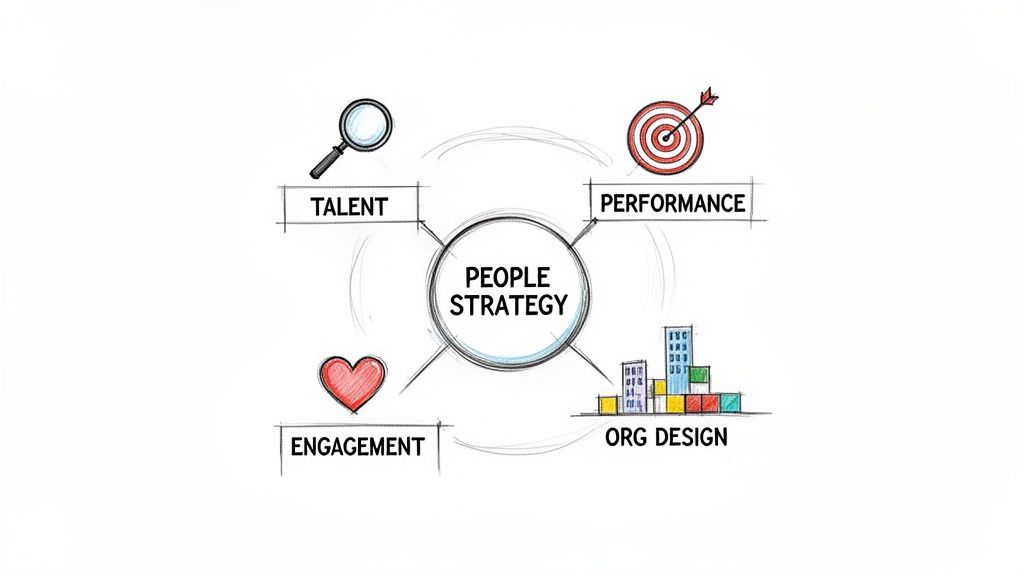
A people strategy isn't a single document you create and forget. Think of it as a dynamic system with interconnected parts working together to fuel your startup's growth.
For any founder or people leader serious about scaling, getting these core components right is non-negotiable. They are the blueprint that moves you from constantly fighting fires to proactively building a brilliant organisation.
The Pillars of a Startup People Strategy
Each pillar serves a distinct purpose but is deeply connected to the others. Get all four right, and you create a powerful flywheel for growth.
Let’s dig into the specifics of what makes each pillar effective in a fast-moving startup.
Talent Acquisition and Management
This goes beyond just filling empty seats. It’s about being deliberate in how you attract, hire, and hold onto the specific people who will propel your business forward.
What does that look like in practice?
Performance and Development
In a startup, performance is everything. A modern approach creates clarity, drives accountability, and fuels growth. This means moving beyond outdated annual reviews toward a lighter, more frequent cycle of feedback and goal-setting.
Good performance management is a coaching system, not a grading system. It's about constant, small adjustments and clear direction that help people do their best work.
This pillar answers one key question: How do we ensure our team is performing at a high level and growing with the business?
Engagement and Culture
Culture is what happens when you’re not in the room. Engagement is the outcome. It's the emotional commitment your team has to the organisation and its goals. Nail this, and you have a massive competitive advantage.
This part of your strategy answers: How do we create an environment where people are motivated to do their best work?
For anyone building a modern people strategy, especially with flexible work, mastering effective remote team management is a must.
Organisational Design and Effectiveness
This is the "how" behind your strategy. It’s about structuring your company to win by ensuring your teams, processes, and reporting lines are set up to help you scale without chaos. It's your operating system for growth.
A well-designed organisation has a few key traits:
This component answers the critical question: Is our organisation structured to execute our strategy effectively as we grow?
Aligning Your People Strategy With Business Goals
A people strategy that doesn't connect to business outcomes is a box-ticking exercise. The entire point is to wire your people initiatives directly into the company's bottom line.
You need to draw a straight line from a core business objective, like grabbing more market share, to a specific people plan. If you can’t make that connection clear, you’re not being strategic. You're just busy.
From Business Goal to People Plan
Translating a business goal into people initiatives comes down to asking one question:
"What has to be true about our people and our organisation for us to achieve this goal?"
Let's play this out. Imagine your company’s number one objective is to expand into the German market. This is a business goal. Your people strategy's job is to build the engine that gets you there.
Working backwards from that objective, your people plan needs to answer specific questions:
This exercise turns a fuzzy idea ("expand to Germany") into a concrete people roadmap. It ensures your function is seen as a strategic driver of growth, not an admin support centre.
A Simple Framework for Alignment
To make this process repeatable, use a straightforward framework. For every major business objective, map out the corresponding people requirements. This discipline ensures your work is always measurable and tied to company success.
What good looks like: You can walk into any leadership meeting, hear a business goal, and immediately articulate the three most critical people initiatives required to make it happen. Your work is woven into the business plan.
By consistently linking your efforts back to revenue, product launches, or market expansion, you demonstrate the value of a well-executed people strategy. It becomes obvious that investing in people isn’t a cost. It’s the main way you’ll achieve your most ambitious goals.
How To Build Your First People Strategy Step By Step
Right, time for action. This is where we build a practical, living plan, not a 50-page document that gathers dust. A great people strategy is about making a few, high-impact choices.
Forget endless meetings. The goal is to create a simple, one-page plan that sets clear priorities for the next two quarters. This process is about building momentum, not chasing perfection.
Gather The Right Input
First, you need the right information. Avoid open questions like, "What should our culture be?". Instead, get laser-focused on specific business challenges.
Run a few short, targeted interviews with your leadership team and a handful of influential people. Ask pointed questions to uncover the real friction points.
This approach gives you concrete problems to solve. It roots your people strategy in commercial reality from day one.
Define Your Operating Principles
Before you set priorities, define the core principles that will guide your decisions. Think of these as the beliefs that shape how you operate. These aren't fluffy values; they are tactical commitments.
What good looks like: "We default to transparency," "We promote from within whenever possible," or "We make data-informed people decisions." These are clear, actionable statements that help you make consistent choices.
A successful people strategy is about embedding new behaviours. It can be helpful to learn about forming habits that stick to make sure these changes are sustainable.
Set Two-Quarter Priorities
Now, use the input you've gathered to identify three to five key priorities for the next six months. You have to be ruthless. You can't fix everything at once, so focus on the initiatives with the biggest impact on your most pressing business goals.
The diagram below shows how your business goals should feed directly into your people plan to drive measurable outcomes.
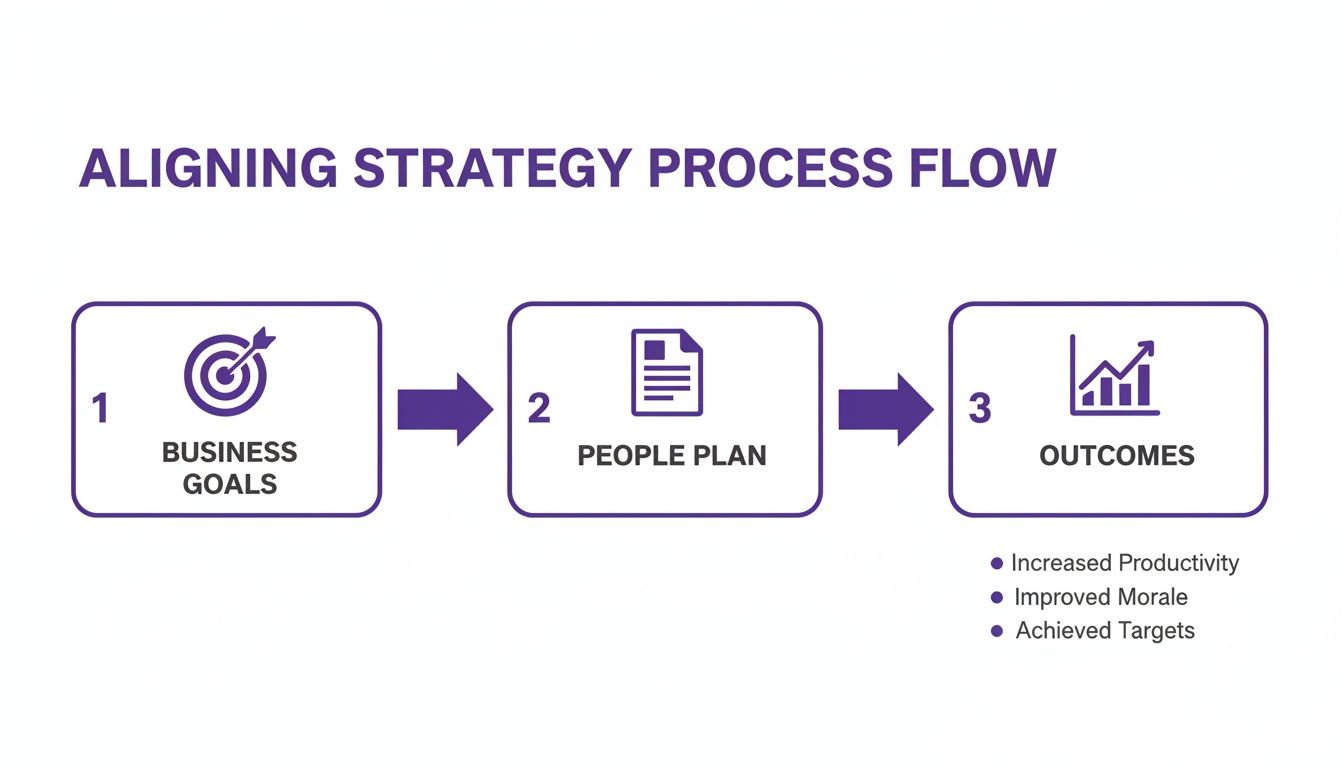
This visual hammers home the direct line you need to draw between company objectives and people initiatives.
For each of your priorities, define:
This structure keeps your plan focused and action-oriented. If you're starting from a blank page, you can fast-track this process. Our free People Roadmap Template is designed to help you build your one-page plan in no time.
Measuring The Success Of Your People Strategy
You can't improve what you don't measure. A people strategy without clear metrics is a collection of good intentions. To prove the value of your work, lock in on the handful of KPIs that give you a real-time pulse on your organisation's health.
The goal isn't a complex dashboard. It's a simple view that tells you if your strategy is working. This data is your secret weapon for proving ROI and getting buy-in for future investment.
Core Metrics That Actually Matter
Forget tracking every metric. For a startup, focus on a few key indicators that directly reflect the health of your people strategy. I recommend starting with these three.
What good looks like: Your leadership team reviews these core metrics in every quarterly business review, alongside revenue and product KPIs. People data isn't just an HR conversation; it's a fundamental part of how the business measures its overall health.
From Data To Decisions
Tracking metrics is only half the battle. The magic happens when you use that data to make better decisions.
If your regrettable turnover spikes, dig into exit interview data to find the root cause. If your eNPS score drops, run a few focus groups to understand what’s driving that sentiment. This data allows you to focus your limited time and resources on the problems that matter most.
Common Mistakes To Avoid When Creating Your Strategy
Learning from others is faster and cheaper. It’s easy to fall into a few common traps that look good on paper but fall flat in practice.
Getting ahead of these pitfalls is key to creating a plan that’s authentic, effective, and built to last.
Ignoring The Foundations
One of the biggest mistakes is getting distracted by trendy perks instead of nailing foundational systems. Free lunches or dog-friendly offices do nothing to fix a broken performance management process or a lack of clear career paths.
What good looks like: You prioritise the hard stuff first. You build robust, fair systems for hiring, feedback, and promotions before you even think about superficial perks. Great companies are built on strong foundations, not gimmicks.
Getting the basics right will always have a bigger impact on engagement and retention than any surface-level benefit.
Copying and Pasting Culture
The next common error is copying another company's culture. You read about Spotify's squads or see Netflix's culture deck and think you can lift and shift their model into your business.
This never works. Your culture must be a product of your specific people, your unique problems, and your business goals.
Building In A Bubble
Finally, too many people leaders create their strategy in isolation. They craft a "perfect" plan, only to find the leadership team isn’t bought in and managers have no idea what their role is.
A people strategy that isn’t co-created with the business is destined to fail.
Here’s what to do instead:
FAQs
When Should We Formalise A People Strategy?
Start thinking seriously about a people strategy right after you hit product-market fit, usually around the 20-50 employee mark.
Before that, focus on your core values and hiring great people. Get intentional about your people approach before you hit hypergrowth and bad habits get baked into your culture.
How Is This Different From A Normal HR Plan?
A traditional HR plan is often about compliance, admin, and putting out fires. It’s reactive. A people strategy is proactive and forward-looking.
It’s about directly linking everything you do with your people to the company's biggest strategic goals. Its purpose is to drive business growth, not just manage risk.
How Often Should We Revisit Our People Strategy?
For a fast-moving startup, a quick review every quarter is a good cadence, with significant updates every six to twelve months. Your business goals can shift quickly.
Your people plan must adapt alongside them to stay useful. An annual review won’t cut it when you’re scaling at pace.
Building a people strategy from scratch is a heavy lift. Open Org gives you the battle-tested playbooks, templates, and AI-powered tools to do it faster and better. Stop guessing and start building with confidence. Get the Content Pass.
