





Learning and Development (L&D) in a startup is your growth engine.
It's the system you build to make sure your team’s skills keep pace with your company’s ambition. Forget stuffy, formal training departments. Think of L&D as a continuous loop of solving real business problems, fast.
What Is Learning and Development in a Startup
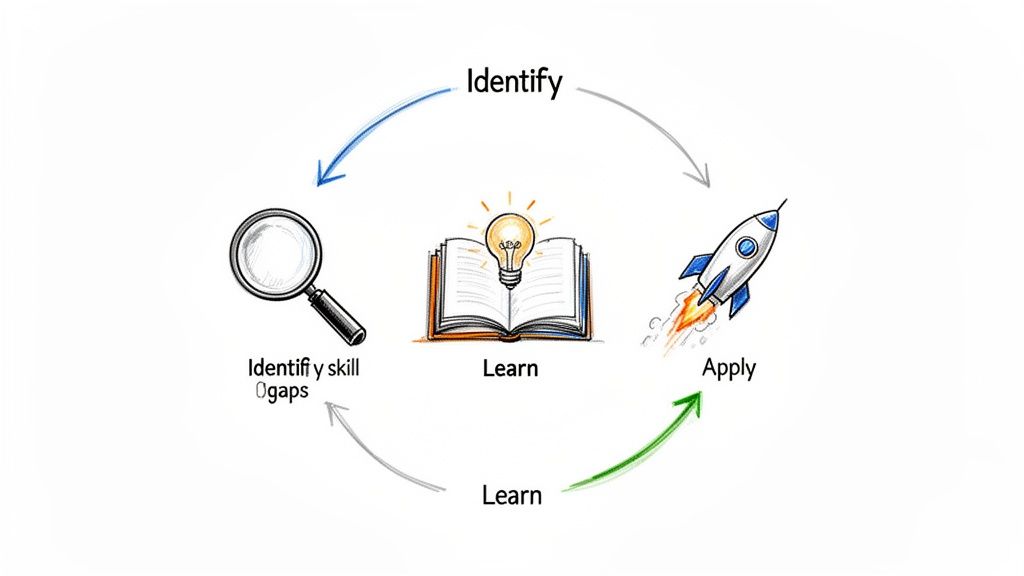
When you're scaling fast, L&D is a direct lever for performance. It's not about ticking compliance boxes.
It’s about giving a new manager the tools to lead their team effectively this week. It's helping your engineers get up to speed on a new technology so they can ship a critical feature before a competitor does. This is how you build a resilient, adaptable organisation. It's a massive piece of any effective talent management strategy, which you can read about in our guide on what is talent management.
How Startup L&D Is Different
Startup L&D has to be lean, agile, and relentlessly focused on impact. There are no nine-month planning cycles or massive budgets. Instead, it’s all about practical, just-in-time solutions that move the needle.
That means prioritising actions that deliver immediate value.
- Solving urgent problems: Focusing on the skills needed right now to unblock a team or get a product out the door.
- Building a learning culture: Making learning and development everyone’s job, not just a function of the People team.
- Leveraging internal expertise: Creating simple ways for your team to learn from each other, whether through peer coaching or quick knowledge shares.
Even with tight budgets and hybrid teams, investing in learning gives companies a strategic edge. One L&D Impact Survey shows that business impact assessments of development activities surged 12% year-over-year. As job skills shift rapidly with tools like generative AI, targeted upskilling is essential for survival and growth.
This guide gives you a clear framework for building an L&D function that actually works for your startup’s stage and size.
Why Traditional Corporate L&D Fails in Startups
Legacy L&D programmes were built for a different world. They’re slow, expensive, and disconnected from the fast-changing challenges your startup is wrestling with right now. An annual training calendar and clunky learning management system just can't keep up when priorities pivot in a single week.
The old model treats learning like an event. Think of a one-size-fits-all training day or a mandatory e-learning module that everyone clicks through to get it done. This approach is broken for high-growth companies that need agile support to solve real problems today.
The Disconnect Between Theory and Reality
Traditional L&D often gets bogged down in abstract theories. Your new manager doesn’t need a lecture on the history of leadership. They need to know how to handle a tough conversation with a direct report this afternoon. This gap between academic concepts and practical application is where most corporate training loses its value.
In a startup, every minute and every pound spent has to deliver a clear return. The goal isn’t just acquiring knowledge. It’s about building specific capabilities that directly drive business outcomes.
What is learning and development in a startup? A performance driver, not a perk. The focus must shift from 'checking the box' on training to equipping your team with the exact skills needed to hit their next milestone.
The Engagement Problem Is Real
Old-school L&D is often boring. This leads to chronically low engagement. According to research from the Learning and Work Institute, just 21% of employed people in the UK are currently learning at work, a sharp drop from 28% the previous year. You can read the full research about adult learning trends from the Learning and Work Institute. This highlights an urgent need for accessible, relevant resources that people actually want to use.
The survey also reveals stark inequalities. Workers earning over £52,200 are nearly twice as likely to access workplace learning as those earning under £26,099. A modern approach to L&D must close this gap by making development accessible to everyone, not just senior leaders.
A Modern Alternative for High-Growth Teams
Instead of top-down mandates, startups need a culture of continuous development owned by everyone. Learning should be embedded into the flow of work, not siloed within a People team.
This modern approach prioritises a few key things.
- Speed and Relevance: Providing answers and skills exactly when they are needed.
- Practical Application: Focusing on frameworks and tools that can be used immediately.
- Peer-to-Peer Learning: Unlocking the expertise that already exists within your team.
This is how you turn L&D from a cost centre into your most powerful advantage for driving performance and retaining your best people.
The Core Components of a Modern Startup L&D Strategy
You don’t need a bottomless budget to build a killer L&D strategy. You do need a sharp focus on the things that will actually make a difference. For a startup, that means being ruthless about prioritising what solves today's problems and helps you keep your best people tomorrow.
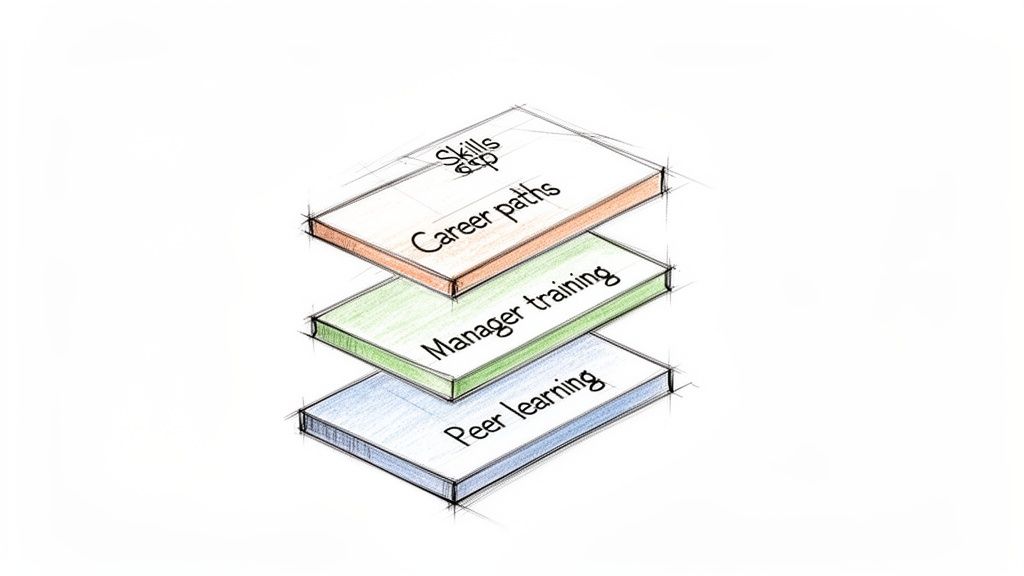
Forget complicated frameworks. A modern, high-impact L&D plan for a growing company is built on four powerful pillars. Think of these as your non-negotiables for building a lean learning function from scratch.
Essential L&D Components for Startups
Here are the four key pillars of a startup L&D strategy, what each one is, and why it’s a game-changer in a fast-paced environment.
Skills Gap Analysis. This is a diagnostic tool to map the skills your team has today against the skills needed to hit future company goals. It stops you from wasting money on random training and points you directly to the highest-impact learning opportunities.
Career Pathing. These are simple, clear frameworks showing employees how they can progress and what skills they need to get to the next level. It’s one of your most powerful retention tools because it shows top talent they have a future with you, not just a job.
Targeted Manager Training. This is practical, hands-on training for managers focused on core skills like feedback, coaching, and running effective 1-on-1s. Great managers are a force multiplier for performance. Investing in them has a ripple effect across their entire team.
Peer-to-Peer Learning. This means creating simple ways for employees to share their existing knowledge and skills with each other. It’s the most cost-effective way to learn. It taps into the expertise you already have and builds a stronger, more collaborative culture.
Each of these components addresses a specific need within a growing business. Let’s dive deeper into each one.
Skills Gap Analysis
Before you build anything, you need a blueprint. A skills gap analysis is how you figure out the difference between the skills your team has now and the skills they’ll need to crush your company’s goals.
What good looks like in a startup.
- Focus on roles, not individuals. What capabilities does your engineering team need to scale the product? What are your salespeople missing that’s stopping them from closing bigger deals?
- Keep it simple. You can gather useful data from existing performance reviews or manager 1-on-1s. Sometimes, a quick survey is all you need.
- Link it to a business outcome. The goal isn't just finding gaps. It's creating a plan to close them so you can achieve something specific, like hitting a revenue target.
Career Pathing and Growth Frameworks
Your best people are always thinking about what’s next. Clear career paths show them how they can grow with you, not just outgrow you. This is one of the most powerful retention tools you have.
This doesn't need to be a complex, 20-level matrix. Start with simple career ladders for your biggest teams. Outline the skills, behaviours, and impact required to move from one level to the next. That transparency gives people ownership over their development.
Targeted Manager Training
Your managers are the ultimate leverage point. Investing in their growth has a direct multiplier effect on their teams. Research shows that well-trained managers can drive a 17% increase in team productivity and a 21% boost in profitability.
Focus training on the practical, day-to-day stuff they struggle with: how to give feedback that actually lands, how to run a 1-on-1 that isn’t a boring status update, and how to coach people instead of just telling them what to do. An empowered manager builds an empowered team.
In a startup, great managers are not born; they are built. Providing them with the right tools and frameworks is the highest-leverage L&D investment you can make. It’s the difference between scaling smoothly and scaling into chaos.
Peer-to-Peer Learning and Mentorship
The smartest people on any given topic are probably already on your payroll. A huge part of L&D is just creating channels to unlock and share that expertise.
This can be simple to get going.
- Lunch and Learns: Casual sessions where a team member teaches a specific skill they're great at.
- Skill Swaps: Pairing up two people who want to learn from each other (e.g., an engineer and a marketer).
- Internal Mentorship: Connecting junior employees with more senior folks for guidance.
Learning from experienced peers is crucial at every level. For example, exploring the founder mentorship benefits for UAE startups shows how this dynamic works at the leadership level. The same principles apply across your team.
High-Impact L&D Programmes You Can Launch This Quarter
Execution is everything. You need to turn theory into something that genuinely helps your team. This section gives you three mini-playbooks for high-impact, low-cost L&D programmes you can get moving on in the next 90 days.
These are all about delivering quick wins and building momentum. Pick one of these to make a tangible impact on your people and business, fast.
Manager Enablement Sprint
Your managers are the biggest leverage point for scaling your culture and performance. This isn’t a six-month course. It's a focused, practical sprint to give managers the core skills they need to lead effectively, right now.
The goal is to arm them with tools for daily challenges like running great one-on-ones, giving feedback that isn't awkward, and coaching their direct reports. Our guide on why cohort-based learning is the future of leadership development offers a great model for this kind of group-based training.
What good looks like.
- Kick-off: A 90-minute workshop covering a core framework, like the Situation-Behaviour-Impact model for feedback.
- Application: Managers are tasked with using the framework in their next 1-on-1 and sharing how it went in a private Slack channel.
- Follow-up: A 60-minute peer-learning session two weeks later to discuss challenges and successes.
Success metrics here are simple. Track manager confidence with a quick pre- and post-sprint survey. You should also look for an uptick in qualitative feedback from their direct reports.
Peer Knowledge Share Framework
Your team's collective knowledge is one of your most valuable and underused assets. A peer knowledge share programme creates a simple way to unlock and distribute expertise.
Think of it as structured water-cooler conversations. You can formalise this without making it feel stiff or corporate.
The goal is to make sharing knowledge a default behaviour, not a special event. Start by identifying a few team members who are go-to experts on a specific tool or process and ask them to lead the first session.
Launch steps.
- Set up a simple sign-up sheet: Use a tool like Airtable or a Google Sheet where people can either offer to teach a skill or request to learn one.
- Schedule monthly "Lunch & Learns": Dedicate one lunchtime a month for a 45-minute knowledge share. The company buys lunch to encourage attendance.
- Promote it: Announce the upcoming session and speaker in your main comms channel a week in advance.
Track success by measuring attendance and sending a one-question follow-up survey: "On a scale of 1-5, how likely are you to use what you learned today in your work?"
Career Conversations Framework
Your best people want to know they have a future at your company. A career conversations framework gives managers a lightweight process for meaningful development discussions. This is a powerful retention tool.
This isn’t about making promises you can't keep. It's about helping people understand their strengths, clarify their aspirations, and identify one or two concrete development goals for the next six months.
The framework can be a simple one-page template in Notion with three sections.
- Reflection: Where are you now and what are you proud of?
- Aspiration: Where do you want to go next in your career (here or elsewhere)?
- Action: What is one skill or experience that would help you get there?
Equip managers with this template and a few talking points. Make it a regular part of their 1-on-1 rhythm, not a scary annual review. Success is measured by tracking employee sentiment on career growth opportunities.
How to Measure the Business Impact of L&D
Proving the value of L&D means moving beyond vanity metrics like completion rates. You need to connect your learning initiatives directly to tangible business outcomes. This shifts the conversation from L&D being a "nice-to-have" to a critical driver of company performance.
For startups, this doesn't require a complex analytics platform. It’s about using the data you already have to tell a clear story about impact. The goal is to show how a specific learning programme influenced performance, productivity, or retention.
Moving Beyond Satisfaction Surveys
Happy sheets and satisfaction scores are easy to collect, but they tell you almost nothing about business impact. A manager can love a training session but still be ineffective. Instead, focus on metrics that your leadership team genuinely cares about.
Start by tying every L&D initiative to a specific business problem. Are you launching manager training? The goal isn't just "to train managers." It's "to reduce regrettable attrition on junior teams by 10%" or "to increase the promotion rate from within by 15%".
This reframing forces you to think about measurement from day one.
A Simple Framework for Measuring Impact
To prove value, connect the dots between the learning and the outcome. This means looking at both leading and lagging indicators.
- Leading Indicators (The 'Did it work?' metrics): These are short-term behavioural changes. Did the salesperson who took the negotiation workshop start using the new framework in their calls? Did the manager who went through feedback training start giving more effective feedback in their 1-on-1s? You can measure this with simple pulse surveys or by gathering qualitative feedback from peers.
- Lagging Indicators (The 'Did it matter?' metrics): These are the business results that follow. This is where you connect that behavioural change to a tangible commercial outcome. This could be an increase in sales conversion rates, a decrease in team turnover, or faster onboarding times for new hires. Check out our detailed playbook for more on proving the ROI on your people initiatives.
Recent UK education and training statistics show that as youth unemployment remains a concern, corporate L&D is crucial for filling skill gaps. Measuring the tangible impact of these efforts is non-negotiable for proving their value.
What good looks like is a simple dashboard that tracks both leading and lagging indicators. This lets you show leadership not just that people completed the training, but that it changed their behaviour and improved a key business metric.
Your First 90 Days Building an L&D Function
So, you’re starting an L&D function from scratch. Where do you begin? Breaking it down makes it manageable. Here’s a tactical 30-60-90 day plan to get you off the ground, build credibility, and show your value from day one.
Think of this as your roadmap to laying a solid foundation for a learning culture that scales with the business.
Days 1 to 30: Listen and Diagnose
Your first month is all about discovery. Before you build a single workshop or buy a tool, you need to understand the business and its biggest headaches. Your mission is to go on a listening tour.
Chat with senior leaders. Ask them what keeps them up at night. Then, sit down with managers and individual team members to hear what’s blocking them day-to-day. Your goal is to find one high-stakes business problem that better skills could help solve.
Once you have a clear hypothesis, get alignment from leadership on that single priority. Don't try to solve everything at once. Focus on one specific area where you can make a visible impact, fast.
Days 31 to 60: Design and Pilot
Now it’s time to get your hands dirty. Design and launch your first high-impact, low-effort initiative. Think of it as your minimum viable product (MVP) for L&D.
Find a small, engaged group for a pilot. This is crucial. It lets you test your approach, get honest feedback, and tweak things quickly without a huge investment. A classic example is a manager enablement sprint for five newly promoted managers. It’s focused, relevant, and the impact is easy to see.
Keep it simple and practical. Give them just-in-time tools and frameworks they can put into practice the next day. This pilot isn’t about perfection. It's your chance to prove the concept and start building momentum.
Days 61 to 90: Measure and Scale
The final stretch is about showing your work and figuring out what’s next. Gather both qualitative and quantitative data to prove the pilot's impact.
Real impact measurement goes beyond just tracking who showed up.
This graphic shows how to connect the dots from initial engagement all the way to tangible business results like performance and retention.
Share these results with leadership. Keep it clear, concise, and always tie your work back to their priorities. Use this early win to build the case for rolling the programme out more widely and securing buy-in for your next L&D initiative.
Got Questions About L&D in a Startup?
If you're a People Leader trying to build a learning function from the ground up, you're not alone. Here are a few common questions we hear.
How Do I Get Budget for L&D in a Startup?
Start small, prove the ROI, and then ask for more. Don't pitch for a huge annual budget right away. Instead, propose a low-cost pilot program that tackles a specific, painful business problem.
For example, run a short manager enablement sprint for your engineering team to reduce regrettable attrition. Once you have results—like better manager confidence scores or a drop in team turnover—use that data to build your case for a bigger investment. This shows you're focused on business impact, not just running programmes.
What’s the Difference Between Training and Development?
Training is about teaching someone how to do a specific task for their job right now. A good example is showing a new hire how to use a piece of software.
Development is broader. It’s about building skills for future roles and nurturing long-term career growth. This includes things like leadership skills, strategic thinking, or coaching. In a startup, you need both: immediate skills training to solve today's problems and long-term development to keep your best people.
What Are the Best L&D Tools for a Small Team?
Step away from complex, expensive Learning Management Systems. The best place to start is with the tools you're already using.
You can create a solid knowledge-sharing hub in Notion or Slack. Quick tutorials can be made in minutes using Loom, and simple survey tools like Typeform are perfect for getting feedback. The best tool is the one your team will actually use. Focus on peer-to-peer learning before you splash cash on external platforms.
Get the frameworks, templates, and AI-powered support you need to build a high-impact L&D function. Open Org gives you the tactical resources to accelerate your work. Explore the Content Pass.
