





Forget posting on job boards and just hoping for the best. That’s a prayer, not a strategy. SEO for recruitment is how you attract brilliant, high-intent candidates directly to your careers page by showing up when they’re searching on Google. It's your unfair advantage in a crowded market.
Why SEO Is Your New Hiring Superpower

Relying on paid ads and the same saturated job boards everyone else uses is an expensive, short-term fix. It’s like renting an audience. The second you stop paying, the pipeline vanishes.
SEO, or search engine optimisation, is different. You build a genuine asset, a talent magnet that pulls in a sustainable flow of great candidates for the long haul.
Think about the last time you looked for a job. You probably opened Google and typed in something specific. "Remote product manager jobs UK" or maybe "startup marketing roles London". The companies that appear at the top of those results are winning. They meet people exactly where they are, at the moment they’re looking.
This guide shows you exactly how to become one of those companies. We'll treat your careers page like a core product and your job descriptions like valuable content. You'll learn the simple mechanics of how candidates search and how to get your open roles onto the first page of Google.
The Rise of AI Models and Their Influence
Search isn’t what it used to be.
For the last decade, recruitment SEO was mostly about one thing: getting your job page to rank on Google. Nail the keyword, get the click, get the applicant.
But right now, we’re in the middle of a shift that’s bigger than “Google changed the algorithm again.”
AI models like ChatGPT, Google’s AI Overviews, and other search assistants — are changing how people discover jobs entirely.
Candidates aren’t just typing in short keywords anymore. They’re asking full, human questions like:
“What’s the best remote-first startup to work for as a product designer?”
“Which companies in London are hiring senior engineers but aren’t toxic?”
“What’s a good salary for a Series B marketing role in the UK?”
“Where can I find flexible people ops roles with real autonomy?”
That’s not a job search. That’s a decision-making conversation.
And this is the opportunity.
Because the companies that win in this new world aren’t just the ones with the most job ads.
They’re the ones with the clearest story, the most useful content, and the most structured information for AI systems to understand and trust.
AI is turning your careers site into your “talent API”
Here’s the shift in mindset:
Old model:
“Post role → hope candidates see it → apply”
New model:
“Publish role + context + proof → AI recommends you → candidates arrive pre-sold”
AI models don’t just look for a job title and location.
They look for signals like:
What your company actually does
What your culture actually values
What the work actually feels like
Whether the role is real, current, and clearly defined
Whether candidates can trust what they’re reading
This means the winners will build careers pages that don’t just list vacancies — they answer candidate questions better than anyone else.
Why this matters: the best candidates don’t want “jobs” they want confidence
Top candidates aren’t struggling to find a role.
They’re trying to reduce risk.
They want confidence that:
the role is real
the manager is solid
the expectations are clear
the company isn’t chaotic
the work will build their career, not burn them out
And here’s the main thing:
AI-powered search rewards clarity.
If your job description is vague, overhyped, or full of internal jargon, AI can’t interpret it well — and candidates won’t trust it even if they do find it.
But if your careers content is specific, structured, and written like a human who respects the reader?
You become the obvious choice.
The new game: “search everywhere optimisation”
It’s not just about ranking in Google anymore.
Your jobs can now be discovered through:
Google and Google for Jobs
AI assistants (“what companies should I apply to?”)
community searches (Slack groups, forums, newsletters)
comparisons (“best startups for engineers in fintech”)
recommendation engines you don’t control
So your goal shifts from:
“How do I rank for this keyword?”
to:
“How do I become the best answer to the candidate’s real question?”
What companies should do differently now
If you want to win the next era of hiring, here’s what to focus on:
- Write for intent, not just keywords
Keywords still matter — but the modern job seeker is searching for outcomes:
“career growth”
“remote flexibility”
“high-performance team”
“mission-driven work”
“better manager”
Your content needs to reflect the real reasons people choose jobs.
- Make your job posts context-rich
A modern job description isn’t just a list of responsibilities. what success looks like in 30/60/90 days
what the team is building right now
what a “great” candidate looks like (behaviours, not buzzwords)
how decisions get made
what the manager cares about
what’s hard about the role (yes, really)
- Build content that AI can surface as “proof”
AI tools love content that teaches, explains, compares, and clarifies. “How our product team ships features”
“How we run performance reviews (without it being a mess)”
“What engineering career growth looks like here”
“How we support remote-first work across timezones”
A predictable talent pipeline. Imagine a consistent stream of inbound applicants who are actively looking for a company just like yours.
A seriously reduced cost-per-hire. By owning your main acquisition channel, you can dramatically slash spending on job boards and agencies.
Higher quality candidates. People who find you through search are proactive. They have done their homework and are genuinely interested in what you’re about.
A much stronger employer brand. Ranking for terms related to your industry and culture builds serious authority and makes you a destination for top talent.
Role + Modifier + Location:
product marketing manager + scale-up + londonIndustry + Role:
healthtech + customer success leadCulture + Role:
flexible working + sales development repProblem-Based Searches:
how to get a job at a series b startupA Killer Page Title and Meta Description. The page title is the first thing Google (and a candidate) sees in search results. Make it clear and include your primary keywords. Something like, "Careers at Acme Inc | Join Our Remote-First Tech Team" works well. Your meta description is the 160-character pitch that follows. Make it compelling enough to earn the click.
Clean Heading Structure. Use a single H1 heading for your main headline, like "Work With Us". Then, use H2s and H3s to break up the page into logical chunks covering your values, benefits, and open roles. This guides the reader and helps search engines understand the page's structure.
Keyword-Rich Copy (That Sounds Human). Weave your keywords naturally into the text. If you’re targeting "startup jobs london," make sure that phrase appears in your copy. Write for people first. Read it out loud. If it sounds robotic or stuffed, it is.
Image Optimisation. Name your image files descriptively (e.g.,
acme-team-working.jpginstead ofIMG_1234.jpg) and always add alt text that describes what’s in the picture. This is great for accessibility and helps you show up in image searches.The Job Title Is Everything. Your job title is your H1 heading, and it must contain the primary keyword. Ditch quirky titles like "Code Ninja". Go for something descriptive like "Senior Backend Engineer (Python, Remote)". Be specific. Data consistently shows that job titles with 1-3 words get better application rates.
Smart Keyword Placement. Get your main keyword into the first paragraph. Then, sprinkle it and your secondary keywords naturally throughout the description. Don't force it in.
Make it Scannable. Nobody reads a huge wall of text. Use bullet points for responsibilities and requirements. Bold key technologies or perks. Keep your paragraphs short and punchy.
A Clear Call-to-Action (CTA). End with an enthusiastic and obvious next step. "Apply Now" is fine. Something like "Ready to build the future of fintech with us? Apply here" has more energy.
Job Title (H1 Tag). Use the primary keyword. Be specific and clear, not clever. e.g., "Senior Product Manager" instead of "Product Guru".
URL Slug. Keep it clean and include the primary keyword. e.g.,
.../careers/senior-product-manager-london.Meta Description. Write a compelling 160-character summary of the role. Include the job title and location to entice clicks from search results.
First Paragraph. Mention the primary keyword within the first 100 words. Set the scene and grab the candidate's attention immediately.
Keyword Integration. Weave primary and secondary keywords naturally throughout the responsibilities and requirements. Avoid stuffing.
Readability & Formatting. Use short paragraphs, bullet points, and bold text to make the description easy to scan. No one reads a wall of text.
Image Alt Text. If you use images (like a team photo), add descriptive alt text. e.g., "The product team at Acme Inc collaborating in our London office."
Call-to-Action (CTA). End with a clear, enthusiastic instruction. Make the "Apply" button impossible to miss.
Use a free tool like Google's Structured Data Markup Helper.
Choose "Job Postings" and paste in the URL of one of your live job descriptions.
Highlight the different bits on your page (the title, salary, etc.) and tag them accordingly.
The tool generates the code for you. You or a developer can then add this to your job description template.
'A Day in the Life' Posts. Get someone from the team to walk through their typical day. What tools do they use? What specific problems are they trying to solve? This makes the role feel tangible and human.
Deep-Dive Technical Articles. Let your engineers write about a complex technical challenge they’ve recently overcome. This builds massive credibility and acts as a magnet for other talented engineers.
Career Progression Guides. Show people what a career path at your company actually looks like. A post titled "From Junior to Senior Engineer in 3 Years at [Your Company]" is incredibly powerful.
'How We Work' Playbooks. Be transparent about your internal processes. Do you have a unique approach to product development or remote collaboration? Document it and share it. People love this stuff.
Team Lead Interviews. Sit down with a hiring manager and ask them what they really look for in a new hire. What are the team’s biggest goals for the next year? This provides invaluable insight you can't get from a job spec.
Publish Date. When the post will go live.
Topic/Title. The working title for the article. Be specific.
Target Keywords. The main search terms you're aiming for.
Author/Team. Who is responsible for writing it? (e.g., Engineering, Product).
Target Audience. Which role are you trying to attract? (e.g., Senior Product Designers).
Status. A simple tracker (e.g., Idea, In Progress, Published).
Organic Traffic to Careers Pages. This is your top-line number. Is the total number of people landing on your careers section from search engines going up? Look for a steady month-on-month increase.
Keyword Rankings for Target Roles. Are you showing up on the first page for your priority job titles? Keep a simple spreadsheet to track the rankings for your top five to ten most critical roles.
Applications from Organic Search. This is the big one. How many candidates who started their journey on Google ended up hitting "apply"? You can track this by setting up a simple goal in Google Analytics.
Source of Hire. This is the number that shows real impact. Of the people you actually hire, how many came from organic search? This proves the business value to your leadership team.
Top-Line Summary (The 'So What?'). Kick it off with a single, powerful sentence. For example: "This month, organic search drove 25% of our total applications for engineering roles, a 10% increase from last month."
Key Metrics Snapshot. Show a simple graph for each of your core KPIs. Organic Traffic, Applications from Organic, and Keyword Ranking improvements.
Wins & Insights. What worked? Did that blog post about your engineering culture bring in two incredible candidates? Did changing a job title from "Growth Hacker" to "Growth Marketing Manager" triple its organic traffic? Call these wins out.
Next Month's Focus. What’s the priority for the next 30 days? Be specific. "We're focusing on optimising our three new sales roles and writing a 'Day in the Life of a BDR' post."
Pick a Role. Choose a job that gets decent traffic but could have a better application rate.
Create a Variation. Keep your current job title (Title A). Write a new, different one (Title B). Maybe Title A is "Software Engineer" and Title B is "Remote Software Engineer (Node.js)".
Run the Test. Post the job on your careers page with Title A for two weeks. Track the number of views and applications. Then, change only the title to Title B for the next two weeks and track the same metrics.
Analyse the Results. Which title got a better view-to-application conversion rate? Use the winner as your new default for similar roles going forward.
Google Keyword Planner. The perfect starting point for figuring out what terms candidates are actually searching for.
Google Search Console. This is your performance dashboard. It shows you exactly which keywords are bringing people to your site and flags any technical hiccups.
Google Analytics. Use this to track how many people are landing on your careers pages from organic search and how many are hitting "apply".
It’s a conversion asset.
The strongest job posts now include:
That kind of honesty doesn’t scare off top talent.
It filters in the right ones.
That’s why the most powerful recruitment SEO isn’t always a job ad.
It’s things like:
This content builds trust before the candidate ever clicks “Apply.”
The unfair advantage: candidates arrive already warmed up
When your careers page and role pages are built for this new AI-driven discovery world, something magic happens:
You stop convincing candidates from scratch.
Instead, candidates show up thinking:
“I already like these people.
This role sounds real.
This company actually gets it.”
That’s the whole point.
In a market where everyone is shouting the same generic job ads into the void…
The companies who win are the ones who become the clearest signal in the noise.
AI is just accelerating that truth.
What This Actually Means for You
You don't need to become a tech wizard or blow your budget on complicated tools. It’s a mindset shift. You’re going to start thinking like a marketer to attract talent. To get a handle on this, it's worth understanding the core principles of what is search engine optimization.
Here’s what good looks like once you nail this:
This approach builds a system that works for you 24/7. While your competitors are stuck manually sourcing on LinkedIn, your careers page will be attracting and converting candidates in the background.
Consider this your playbook for building a direct hiring channel that gives you a real competitive edge. We will skip the theory and get straight into the practical, step-by-step actions you can take today. We will cover everything from finding the right keywords to optimising your job posts and measuring what actually works.
The goal is to equip you to start winning the war for talent before your competitors even know there's a fight.
How to Find What Candidates Are Actually Searching For
To get in front of the right candidates, you have to get inside their heads. Stop guessing what they’re searching for and start using real data to find out. This is keyword research, and it’s the bedrock of solid recruitment SEO. Getting it right is the difference between attracting A-players and hearing crickets.
Your goal is to uncover the exact phrases your ideal hires are typing into Google. Think beyond just the job title. What about the location, seniority, or industry? Is the role remote? A great candidate isn't just looking for a "Software Engineer" role. They're hunting for a "remote senior software engineer job uk" or a "fintech backend developer role london".
These longer, more specific phrases are called long-tail keywords. They have lower search volume, but their intent is sky-high. Someone searching with that much detail knows exactly what they want. If your job ad meets that specific need, you’re in a prime position to get their application.
Start with a Simple Brainstorm
Before you touch a tool, grab a pen and paper. This isn't about being an SEO wizard. It's about deeply understanding the person you want to hire.
Jot down all the potential search terms you can think of. To keep things organised, try grouping them into a few buckets.
This simple exercise builds a map of your candidate's mindset. It’s the foundation for your entire strategy.
Use Free Tools to See if You’re on the Right Track
Now let's add some data. You don’t need to spend on expensive subscriptions to get started. Google’s own tools are powerful enough.
Head over to Google Keyword Planner (you'll need a free Google account). Plug in the ideas from your brainstorm. It will return the average monthly search volume for those terms and suggest dozens of related keywords you probably hadn’t considered.
Look for phrases with decent search volume, but don't obsess over massive numbers. A keyword with 50 monthly searches from the perfect candidates is infinitely more valuable than one with 5,000 searches from the wrong crowd.
What Good Looks Like: You should end up with a spreadsheet listing 20-30 target keywords for each high-priority role. Put the monthly search volume next to each one. This gives you a clear roadmap of what to prioritise.
Here’s another quick tactic. Use Google's autocomplete. Type one of your core job titles into the search bar and see what Google suggests. These are real, popular searches people are making right now. It's a simple but effective way to find relevant long-tail keywords.
See What Your Competitors Are Up To
Want a shortcut? Figure out what’s already working for the companies you’re competing with for talent.
Use a free tool like Ubersuggest or the free version of Ahrefs. Enter the URL of a competitor’s careers page. It will reveal some of the keywords they’re ranking for.
Don’t just copy their list. Look for patterns. Are they targeting specific seniority levels? Are they including "remote" or "hybrid" in their job titles? This is valuable intel on market demand and helps you spot gaps in their strategy that you can own.
This kind of strategic thinking is vital in the UK, where competition for startup talent is fierce and smart SEO can give you a serious edge. Data from IT Jobs Watch shows consistent demand for specific tech roles, highlighting which skills candidates are actively searching for.
Optimising Your Careers Page and Job Descriptions
You have done the research and have your target keywords. Now it’s time to put them to work. This part of SEO for recruitment moves from theory to action, transforming your careers page and job descriptions into magnets for the right talent.
Think of your careers page as your company's front door for potential hires. When someone lands there, they need to instantly get a feel for who you are, what you stand for, and why they should join your team. Good on-page SEO makes sure they find that front door in the first place.
The Careers Page On-Page SEO Checklist
Your main careers page is the central hub for every role you're hiring for. It needs to be optimised to rank for your core employer brand keywords, like "[your company name] careers" or "jobs at [your company name]".
Here are the must-haves:
Writing Job Descriptions That People Actually Find (And Read)
Each of your job descriptions is its own landing page. Treat it that way. This is a critical part of your recruitment SEO strategy. You need to write for search engines while creating compelling copy that makes a brilliant candidate stop scrolling and think, "This is the one."
Looking at what candidates already put in their applications can give you direct insight into the language your ideal hires are using. Understanding the importance of resume keywords for ATS will inform your word choices.
Here's how to structure your job descriptions for both humans and algorithms.
To help you get this right every time, here's a quick checklist to run through before you hit publish.
On-Page SEO Checklist for Job Descriptions
Use this list as a quick reference to make sure you're ticking all the boxes for visibility and engagement.
Nailing these fundamentals will put you leagues ahead of the competition.
Supercharge Your Job Listings with Schema Markup
This part sounds technical, but it’s a simple tweak with a massive impact. JobPosting schema is a snippet of code you add to your job description pages. It doesn't change how the page looks to a person, but it speaks Google's language, giving it structured information about the role.
This structured data tells Google all the important details. The job title, location, salary range, application deadline, and more. In return, Google can feature your job in its special "Google for Jobs" search results box, complete with your logo. This boosts your visibility and click-through rates.
This whole process starts with solid keyword research. The flow below shows how you move from discovery to implementation, which informs the content you put into your job descriptions.
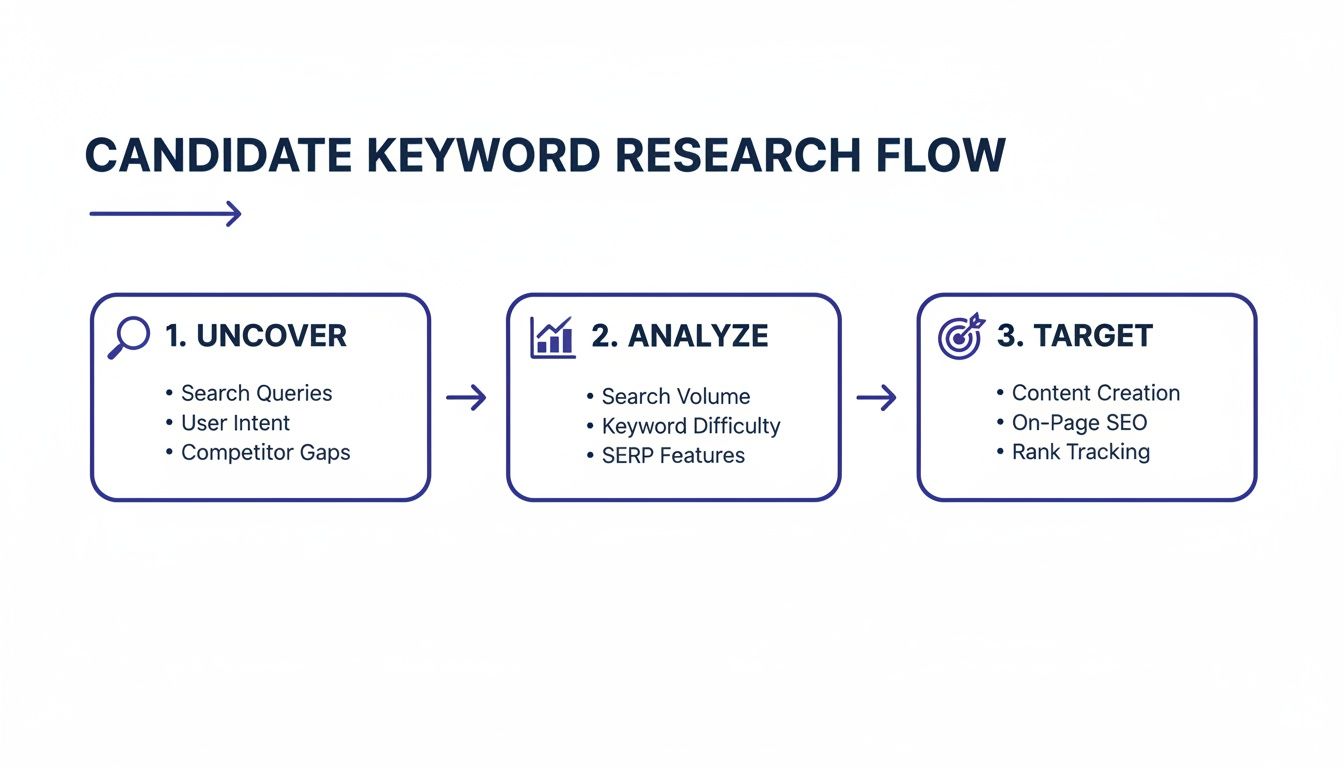
This flow, uncovering what candidates search for, analysing the data, and targeting the right terms, is the foundation. You can’t optimise a page until you know what you’re optimising it for.
You don't need to be a developer to implement schema.
For a much deeper dive into building out a world-class hub for all this activity, check out our career site playbook.
Getting these on-page details right is a fundamental part of a successful SEO for recruitment strategy. It ensures that when your perfect candidate is searching, your opportunity is waiting for them.
Using Content to Attract Passive Talent

A world-class SEO for recruitment strategy goes beyond optimising job descriptions. The smartest People teams attract passive talent. These are the brilliant people who aren't actively job hunting but are exactly who you want to hire next.
This is where your content strategy comes into play. You need to build an employer brand that pulls people in long before they think about making a move.
A top-tier engineer probably isn't Googling "software developer jobs" today. But they are searching for things like "how to scale a microservices architecture" or "comparing rust vs go for performance". If your engineering blog pops up with a genuinely helpful article, you've just made a powerful first impression without a recruiter lifting a finger.
Go Beyond the Job Description
Your careers blog or resources hub is your stage. It's where you prove you're not just a great place to work, but also a team of experts in your field. This is not about fluffy posts on company culture. It's about creating content with real utility that solves problems for the people you want to hire.
This content does two things. It builds your authority and helps you rank for a wider set of keywords than just job titles. You start catching attention at the top of the funnel, building a warm pipeline of candidates who already respect your company. For a deeper dive, check out this great piece on what employer branding truly is and how it fuels this entire approach.
Good content answers the questions your ideal candidates are already asking Google. It showcases the interesting challenges your team is solving and provides a window into what it's actually like to work with you. This is how you win hearts and minds before you even post a job.
Practical Content Ideas That Actually Work
Let's get tactical. Here are some proven content formats that attract top-tier passive talent. Steal these ideas and adapt them for your own teams.
Build a Simple Content Calendar
Don't overcomplicate this. The goal is consistency. A simple spreadsheet is all you need to get started.
Here’s a basic structure you can copy and use right away.
Aim for one or two high-quality posts a month. Focus your energy on the roles that are the hardest to fill. By consistently publishing valuable content, you create a powerful, long-term asset that attracts the right people on autopilot.
How to Measure Your SEO Success
You can’t improve what you don’t measure. Pouring time and energy into SEO without tracking results is like flying blind. This is about drawing a direct line from your SEO work to actual hiring outcomes.
The goal is to answer one simple question. Is this actually working? You need a straightforward way to see what's driving applications so you can double down on it. We’re talking about the specific numbers that prove your SEO for recruitment is paying off.
The Only Metrics That Really Matter
You don't need to track dozens of different data points. For a busy People Leader, there are only a handful of metrics that signal success. You can find them all for free in Google Analytics and Google Search Console.
Focus your attention on these key performance indicators (KPIs).
Don't get lost in the weeds with metrics like bounce rate or time on page. They don't directly tell you if you're hiring great people. Focus on what connects SEO to applications and hires. That's what moves the needle.
Building Your Simple SEO Report
When you talk to leadership, you need to speak their language. No jargon, no fluff. Just a crystal-clear connection between your work and the company's hiring goals.
Here’s a simple template for a monthly recruitment SEO report. You can build this in a slide deck or a brief document.
This kind of simple report tells a clear story of progress. For a more detailed guide on connecting your work to business results, check out our playbook on proving the ROI on your People initiatives.
The UK recruitment scene has seen explosive growth in online applications, which makes a measured SEO approach more critical than ever. According to data covered by artios.io, job boards can see nearly 100 applications per post. This noise means connecting your SEO efforts to measurable hiring outcomes is the only way to prove you're attracting quality, not just quantity.
A Quick Guide to A/B Testing Job Titles
Once you start getting some traffic, you can begin optimising. A/B testing is a simple way to find out what makes more candidates click "apply". Your job title is the easiest and most impactful thing to test.
Here’s how to do it without any fancy software.
This methodical approach will turn your recruitment SEO from a guessing game into a predictable and powerful engine for attracting top talent.
Got Questions About SEO for Recruitment?
Diving into SEO for recruitment can feel like learning a new language. You probably have a few practical questions. Here’s a no-fluff guide to the most common queries we hear from People Leaders.
How Long Does This Stuff Actually Take to Work?
This isn’t an overnight fix. Anyone who promises you instant first-page rankings is selling snake oil. SEO is a long game.
You might see some positive movement in a few weeks for very specific, long-tail job titles. Realistically, expect it to take 3-6 months to see significant, consistent organic traffic and applications.
Consistency is key. Every optimised job description or piece of career content you publish is a small asset. Over time, these assets compound, telling search engines that your careers page is an authority worth sending candidates to.
Think of it like planting a tree. You won't get shade tomorrow, but you're building something that will generate a pipeline of candidates for years.
Do I Need to Spend a Fortune on Fancy SEO Tools?
Absolutely not. You can get fantastic results with a suite of completely free resources.
For a startup or scale-up People team, the essentials are already at your fingertips.
The most important ‘tool’ you have is your deep understanding of who you want to hire. Focus your energy on creating high-quality, helpful content first. The tools are just there to help you measure and refine things along the way.
Your goal isn’t to become an SEO expert. It's to become an expert at communicating your company's value to the right people through a new channel. Free tools are more than enough to get that job done.
So, Can SEO Completely Replace Job Boards?
It can definitely reduce how much you lean on them, and for many roles, it can replace them. The point of building your recruitment SEO engine is to create a strong, direct channel for inbound applicants that you own and control.
Over time, as your organic traffic grows, you'll see a greater volume and quality of applications coming directly through your careers page. This means lower costs-per-hire and candidates who are actively seeking you out.
However, job boards can still be a useful supplement for niche roles or when you have an urgent hiring need. The ideal approach is a healthy mix, with the long-term goal of making organic search your primary, most cost-effective, and highest-quality source of hires.
Ready to stop relying on job boards and start building a hiring engine that works for you 24/7? Open Org gives you the playbooks, templates, and AI-powered tools to do it faster. Get the practical support you need to attract top talent at https://www.openorg.fyi.
