





A modern performance management process isn't a once-a-year headache. It’s a continuous system of goal-setting, feedback, and coaching that keeps your team aligned with company goals. It kills the outdated annual review for a lightweight, forward-looking rhythm that helps people get better at their jobs.
Why Your Performance Management Process Is Failing
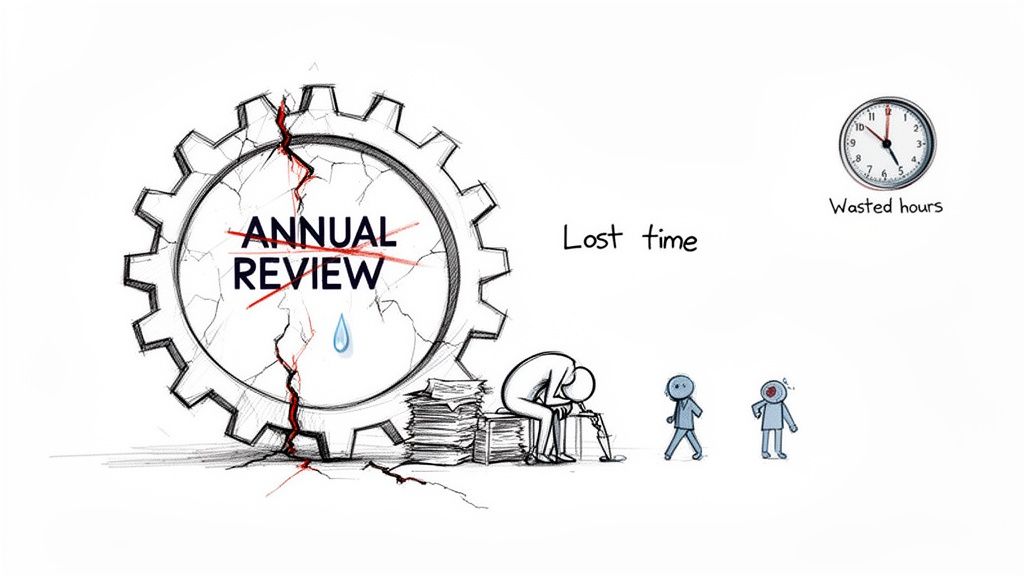
Let’s be direct. The traditional annual performance review is broken. For a fast-moving startup, it’s a huge waste of time and energy. It was designed for a slow, industrial era of work, not for companies that ship code or close deals every week.
If your current process feels like a bureaucratic chore that everyone dreads, you’re not alone. It’s probably doing more harm than good, creating drag when you need to be accelerating.
The True Cost of Outdated Reviews
Old-school reviews don't just feel bad. They actively damage high-growth companies. They create anxiety, reward recency bias where only the last few weeks matter, and decouple feedback from the actual work.
The biggest hidden cost is manager burnout. We ask our managers to lead, coach, and execute, then we saddle them with an administrative marathon once a year. This is a massive drain on your most critical leaders.
A core failure of the annual review is simple. It saves up feedback for a single, high-stakes conversation. This makes feedback feel like a verdict, not a tool for growth. In a startup, that delay is lethal.
The data paints a grim picture. In the UK, a staggering 74% of workers believe traditional appraisals are not useful. It’s just as bad from the other side. Only 5% of HR leaders are happy with their current review system.
For scale-ups, this translates into a huge time sink. Managers spend around 210 hours a year on annual reviews. That's more than five full working weeks. In a 50-person startup with eight managers, that’s over 1,600 hours poured into a process nobody values.
Recognising the Symptoms of a Broken System
How do you know if your performance management process is holding you back? The signs are usually obvious.
- Surprises in review meetings: An employee hears critical feedback for the first time in their annual review. The system has already failed.
- A focus on the past: Conversations get stuck on justifying a rating based on past events instead of planning for future growth.
- Manager fatigue and cynicism: Your managers openly complain about the time and effort, viewing it as a box-ticking exercise.
- Inconsistent standards: Every manager runs reviews differently, which leads to feelings of unfairness across the team.
If these symptoms feel familiar, your process is creating friction instead of alignment. It's time for a smarter approach. To see what good looks like, check out these 9 Performance Management Best Practices That Don't Suck.
Building Your Core Performance Framework
Forget complex, ten-step corporate models. At startup speed, your performance management framework needs to be simple enough to sketch on a whiteboard. This isn’t about building bureaucracy. It’s about creating clarity and momentum.
A solid framework has three core components: goal setting, continuous feedback, and lightweight check-ins. If one is weak, the whole system wobbles. Get all three working together, and you have a stable foundation for high performance.
Start with Clear Goals
Everything flows from clear goals. Without them, performance is just a matter of opinion. For startups, Objectives and Key Results (OKRs) are a great tool, but only if you strip away the corporate baggage.
The aim isn't to perfectly cascade OKRs from the CEO down to every intern. It's to create focus. A good starting point looks like this:
- Set Company-Level Objectives: The leadership team defines 3-5 top priorities for the quarter. These should be ambitious and set a clear direction.
- Teams Define Their Contribution: Each team then sets its own OKRs that directly support the company objectives. This creates alignment without micro-management.
- Keep it Simple: Limit each team to just 3 objectives, each with 3-4 measurable key results. Any more is just a glorified to-do list.
Goals are a compass, not a GPS. They point you in the right direction but give you the flexibility to navigate the terrain.
Establish a Continuous Feedback Rhythm
Annual feedback is useless. In a startup, a project from six months ago feels like it happened at a different company. Feedback needs to be timely, frequent, and forward-looking to have any impact.
This isn’t about forcing awkward conversations. It’s about building lightweight habits that make giving and receiving feedback a normal part of how you work.
- Weekly 1-on-1s: This is the heartbeat of your feedback rhythm. The manager's job is to protect this time. The employee's job is to drive the agenda.
- "Always-On" Feedback: Encourage people to share feedback in the moment. A quick Slack message saying, "Great job on that client call, your preparation really showed," is more powerful than saving it for a formal review.
- Focus on the Future: Always frame feedback around what to do next, not just what went wrong. Use questions like, "What could we do differently next time?" or "How can I support you on this?"
Good feedback is just data. It’s information that helps someone adjust their approach to get a better outcome. The more you normalise giving and receiving this data, the faster everyone learns.
Run Lightweight Performance Check-ins
This is where you kill the annual review. Instead of one massive, backward-looking conversation, you run a lightweight, forward-looking check-in every quarter.
By the time this conversation happens, there should be zero surprises. It’s a summary of all the feedback and progress discussions from your 1-on-1s. The purpose is to zoom out and look at the bigger picture together.
A simple check-in workflow can look like this:
- Self-Reflection: The employee fills out a short form answering a few questions about their wins, challenges, and goals for the next quarter.
- Manager Input: The manager adds their perspective, focusing on observed strengths and key development areas.
- The Conversation: You have a 45-minute discussion focused on career growth, development opportunities, and setting priorities for the quarter ahead.
The output is a simple document with a handful of clear action points for the next 90 days. To make your framework repeatable, look at principles from effective process management. This helps turn a good idea into a reliable system.
For a ready-to-use structure, grab our free Performance Handbook Template to get started today.
Setting the Right Rhythm for Feedback and Check-ins
A great performance management process is not a series of one-off events. It’s a continuous rhythm that builds momentum. Think of it as your company's operating system for performance. It should run in the background, keeping everyone aligned and moving forward.
Forget the mad dash of the annual review. For a startup, the ideal cadence is built on smaller, frequent touchpoints. This turns performance conversations from a backward-looking judgement into a normal, forward-looking part of the routine.
This timeline shows how goals, feedback, and check-ins should work together as a continuous loop, not a linear process.

Each element builds on the last. It creates a system where regular conversations mean there are no surprises at the end of the quarter.
The Weekly 1-on-1: The Heartbeat of Your Process
The weekly 1-on-1 is the most important meeting a manager has. It's the engine room of your performance process, where real coaching and feedback happen. Get this meeting right, and everything else becomes easier.
This is not a status update. It's protected time for the direct report to talk about their priorities, roadblocks, and professional development. A great 1-on-1 agenda is simple and consistent.
- Top of Mind (10 mins): What's the most important thing for us to talk about this week? This gives the employee ownership from the start.
- Goal Progress (10 mins): How are you tracking against your quarterly goals? Where are you stuck?
- Long-Term Growth (5 mins): What are you learning? What skills do you want to build next?
- Feedback & Support (5 mins): What feedback do you have for me? How can I better support you?
Managers should capture brief notes in a shared document. This creates a running record of conversations, making quarterly check-ins a simple summary of what’s already been discussed.
Monthly Goal Tracking: Keeping the Compass Aligned
While weekly 1-on-1s handle the micro-level, a monthly goal check-in handles the macro. This doesn't need to be another meeting. It’s a moment for teams to reflect on their progress against their OKRs.
This can be a lightweight, asynchronous process. At the start of each month, ask each team member to post a short update in a dedicated Slack channel or shared document.
What did we achieve last month? Where are we off-track? What are our main priorities for the next four weeks? A simple, public check-in like this creates accountability and helps teams course-correct early.
This isn’t about judging success or failure. It’s about creating transparency and spotting problems before they escalate.
Quarterly Performance Check-ins: The Lightweight Review
The quarterly check-in replaces the dreaded annual review. It’s a 45-minute, forward-looking conversation. By the time it happens, 90% of the content should have already been covered in weekly 1-on-1s. There should be zero surprises.
The point is to connect recent performance with future growth.
- Employee Self-Reflection (Pre-work): The employee completes a short form answering three simple questions: What was your biggest win this quarter? What was your biggest challenge? What do you want to focus on next quarter?
- Manager Preparation (Pre-work): The manager reviews the self-reflection and their 1-on-1 notes, then prepares talking points on key strengths and development areas.
- The Conversation: The discussion centres on career aspirations, skill development, and aligning on priorities for the upcoming quarter.
This rhythm creates a performance management process that feels supportive, not evaluative. You’re embedding continuous feedback into your culture.
Equipping Your Managers to Be Great Coaches
A well-designed performance management process is just a blueprint. Your managers have to build it. If they aren't equipped to be great coaches, even the best framework will fail. The goal is to shift their mindset from being a 'judge' to being a 'coach'.
Unfortunately, there's a huge gap here. Only 26% of organisations believe their managers are effective coaches. In UK SMEs, this is worse. Only 32% of managers feel they have a strong grasp of employee engagement. The full research on UK employee hopes and fears shows the scale of the problem.
For startup People Leaders, this points to a clear agenda. Invest in lightweight training that turns managers into confident coaches.
From Difficult Conversations to Development Moments
Many managers dread giving constructive feedback. They either water it down so the message gets lost, or they put it off entirely. Your job is to hand them simple, repeatable frameworks that take the fear out of these moments.
One of the most powerful tools is the Situation-Behaviour-Impact (SBI) model. It’s a simple script for giving feedback that feels objective and actionable.
- Situation: "During the team planning meeting on Tuesday..." (Be specific about the time and place).
- Behaviour: "...you interrupted Sarah a few times while she was presenting her ideas." (Describe the observable action, not your interpretation).
- Impact: "...and the impact was that the rest of the team went quiet and we lost some valuable contributions." (Explain the real-world consequence).
This framework strips out emotional language. It turns an awkward chat into a factual discussion about cause and effect.
The Manager's Coaching Toolkit
Great managers need a toolkit of questions and scripts they can use in different scenarios. Your role is to provide these ready-to-use assets, not just theory.
What good looks like is a manager who sees their primary role as unlocking their team's potential. They ask more than they tell. Their 1-on-1s are focused on development, not just status updates.
Here are some core components you should build into your manager coaching toolkit:
- "When you look at the next six months, what's one new skill you'd be excited to learn?"
- "Is there a project in another team that you're curious about?"
- "What part of your role currently gives you the most energy?"
- For a high-performer with poor team skills: "Your individual results are fantastic. The team really relies on your output. I want to talk about how we can make your collaboration as strong as your execution."
- For someone missing their goals: "Let's look at the goals we set for this quarter. It looks like we're off track. Can you walk me through the biggest roadblocks for you?"
- Prep Work: Before the meeting, managers submit their provisional performance summaries for their direct reports, with a brief justification.
- The Meeting: A facilitator (usually the People Lead) guides the managers through a discussion of each employee, team by team.
- The Goal: The group collectively sense-checks the ratings. A manager might say, "Here's why I rated Alex as 'Exceeding'," and another manager can ask questions to ensure the bar is consistent.
- Level 1 (e.g., Associate): Focuses on learning and execution. They’re mastering their core tasks with guidance.
- Level 2 (e.g., Mid-Level): Works more independently. They can own small projects from start to finish.
- Level 3 (e.g., Senior): Thinks strategically. They don't just execute, they improve the process and start mentoring others.
- The Outcome: Clearly state the new salary or title.
- The Rationale: Connect it directly back to performance conversations and the career ladder. For example, "You've been consistently operating at a Senior level by leading projects and mentoring others, so we're promoting you to recognise that."
- Future Focus: Briefly touch on the expectations for the new role and discuss the next set of growth goals.
- Goal Setting: A clean way to track company and team OKRs.
- 1-on-1s: A shared space for managers and direct reports to build agendas and track action items.
- Continuous Feedback: A simple way for anyone to give or request feedback at any time.
- Needs Support: Not consistently meeting role expectations and needs a clear support plan.
- Meeting Expectations: Consistently meeting expectations for their role and level. This should be the most common outcome.
- Exceeding Expectations: Consistently performing above and beyond role expectations.
- Be Disciplined with 1-on-1s: These are non-negotiable. They become the primary channel for connection, coaching, and feedback.
- Document Everything: Goals, progress, and feedback must live in a shared, accessible system. You can't rely on passing conversations.
- Embrace Asynchronous Feedback: Encourage written feedback that is thoughtful and specific. This is even more valuable when you can't just pull someone aside for a quick chat.
By equipping managers with practical tools like these, you lower the barrier to having high-quality conversations. For a deeper dive, our guide on The Open People Manager Handbook provides even more templates and frameworks.
Linking Performance to Growth and Compensation
This is where the rubber meets the road. A great performance management process falls apart if people can't see a clear, fair link between their contribution and their growth. Connecting performance to pay, promotions, and career development is key to building trust.
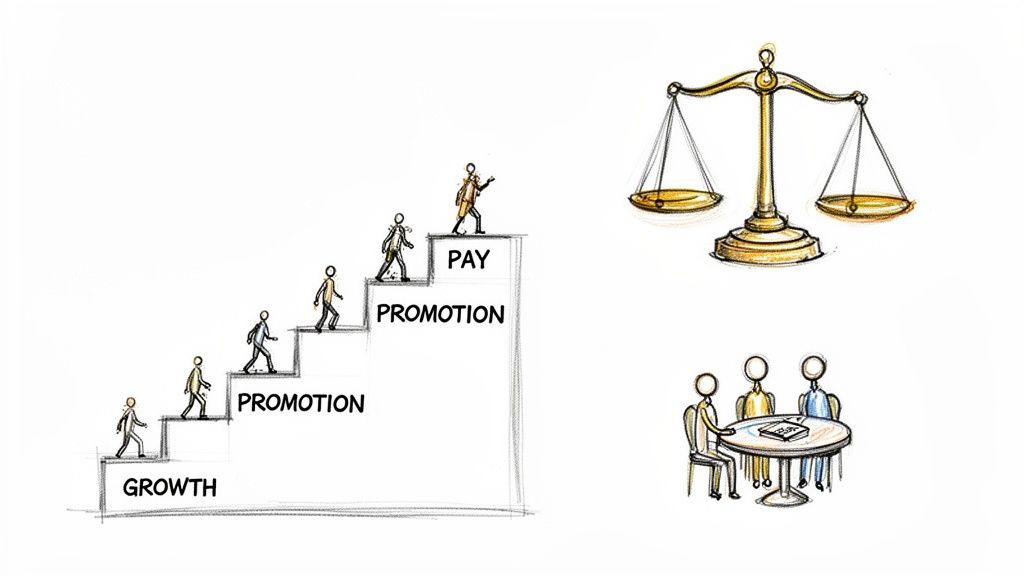
The goal is to demystify this connection without creating a rigid system. People need to feel the process is transparent and the outcomes are deserved. When you get this right, it becomes a powerful motivator.
For high-growth UK companies, this is a massive opportunity. Low engagement costs the UK economy over £257 billion a year in lost productivity. Yet a staggering 12% of UK SMEs say they prioritise engagement strategies. The gap is huge. You can dig into more UK employee engagement statistics to see the scale of the problem.
Running Simple Calibration Sessions
Fairness is everything. Calibration is your secret weapon to ensure that 'exceeds expectations' in engineering means the same thing as it does in marketing. It's a structured meeting where managers discuss their teams' performance, normalising standards across the company.
This doesn't need to be a complex, day-long affair. For a startup, a calibration session can be a lean, 90-minute meeting.
The outcome isn't about forcing a bell curve. It’s about creating a shared understanding and making sure that manager bias doesn't create an unfair system.
A Lightweight Career Ladder for Startups
You don't need a 50-page document for every role. An early-stage career ladder can be simple. Its main job is to show people what 'good looks like' at the next level and what skills they need to build to get there.
A great starting point is to define 3-4 core competencies for your company, then outline what each one looks like at different levels.
A career ladder should be a map that helps people navigate their own growth. It empowers them to have focused career conversations with their manager.
Communicating Compensation and Growth Decisions
Transparency doesn't mean sharing everyone's salaries on a spreadsheet. It means being clear about the 'how' and 'why' behind compensation decisions. This is where having a clear compensation philosophy is non-negotiable.
Your philosophy should explain how you approach pay, linking it to performance, role level, and market data. When it's time to communicate a pay rise or promotion, the conversation should be straightforward.
When delivering the news, managers should be equipped to explain:
By building a clear link between your performance process and rewards, you create a system people can trust. For more on this, check out our Compensation Philosophy Template to get started.
Common Questions About Startup Performance Management
We get it. Building a performance management process from scratch can feel daunting. Here are straight answers to the questions we hear most from startup and scale-up leaders.
What Is the Best Performance Management Software for a Small Startup?
The best software is the simplest. When you’re starting out, your priority isn’t a platform with a million features. It’s getting the actual process and habits right. Look for tools that nail the basics.
Your non-negotiables should be:
Tools like Lattice, 15Five, and Leapsome are popular for a reason. They are user-friendly and built for fast-moving teams.
But here’s our strongest advice. Don't buy anything yet.
Start with well-designed templates in Notion or Google Docs. Run your entire performance management process manually for one full quarter. This forces you to get the fundamentals right first. You'll quickly learn what works for your culture. Only then should you look for a tool that automates the system you’ve already proven.
How Do We Handle Performance Ratings Without Demotivating People?
The trick is to shift the focus from the rating itself to the conversation around it. Ratings only become demotivating when they feel like a surprise judgement. When they are just a summary of ongoing conversations, they lose their sting.
First, keep your rating scale simple. A three-point scale is often enough for a startup.
You have to make it crystal clear that the rating is just a shorthand summary of feedback shared all quarter. It should never be a surprise.
A rating is the beginning of a conversation about development, not the end of a conversation about judgement. If you frame it this way, you remove the fear and turn it into a tool for growth.
Finally, separate the performance conversation from the compensation discussion. If possible, have them at different times of the year. This keeps the focus on growth and development, not just the money.
How Do We Roll Out a New Performance Management Process?
Don't try to boil the ocean. A big-bang launch of a completely new process is a recipe for disaster. It overwhelms managers and feels like a massive, top-down mandate.
A phased rollout is critical for success.
Start with the highest-impact, lowest-disruption piece. Structured 1-on-1s. It’s a habit you want to build anyway, and it immediately improves manager-employee conversations. Give your managers a simple template and run a quick training session on how to have better weekly check-ins.
Once that habit is embedded, introduce the next element, like lightweight quarterly goal setting. With each step, communicate clearly why you're making the change and what problem it solves.
The best way to get started? Run a pilot with a single, enthusiastic team first. Let them be your champions. They'll help you work out the kinks and give you valuable feedback before you roll it out company-wide.
Should Performance Management Be Different for Remote Teams?
The core principles of a good performance management process are the same for remote teams. Clear goals, frequent feedback, and forward-looking conversations. The execution, however, needs to be far more intentional.
In a remote setting, you lose spontaneous check-ins and casual feedback. You have to deliberately build those moments into your process.
This just means being more structured and documented.
A good remote performance process is just a good performance process with better documentation and more deliberate communication.
Ready to build a performance management process that actually works? Open Org gives you the templates, playbooks, and AI-powered support to design People programmes that drive results. Stop guessing and start building with frameworks used by the world's best startups. Learn more and get started at Open Org.
