





Evaluating manager performance is one of the highest-leverage things a People Leader can do.
Get it right and you unlock team engagement, retention, and execution speed.
Get it wrong and you breed cynicism, lose your best people, and watch productivity stall.
Most resources are filled with academic fluff that doesn't work in a startup.
You need battle-tested frameworks you can implement this quarter.
This article delivers exactly that.
We're breaking down eight practical manager performance evaluation examples used by successful startups.
This is a playbook for building an evaluation process that drives performance and creates clarity.
For each model, we cover the core mechanics, pros, cons, and tactical tips for getting it right.
You get concrete examples of phrasing for different performance levels, from strengths to development areas.
For a broader look, you might find valuable insights in these examples of performance assessments as a complementary resource.
We will explore everything from 360-degree feedback and OKR-based assessments to competency frameworks.
This guide gives you replicable strategies to build better managers and stronger teams.
1. 360-Degree Feedback Evaluation Model
A 360-degree feedback model gathers confidential, anonymous feedback from a manager’s direct reports, peers, and their own supervisor.
The manager also completes a self-assessment.
This creates a comprehensive, multi-faceted view of their performance, behaviours, and impact.
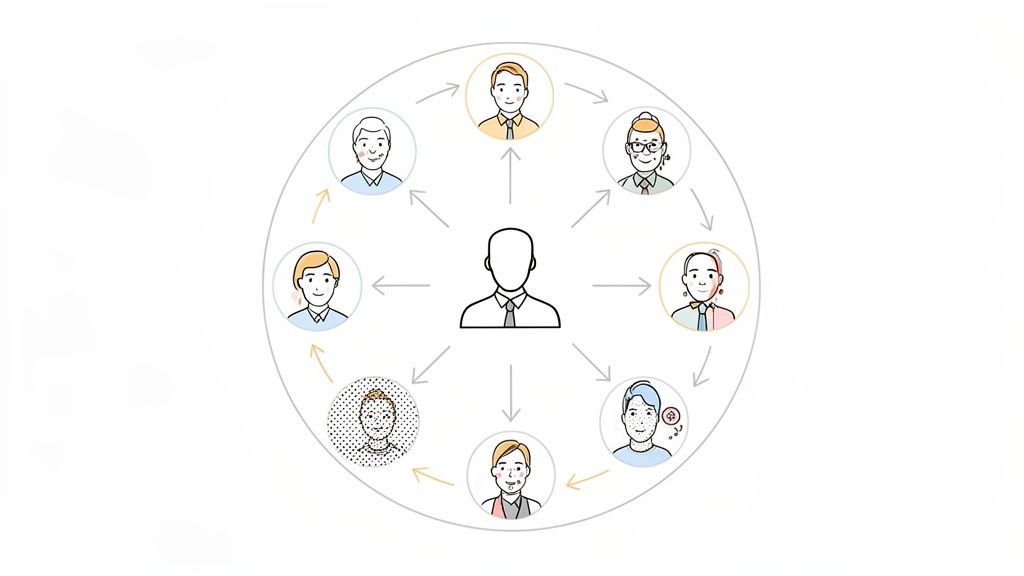
This method is highly effective for identifying leadership blind spots a traditional review might miss.
You get a holistic picture of a manager's effectiveness in communication, collaboration, and team leadership.
Why It’s a Go-To Model for Startups
For fast-growing companies, a manager's interpersonal skills are as critical as their functional expertise.
The 360 model provides the qualitative data needed to coach managers on behaviours that build a high-performance culture.
Adobe famously replaced its annual reviews with a more continuous feedback system, using frequent check-ins and 360-style input to focus on development.
Microsoft used 360 feedback to help shift its culture from "know-it-all" to "learn-it-all," encouraging leaders to embrace growth.
How to Implement It Effectively
Getting 360 feedback right requires careful planning.
Separate from Compensation: Use the first cycle purely for development. Linking results to pay too early creates fear and less honest feedback.
Coach the Coach: Provide managers with coaching or HR support to help them interpret the feedback and create an action plan.
Focus on Behaviours: Train raters to give specific examples. "In the Q2 planning meeting, Sam interrupted the junior engineers twice" is better than "Sam is arrogant".
Debrief Quickly: Schedule a debrief session with the manager within two weeks of them receiving their report to keep it actionable.
Follow Up Quarterly: Check in on progress against their development plan each quarter to maintain momentum.
Leverage Tech: Use tools like Open Org's AI-powered coaching feature to help managers instantly translate their 360 feedback into a structured development plan.
2. OKR-Based Manager Performance Assessment
An OKR (Objectives and Key Results) based assessment evaluates managers on their ability to set ambitious goals and drive measurable outcomes.
It assesses not just what was achieved, but also how a manager enabled their team to succeed.
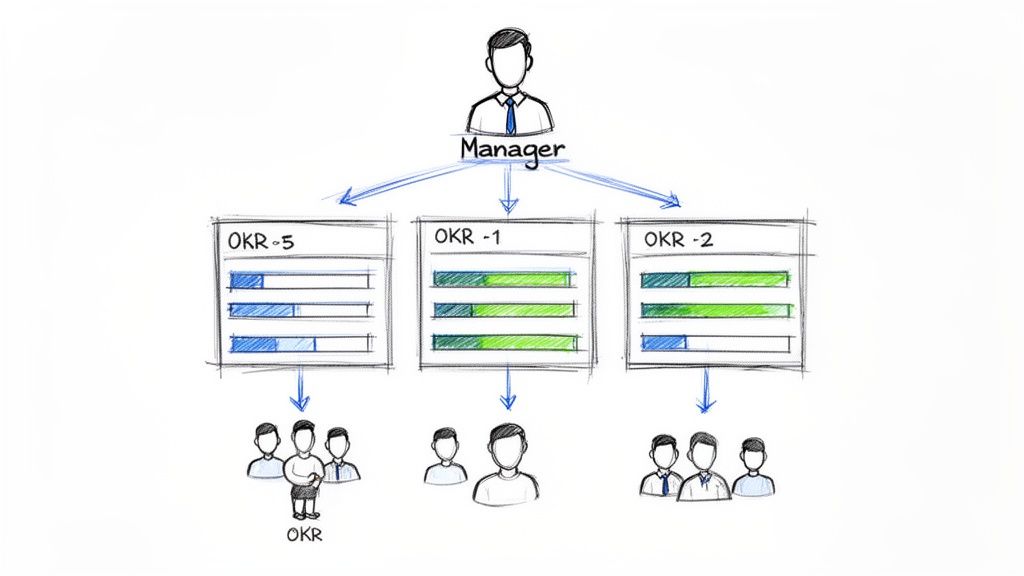
This approach provides a clear, data-informed basis for performance conversations.
It shifts the focus from subjective opinions to objective achievements.
This is one of the most effective manager performance evaluation examples for results-driven cultures.
Why It’s a Go-To Model for Startups
In a startup, alignment and execution speed are everything.
OKRs provide a transparent system for ensuring every team is pulling in the same direction.
It forces clarity on what matters most and holds managers accountable for results, not just activity.
Google popularised the OKR framework, assessing managers on their ability to set stretch goals and guide their teams toward ambitious targets.
LinkedIn combines OKR results with 360-degree feedback to balance the 'what' (goal achievement) with the 'how' (leadership behaviours).
How to Implement It Effectively
Rolling out OKR-based assessments requires discipline.
Focus on 3-5 OKRs: Keep managers focused on a few high-impact objectives. Too many OKRs dilutes effort.
Aim for 70% Completion: Set stretch goals where achieving 70% is a success. If managers are hitting 100% consistently, their goals aren't ambitious enough.
Balance Outcomes and Behaviours: Weight OKR achievement at around 60% of the final performance rating. The other 40% should assess competencies like coaching and communication.
Review Mid-Cycle: Use quarterly check-ins to assess progress and adjust Key Results if priorities shift.
Separate from Compensation (Initially): In the first cycle, decouple OKR scores from salary reviews to encourage risk-taking.
Create a Playbook: Use a clear framework to ensure every manager sets and tracks goals consistently. Build your own using our performance handbook template.
3. Competency-Based Manager Framework with Behavioural Anchors
A competency-based framework assesses managers against a list of core competencies like "Strategic Thinking" or "Team Development".
It uses a behaviourally anchored rating scale (BARS) with concrete examples of what performance looks like at each level.
This approach reduces rater bias.
Instead of guessing what "good communication" means, evaluators can match a manager’s actions to specific descriptions like "Proactively shares context in team meetings".
It creates a shared language for performance and clarifies what is expected of managers.
Why It’s a Go-To Model for Startups
In a startup, you need managers to develop specific skills quickly.
A competency framework makes these needs explicit and provides a clear roadmap for development.
It helps scale leadership capabilities consistently as the company grows.
Stripe built its manager expectations around competencies like "Bias for Action" and "User Obsession," with clear behavioural examples.
Spotify defined six core leadership competencies with behavioural anchors that guided manager development as the company scaled.
How to Implement It Effectively
A bad framework can feel bureaucratic. The goal is clarity, not complexity.
Define What Matters: Involve managers and high-performers in defining 5-7 core competencies. Ask them: "What behaviours do our best managers consistently demonstrate?".
Keep It Simple: Avoid framework fatigue by limiting the number of competencies. Focus on the most critical skills your startup needs now.
Create Behavioural Anchors: For each competency, write 2-3 specific, observable behavioural examples for each rating level. This is crucial.
Make It Accessible: Create a one-page reference guide for evaluators. This ensures everyone is calibrated.
Link to Development: Use the assessment to identify skill gaps. The results should directly inform a manager's development plan.
Refresh Annually: A startup’s needs change fast. Review and update your competencies each year to ensure they align with your strategy.
4. Peer-Nominated Manager Excellence Recognition Program
A Peer-Nominated Manager Excellence Recognition Program formalises praise into a structured performance metric.
This evaluates managers partly on the frequency of peer-submitted recognition.
It signals their cross-functional collaboration and impact beyond their immediate team.
This model quantifies a manager’s influence across the organisation.
It highlights the vital work of building relationships and unblocking other teams.
Why It’s a Go-To Model for Startups
In a startup, cross-functional friction kills momentum.
This model rewards managers who act as organisational glue.
It highlights leaders respected by their peers across different departments.
Salesforce uses peer recognition in Slack as a direct input for manager performance conversations.
Canva has integrated peer recognition into its quarterly performance review cycles, ensuring collaborative efforts are consistently considered.
How to Implement It Effectively
A successful program needs a clear structure.
Use a Structured Nomination Form: Prompt for specifics with questions like, "Describe a specific example of how this manager helped your team achieve its goals".
Set a Minimum Threshold: Require a minimum number of nominations (e.g., 3+) for the feedback to be included in a formal review.
Weight It Appropriately: Weight peer recognition at around 15-20% of the overall manager performance rating.
Review for Patterns: Analyse nomination data for recurring themes. Consistent praise reveals core leadership strengths.
Promote and Celebrate: Promote the programme through Slack, newsletters, and all-hands meetings. Publicly celebrate winners to reinforce the behaviours.
Drive Participation: Dedicate a few minutes in monthly team meetings for "recognition moments" to build the habit.
5. Development-Focused Manager Conversation Framework (Continuous Feedback Model)
A development-focused conversation framework shifts performance management from a single evaluation to a continuous cycle of growth.
It replaces the annual review with frequent, structured check-ins that prioritise coaching and real-time support.
Performance discussions become a forward-looking partnership.
This approach builds trust and psychological safety.
Making feedback a regular, low-stakes activity removes fear from performance reviews.
Why It’s a Go-To Model for Startups
Waiting a year for feedback is a recipe for disengagement in a startup.
Continuous feedback models allow teams to adapt quickly and address challenges as they arise.
These conversations also help managers understand strategies for improving employee retention by discussing career goals.
Microsoft moved to its "Connect" framework, which centres on continuous conversations to empower employees.
Spotify and Airbnb adopted similar principles, using regular check-ins to drive their agile cultures.
How to Implement It Effectively
Success depends on consistency, structure, and training.
Schedule and Protect Time: Book recurring bi-weekly or monthly 30-minute blocks and treat them as non-negotiable.
Use a Simple Guide: Equip managers with a short guide of 3-5 key questions. Ask things like "What are you learning right now?" or "What support do you need from me?".
Train Your Managers: Provide training on active listening and delivering constructive feedback. This is a common failure point. Get this right by building a feedback culture.
Document Key Points: Use a simple shared document to log discussion points, actions, and development goals.
Connect to Quarterly Goals: Link these conversations to broader quarterly development goals to support tangible progress.
Leverage Tech for Prompts: Use tools that provide automated reminders for both parties to prepare ahead of their check-in.
6. Data-Driven Manager Performance Dashboard with KPI Scorecard
A data-driven manager performance dashboard grounds evaluation in objective, quantifiable outcomes.
This system uses a real-time dashboard displaying manager-specific Key Performance Indicators (KPIs).
Metrics often include team retention, engagement scores, and promotion rates.
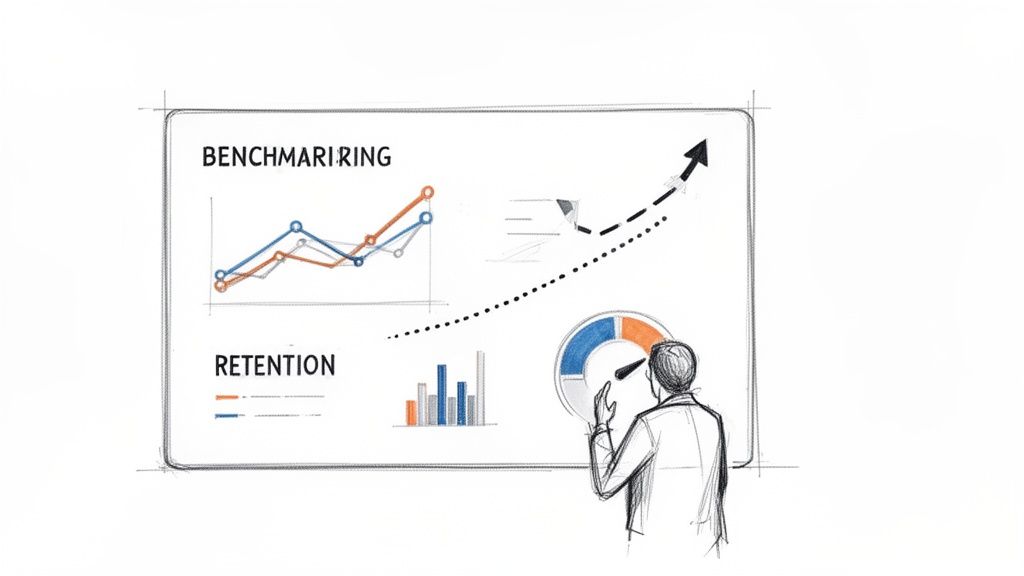
This method provides an evidence-based foundation for performance discussions and talent reviews.
It helps People teams identify which managers are excelling and which need targeted coaching.
Why It’s a Go-To Model for Startups
People teams need scalable, objective ways to measure manager effectiveness.
A KPI scorecard cuts through the noise and focuses on results that drive the business.
It holds leaders accountable for the health and performance of their teams.
Google’s People Analytics team developed a manager scorecard that identified metrics to predict team performance and retention.
Amazon heavily relies on data like employee retention and promotion rates in its manager assessment process.
How to Implement It Effectively
A dashboard is only as good as the data behind it.
Start with Core Metrics: Begin with 5-6 essential KPIs like team retention, engagement survey results, and progress against team OKRs.
Weight Retention Heavily: Team retention is a critical indicator of leadership quality. Consider weighting it at 25-30% of the overall score.
Balance Lagging and Leading Indicators: Include lagging metrics like retention (past success) and leading indicators like engagement scores (predict future outcomes).
Provide Context: Adjust metrics for specific situations. Use a grace period for new managers or different KPIs for R&D versus sales teams.
Combine with Qualitative Feedback: Data tells you what is happening, but qualitative feedback tells you why. Use the dashboard as a starting point for discussion.
Empower Self-Monitoring: Make the dashboard accessible to managers. When they can track their own progress, they are empowered to self-correct.
7. Situational Leadership Effectiveness Assessment (Context-Adaptive Evaluation)
Great managers adapt their approach to the needs of their team and the situation.
A Situational Leadership assessment evaluates this adaptability.
It measures if a manager can be a director, coach, supporter, or delegator when required.
This method assesses dynamic effectiveness.
It gauges how a leader performs in diverse scenarios, like guiding a new hire or navigating a crisis.
The focus is on choosing the right tool for the job.
Why It’s a Go-To Model for Startups
In a startup, change is constant.
Teams form, projects pivot, and crises emerge quickly.
A manager who can only lead one way will fail.
This model identifies leaders who can thrive in chaos.
Microsoft has used the Situational Leadership II framework to build flexibility into its management culture.
The US Navy SEALs use scenario-based evaluations to assess a leader's decision-making under extreme pressure.
How to Implement It Effectively
This model requires looking beyond standard review questions.
Use Scenario-Based Questions: Frame conversations around concrete situations. Ask, "Tell me about a time you had to adjust your management style for a struggling team member. What did you do?".
Assess the Full Spectrum: Evaluate tendencies towards both micromanagement and being too hands-off. A great manager knows when to step in and when to step back.
Ground It in Reality: Use real team scenarios from the past quarter to make the assessment evidence-based. Did the manager’s approach to the product launch crisis help or hinder the team?.
Incorporate 360-Degree Feedback: Ask direct reports specific questions like, "Does your manager adjust their approach based on your individual needs?".
Weight It Appropriately: In a volatile startup, consider weighting contextual effectiveness at around 20-25% of a manager's overall rating.
Coach for Flexibility: If a manager is rigid, make adaptability a primary development goal. Use tools like Open Org's AI coaching features to help them expand their leadership toolkit.
8. Integrated Performance & Potential Matrix (9-Box Grid) for Manager Assessment
The 9-box grid is a visual talent management tool that evaluates current contributions and future potential.
It plots individuals on a matrix based on performance and potential.
This provides a simple framework for differentiating talent and tailoring development and succession strategies.
This is one of the most effective manager performance evaluation examples for identifying future leaders.
Separating performance from potential forces a more nuanced conversation about what makes a manager successful.
Why It’s a Go-To Model for Startups
In a fast-scaling company, identifying high-potential managers early is a competitive advantage.
The 9-box grid provides a clear, data-driven way to map out leadership pipelines.
It ensures you are investing development resources in the right people.
General Electric pioneered the 9-box grid as part of its world-renowned succession planning process.
Salesforce uses the grid to spot high-potential managers for its accelerated leadership development programmes.
How to Implement It Effectively
A 9-box grid is only as good as the data and conversations that fuel it.
Assess Dimensions Separately: Evaluate performance based on goal achievement. Assess potential based on traits like learning agility and resilience.
Run Calibration Sessions: The leadership team should discuss and debate manager placements on the grid. This meeting is crucial for standardising ratings and reducing bias.
Define Actions for Each Box: Each box should have predefined actions. A "High Potential, Moderate Performer" might get a stretch assignment and a coach. A "High Performer, Low Potential" is rewarded for expertise in their current role.
Communicate Carefully: Frame the manager's placement as a developmental tool, not a permanent label. Focus the conversation on actions to support their career.
Use for Succession Planning: The grid is an excellent input for identifying successors for critical roles. You can learn more about building a robust succession planning process.
Leverage Tech: Use Open Org’s talent management templates to build your grid and establish clear advancement criteria for each box.
Choosing The Right Model For Your Startup
There is no single "best" approach.
The right method depends on your company’s stage, culture, and strategic priorities.
An early-stage startup might prefer a lightweight, development-focused conversation framework.
A 150-person scale-up likely needs the rigour of a competency model or a 9-box grid.
Don't adopt a system because it is popular.
Choose one because it solves a specific problem your company is facing right now.
Key Takeaways for Immediate Action
Here are the most critical insights from the examples we covered.
Specificity is Non-Negotiable: Vague feedback like "good leadership" is useless. Actionable evaluations are built on specific, observable behaviours. Link every comment to a concrete action or outcome.
Balance Performance and Behaviour: Evaluating what a manager achieves is only half the story. How they achieve it is equally important. A manager who hits targets but burns out their team is a net negative.
Data Elevates the Conversation: Objective data from a KPI scorecard or 360 feedback transforms the evaluation from a subjective opinion into an evidence-based discussion.
Future-Focus Over Past-Blame: Effective evaluations are forward-looking. The primary goal is to align on future growth. Every piece of constructive feedback should have a clear, actionable development plan.
Your Next Steps
Don't try to implement everything at once.
Choose the one model that addresses your most pressing need.
Diagnose Your Primary Pain Point: Lack of clear leadership standards? Start with a simple Competency Framework. Managers struggling to connect their team's work to company goals? Implement an OKR-Based Assessment.
Start Small and Iterate: Pilot your chosen approach with a single team. Gather feedback from managers and their reports. Refine the process before rolling it out company-wide.
Equip Your Managers: Launching a new process without training your managers is setting them up to fail. Provide clear guidance, the manager performance evaluation examples shared here, and coaching on how to deliver feedback.
Mastering manager evaluation is a strategic lever for growth.
When you empower your managers with clear expectations and actionable feedback, you are not just improving individual performance.
You are building the leadership engine your organisation needs to scale.
Ready to move from examples to execution, faster?
Open Org gives you all the templates, frameworks, and AI-powered tools to build and run a world-class manager performance process.
Get the practical playbooks you need to support your leaders and scale your culture at Open Org.
