





An employee referral scheme is a simple idea. It is a structured way to encourage your team to recommend great people from their personal networks for your open roles. In return, you offer a bonus or reward when their recommendation gets hired.
For a startup, this is one of the most powerful and budget-friendly ways to find top talent. You turn your entire team into a recruiting force, tapping into networks you could never access otherwise.
Why Your Startup Needs A Referral Scheme Now
Let's get straight to it. A referral scheme is not another HR initiative for the back-burner. For any fast-growing startup, it’s a high-impact growth engine. Other sourcing channels can feel like shouting into a void. Referrals give you a direct line to carefully considered, high-intent candidates.
The magic ingredient is trust. A referral is a pre-vetted endorsement. Your employee is putting their own reputation on the line. This means they will only suggest people they genuinely believe can do the job and fit into the team. This instantly raises the quality of candidates.
The Tangible Business Impact
A well-executed referral scheme delivers real, measurable results. It boosts your bottom line and makes your operation more efficient. When every hire is critical, you cannot afford to ignore the data.
Referred hires get up to speed faster, perform better, and stay longer. They walk in on day one with a built-in support system and a clearer picture of the company culture. It’s about finding someone set up to thrive from the start.
What good looks like: A strong referral programme does more than just fill roles; it actively reinforces your culture. When your team brings in new talent, they become powerful brand ambassadors and true partners in building the company.
Employee referral schemes are a cornerstone strategy for attracting top talent. Paired with things like leadership training, they are crucial for building high-performing teams. The benefits tackle the biggest headaches for growing companies:
- Slash Hiring Costs: You can dramatically cut back on hefty agency fees and the cost of advertising on job boards. We're talking thousands saved per hire.
- Improve Candidate Quality: Your own team becomes your best filter. They bring you people who are not just skilled, but genuinely aligned with your company's values.
- Increase Retention Rates: Referred employees often have a 46% higher retention rate after their first year. They start with a realistic job preview and an existing connection. This leads to greater long-term commitment.
- Strengthen Your Brand: A buzzing referral programme is a huge signal that you have built a positive work environment. To dig deeper, it's worth understanding what is employer branding and how it all connects.
Designing A Referral Scheme That Actually Works
A great employee referral scheme starts with smart design, not just a big cash bonus. If the process is clunky or the rules are confusing, even a generous reward will not get you results. The goal is to build a system that is simple, fair, and motivating.
This begins with laying down clear ground rules from day one. You need to decide who is eligible to participate and for which roles referrals are accepted.
Setting Clear Eligibility Rules
First, define who can make a referral. Is it open to everyone? What about contractors, interns, or senior leadership? You need a clear policy.
A common approach is to allow all full-time and part-time employees to participate. It is often a good idea to exclude hiring managers for roles in their own team and anyone in the People or Talent team. Sourcing candidates is already part of their job. Be explicit about this.
Next, clarify which roles are eligible for a referral bonus. You could open it to all roles. A more strategic approach is to focus on your highest-priority or hardest-to-fill positions. This directs your team's energy where it will have the most impact.
- Who can refer? All permanent employees, excluding senior leadership and the People team.
- Who can be referred? Anyone not already in your hiring pipeline or who has not applied in the last six months.
- Which roles are eligible? Start with your priority roles. Think Senior Software Engineers or a Head of Marketing. You can always expand the list later.
This structured approach avoids disputes. The standard rule is simple: the first person to submit the referral through your official process gets credit. A clear submission process with automatic timestamps is your best friend here.
Moving Beyond Just Cash Incentives
Cash is a powerful motivator, but it is not the only option. Smart startups mix it up to appeal to different motivations and make the budget stretch further. Your incentive structure should reflect your company culture and what your team values.
Think about what truly motivates your people. For some, extra time off is more valuable than cash. For others, an investment in their professional growth sends a powerful message.
What good looks like: A tiered reward system. It allows you to offer a higher bonus for roles that are more critical or difficult to fill, making the incentive proportional to the value of the referral.
Here are some different incentives you could offer.
Referral Incentive Options for Startups
- Cash Bonus. Example: £1,000 - £5,000 paid post-probation. Pros: Simple, universally motivating, and easy to administer. Cons: Can be expensive and may not appeal to all employees equally. It is purely transactional.
- Extra Holiday. Example: 3-5 additional days of paid time off. Pros: Highly valued for work-life balance. Low direct cost to the business. Cons: Value is subjective; less appealing to those who do not use all their leave.
- L&D Budget. Example: £2,000 for courses, conferences, or books. Pros: Invests in employee growth, boosting skills and loyalty. Cons: May have less immediate appeal than cash. Requires tracking and approval.
- Donation to Charity. Example: £500 donated to a charity of their choice. Pros: Aligns with company values and appeals to altruistic motivations. Cons: Not a personal reward, so may be a weaker incentive for some.
- Experiences. Example: Vouchers for a weekend trip or a fancy dinner. Pros: Memorable and personal. Great for building a positive company culture. Cons: Can be harder to standardise and administer than a cash payment.
Offering a choice empowers your team. It transforms the reward from a simple transaction into a more meaningful recognition.
For example, you could structure your rewards like this:
- Tier 1 (e.g., Junior Roles): £1,000 cash bonus or five extra days of holiday.
- Tier 2 (e.g., Senior/Specialist Roles): £2,500 cash bonus or a £3,000 learning and development budget.
- Tier 3 (e.g., Leadership Roles): £5,000 cash bonus and a donation of £1,000 to a charity of the employee's choice.
If you are just getting started with your broader hiring strategy, you can find useful frameworks in the Open Org Hiring Playbook Template.
This infographic breaks down the core benefits of getting your employee referral scheme right.
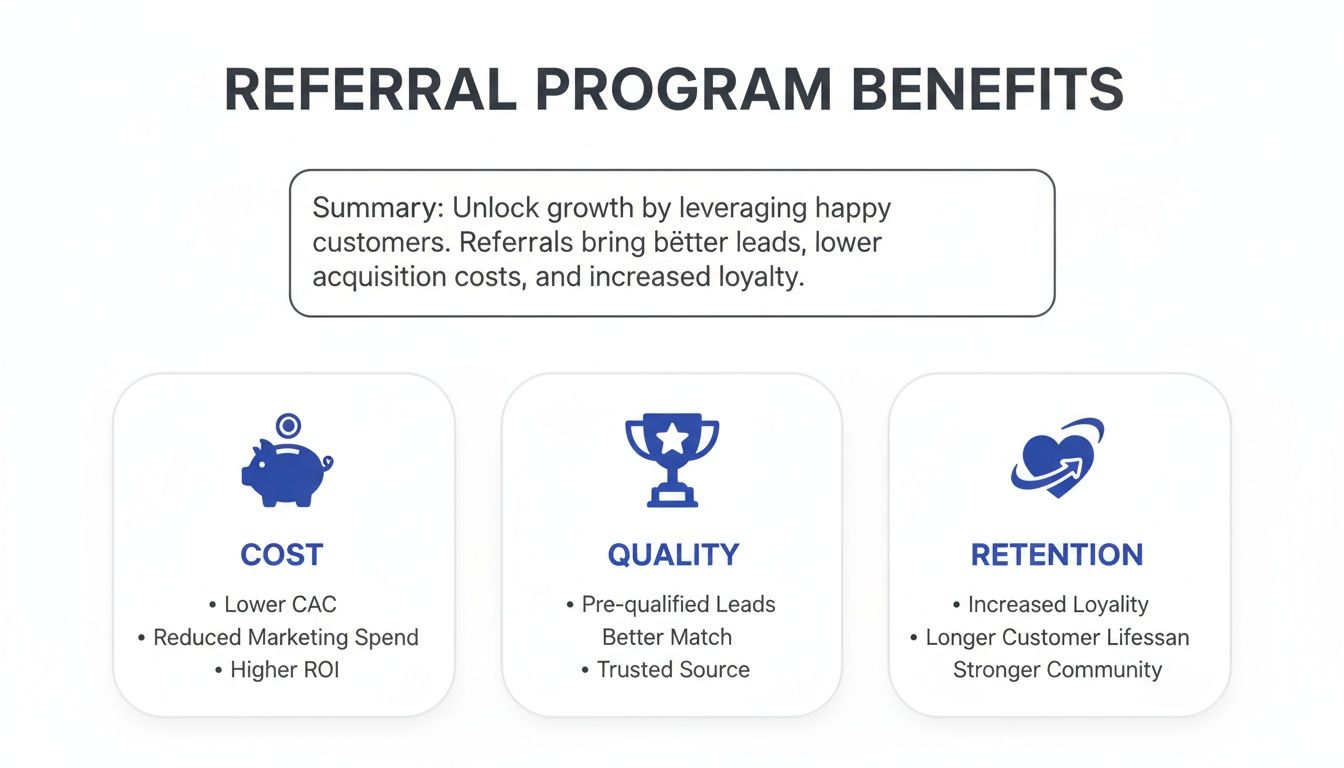
The data highlights that referrals improve cost, candidate quality, and long-term retention all at the same time.
For UK scale-ups, referrals deliver standout results. Research shows that referred candidates have a stronger cultural alignment, with 70% of employers seeing a better fit. This translates into tangible benefits, like a 46% higher retention rate for referred hires after one year. That frees up your People team to focus on building culture instead of constant backfilling.
By designing a thoughtful, transparent, and motivating programme, you can turn your entire team into your most effective recruiting asset.
Launching Your Scheme and Getting Your Team On Board
You have designed a solid employee referral scheme. Now for the launch. A half-hearted announcement gets half-hearted results. You need a launch that creates genuine excitement and total clarity.
Your team needs to see this as an invitation to become active partners in building the company. The goal is to make participation frictionless and show them how their contribution helps everyone win.
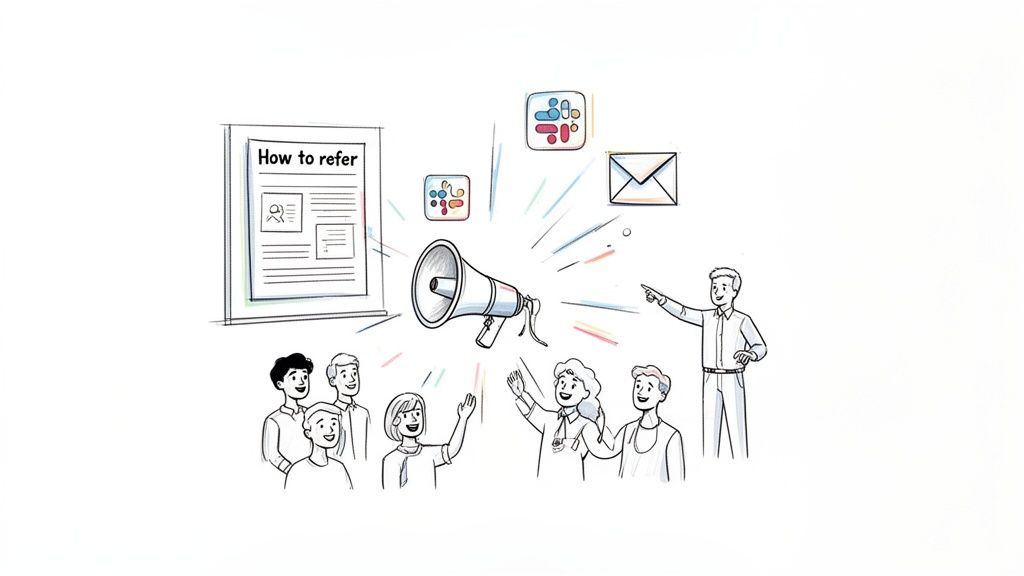
This is not about a single email blast. A high-impact launch is a proper campaign, using multiple channels to get the message across. It needs to be simple, energetic, and impossible to miss.
Creating Your Launch Comms
Your communication has to be direct. Answer the essential questions upfront: What is this? Why are we doing it? How does it work? What’s in it for me? Forget long, formal documents. Your launch assets should be built for speed.
Start by nailing your core messaging. Focus on the "why" before the "what". Explain that you are launching the scheme because you believe the best people already work here, and great people know other great people. Frame it as a way for everyone to build a stronger team, together.
Here are the essential assets you will want to create:
- A Simple One-Pager: This is your source of truth. It is a single document outlining the rules, rewards, and process in plain language. Link to it from everywhere.
- Slack/Teams Announcement: A punchy, visual message for your main company channel. Use emojis and bold text to make it scannable.
- All-Hands Launch Segment: Carve out five minutes in your next company-wide meeting. Get your CEO or a senior leader to introduce it. This gives it real weight.
- Email to All Employees: A follow-up to the All-Hands with a link to the one-pager and clear calls to action.
What good looks like: The single biggest mistake is making it complicated. If an employee has to spend more than 60 seconds figuring out how to submit a referral, you have already lost them. Simplicity is everything.
Once you have these assets, you are ready to plan the rollout. For a deep dive into structuring your comms, our Internal Comms Blueprint offers a great framework.
Your Go-Live Action Plan
A successful launch is about timing and reinforcement. Do not drop everything at once. Stagger your communications to build momentum and make sure the message sinks in.
Here is a practical, week-long launch sequence you can use:
- Monday (Pre-Launch): Brief your managers. Give them a heads-up and the one-pager. Your managers are your most important champions. They need to be ready to answer questions.
- Tuesday (Launch Day): Announce the scheme at your All-Hands meeting. Immediately after, post the announcement in your main Slack/Teams channel and send the launch email.
- Wednesday (First Reminder): Post a specific, high-priority role in your comms channel with a reminder about the referral bonus. This makes the scheme tangible and gives people an immediate action to take.
- Friday (Celebrate Early): Did you get your first few referrals? Give a public shout-out in Slack (without naming candidates). Something like: "Amazing to see five referrals come through already for our Senior Engineer role! Huge thanks to those who have tapped their networks."
This cadence keeps the programme top of mind during its most critical phase. It shows you are serious and encourages people to get involved right away.
Empowering Your Managers to Drive Adoption
Your managers are key to making your referral scheme a long-term success. If they are bought in, they will consistently encourage their teams to participate. If they see it as just another admin task, it will fizzle out.
That pre-launch briefing is crucial. Explain how the scheme directly benefits them by helping them build stronger teams with less effort. Give them talking points for their 1-on-1s and team meetings.
Ask them to actively prompt their teams. For example, a manager could say, "We have a spot opening for a Product Designer. The role is eligible for the referral bonus, so please think about anyone in your network who would be a great fit." This small nudge is incredibly powerful.
Running The Scheme Without The Admin Headache
You have launched your referral scheme. The announcement was made, the team is excited, and the first few names are trickling in. The real work begins now.
The long-term success of your scheme hinges on what happens next. It is all about operational excellence. A clunky, slow, or confusing process will kill engagement. Your focus now needs to shift to building a smooth, reliable, and almost invisible backend system. This is about creating a simple, repeatable workflow using the tools you already have.
Your success boils down to two things: bulletproof tracking and brilliant communication.
Building A Simple Tracking Workflow
You need a single source of truth for all referrals. Otherwise, you will quickly lose sight of who referred whom, when they were submitted, and where they are in the hiring process. That leads to disputes, missed payouts, and a loss of trust.
You can solve this with a simple spreadsheet or a dedicated pipeline in your Applicant Tracking System (ATS).
If you are using an ATS like Ashby, Lever, or Greenhouse, you are halfway there:
- Create a Unique Source Tag: Set up a specific source tag like "Employee Referral". This makes filtering and reporting a breeze.
- Use a Referral Form: Most modern ATS platforms have a feature that lets employees submit referrals directly. This is the gold standard. It automatically captures the referrer's name, the candidate's details, and a timestamp.
- Build a Referral Pipeline: Create a separate pipeline or add referral-specific stages to your existing one. Think stages like “Referral Received,” “Screening,” “Interviewing,” and “Hired.” This gives you a clear view of every referred candidate.
No fancy ATS? No problem. A well-organised Google Sheet or Airtable base works just as well. Just make sure your tracker includes these columns:
- Candidate Name
- Referred By (Employee Name)
- Date of Referral
- Role Applied For
- Current Status (e.g., Applied, Interviewing, Offer, Hired, Rejected)
- Bonus Payout Date
The key is consistency. Whatever tool you choose, make sure every referral is logged in the same way, every time.
Mastering The Communication Loop
Radio silence is the ultimate referral scheme killer. When a colleague takes time to tap into their personal network for you, they are invested. Leaving them in the dark is a guaranteed way to ensure they never refer anyone again.
A strong, proactive communication loop is essential. It shows you respect your team's effort and keeps them engaged, even if their candidate does not get the job.
What good looks like: Your communication process should be proactive, not reactive. An employee should never have to chase you for an update. Build automated or regular check-ins into your workflow from day one.
Here is a simple but effective communication cadence to follow:
- Immediate Confirmation: As soon as a referral lands in your system, send an automated or template email to the referrer. A quick "Got it, thanks so much!" goes a long way.
- Application Update: Once their candidate has officially applied or you have moved them to the first stage, let the referrer know. A quick Slack message is perfect.
- Interview Stage Update: This is a big one. When the candidate is invited for their first proper interview, send another update. This shows their referral is a genuine contender.
- Final Decision Update: This is the most crucial update. As soon as a final decision is made, inform the referrer personally and promptly. If it is a rejection, be tactful but transparent.
This level of communication builds immense trust and encourages people to keep referring. It transforms the process from a black box into a transparent partnership.
Prompt Payouts And Public Praise
When a referral is hired and passes their probation, you need to act fast on two fronts: the payout and the praise.
A delayed bonus feels like a broken promise. It undoes all the goodwill you have built. Make sure your payroll process is ready to handle these payments smoothly. The bonus should land in the employee's bank account in the next pay run after the new hire completes probation. No excuses, no delays.
Just as important is the celebration. Public recognition reinforces how much you value referrals. Give the successful referrer a massive shout-out in your next All-Hands meeting or a company-wide Slack channel. This is a powerful, real-time advert for the programme itself. It reminds everyone that it works and is worth their effort.
Measuring Success and Optimising Your Programme
You cannot improve what you do not measure. An employee referral scheme is not a "set it and forget it" initiative. To get compounding value, you need to track what is working, what is not, and be ready to make changes based on data.
The goal is to move beyond vanity metrics like the number of referrals. We need to focus on the numbers that signal the health and impact of your programme. Are you hiring better people, faster and more cost-effectively?
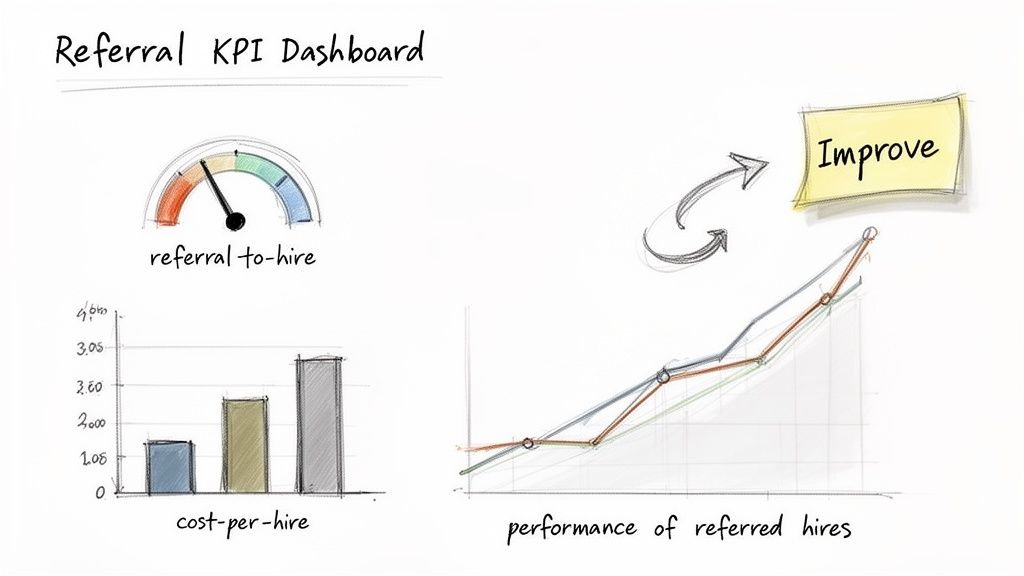
Key Metrics for Your Referral Dashboard
Do not get lost in data. For a startup, focus on a handful of high-signal metrics. You can build a simple dashboard in a spreadsheet to track these month-over-month. This gives you a clear picture of your programme's health.
Here are the essentials to track:
- Referral-to-Hire Ratio: What percentage of referred candidates get hired? A high ratio suggests your team is referring well-aligned candidates. A low one might mean your team does not understand the roles, or your process is filtering out good people.
- Cost-per-Hire (Referral vs. Other Channels): Do the maths. Calculate the cost of a referred hire (total bonuses paid ÷ total referred hires). Compare it with the cost of hiring through agencies or job boards. This is your core ROI metric.
- Time-to-Hire (Referral vs. Other Channels): How many days does it take to fill a role with a referral versus another source? Referrals should be significantly faster. If not, it could point to a bottleneck in your internal process.
Tracking these numbers gives you objective data to prove the value of your scheme and make smart decisions.
Looking Beyond The Numbers
Quantitative data tells you 'what', but qualitative feedback tells you 'why'. Data might show low engagement from the engineering team. Only by asking them will you discover it is because the submission process is a pain to use on mobile.
Regularly gathering feedback from your team is non-negotiable for optimisation. It helps you identify friction points you would otherwise never see.
What good looks like: The most valuable insights often come from people who are not participating. Find out why. Is the reward not motivating? Is the process unclear? Do not just survey the engaged; seek out the silent majority.
Here are a few simple ways to gather this crucial feedback:
- Run a quick poll in Slack. Ask something simple like, "On a scale of 1-5, how easy is it to submit a referral?"
- Add a question to your engagement survey. Put a section on the referral programme in your next company-wide survey.
- Talk to your top referrers. Schedule a quick 15-minute chat with your most active referrers. Ask them what works well and what could be improved.
- Chat with new hires. During their onboarding check-ins, ask referred new hires about their experience of the process.
This feedback loop is your secret weapon for continuous improvement.
How Data Informs Your Strategy
This is not just about collecting data; it is about using it to act. If your metrics show that referrals are your most cost-effective channel, it is a clear signal to double down.
With recruitment budgets often stagnant, an effective employee referral scheme is a powerful lifeline. Recent findings show that 68% of companies are actively using referrals. This channel is especially critical for experienced hires, where 89% of teams rely on it. Given that 53% of UK recruiters see candidate scarcity as their biggest challenge, referrals offer a proven way to reduce time-to-hire and boost quality without big ad spends.
A key metric for evaluating success, particularly for retention, is the employee turnover rate. You can easily learn how to calculate employee turnover rate to see if referred hires stay longer than those from other channels.
By combining hard data with human feedback, you create a powerful cycle of optimisation. This data-driven approach ensures your employee referral scheme delivers increasing value over time.
Answering Your Employee Referral Scheme Questions
When you are scaling a startup, you need quick, practical answers to tricky situations.
Here are the most common questions People Leaders ask when building an employee referral scheme, with direct, no-fluff answers.
How Much Should We Pay For A Successful Referral?
There is no single magic number. A solid starting point for UK startups is between £1,000 and £5,000. The final amount should hinge on the role's seniority and how tough it is to fill. High-demand tech roles should command a bonus at the higher end of that scale.
A tiered structure is your best bet. Something like this works well:
- Junior Role: £1,500
- Senior/Specialist Role: £3,000
- Leadership/Exec Role: £5,000
Always check what similar-stage companies in your industry are offering to stay competitive. And do not underestimate non-cash incentives. Extra paid time off or a generous learning budget can be just as motivating.
When Should We Pay The Referral Bonus?
Paying promptly is critical for building trust. The most common approach is to pay the full bonus after the new hire has passed their probation period, typically three or six months. This helps ensure the referral is a quality, long-term fit.
Some companies split the payment. For example, 50% on the new hire’s start date and the other 50% after probation. This can give an immediate boost in engagement, but it adds more admin. Whichever path you choose, make sure the policy is crystal clear from day one.
What good looks like: The rule is simple: pay on time, every time. A late bonus payment erodes trust and kills motivation for future referrals. Make it a non-negotiable part of your process.
What Is The Best Way To Promote The Scheme Internally?
Consistent, multi-channel promotion is essential. You cannot just announce the scheme once and expect it to build its own momentum. You need to weave it into your existing internal comms rhythms.
Here is what good looks like:
- Create a dedicated Slack channel (e.g.,
#referrals) where you can post new, bonus-eligible roles. - Celebrate successful referrals in your weekly or monthly All-Hands meetings. Public praise is a powerful motivator.
- Send a regular, simple email digest of priority open roles to keep them top-of-mind.
- Empower your managers to talk about the scheme in their team meetings and 1-on-1s.
The key is repetition and visibility. Make it almost impossible for your team to forget that the programme exists.
What Happens If Two People Refer The Same Candidate?
Your policy must address this from the outset to avoid disputes. The standard, and fairest, rule is 'first come, first served'.
The bonus goes to the employee whose referral was logged first in your official tracking system. Your submission process must automatically timestamp every referral to make this easy to verify. Communicate this rule clearly so everyone knows how it works. Transparency and consistency are your best friends here.
Building a high-impact People function from scratch is tough. With Open Org, you get the playbooks, templates, and AI-powered tools you need to build and scale your startup's People strategy. Stop reinventing the wheel and start executing faster. Check out the Open Org Content Pass.
