





Let’s be direct. 360 feedback questionnaires are a high-leverage tool for startups. They uncover leadership blind spots by gathering structured, multi-source feedback.
This is a developmental tool. It gives your leaders candid insights from their manager, peers, and direct reports so they can actually improve. It is not a traditional performance review.
Why 360 feedback matters in a startup
In a startup, you don’t have time for processes that don’t deliver immediate value. You’re moving too fast. Communication breaks down, leaders develop blind spots, and high-potential talent plateaus without the right guidance.
360 feedback cuts through the noise to solve these critical growth-stage problems.
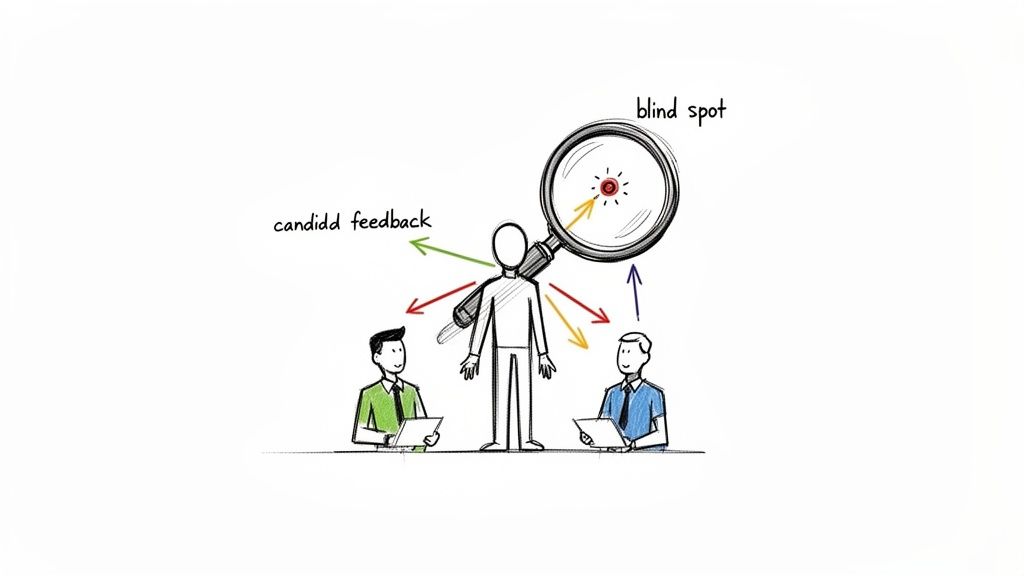
Pinpoint leadership blind spots
Founders and new managers often have significant gaps between how they think they lead and how their team experiences their leadership. A well-designed 360 feedback questionnaire provides unfiltered data that highlights these perception gaps.
For example, a Head of Engineering might believe they empower their team. Feedback could reveal their tendency to micromanage technical decisions is slowing down sprints. Without that insight, they’d carry on being a bottleneck.
According to First Round Review, one of the biggest failure points for new managers is a lack of self-awareness. 360s are a direct mechanism to build that awareness with real data from the people they work with every day.
Accelerate development for rising stars
Your future leaders need more than one person's perspective to grow. 360 feedback gives them a complete picture of their impact across the business. It shows them how peers perceive their cross-functional collaboration or how their communication lands with direct reports.
This multi-dimensional view allows them to build a targeted development plan that addresses real-world challenges. It's specific, actionable stuff they can use immediately.
What good looks like:
Identifies hidden talent needs: Aggregated data can reveal skill gaps across your entire management layer, informing your L&D strategy.
Builds a feedback culture: Normalising multi-source feedback makes it a standard part of how you operate.
Improves team alignment: When leaders understand their impact on other teams, they can better solve cross-functional friction.
Designing a questionnaire that gets real answers
A bad questionnaire is worse than no questionnaire. It wastes everyone’s time, spits out confusing data, and drives the wrong actions. Let's get tactical about building your 360 feedback so you get answers that actually mean something.
The foundation of a strong questionnaire is focusing on behaviours and competencies, not vague personality traits. You need to ask questions that probe how someone acts in specific situations relevant to their role. Generic questions lead to generic, useless feedback.
This is a flexible framework you can grab and adapt today.
Start with core competencies
Before you write a question, be clear on what you’re measuring. For a fast-moving company, focus on a handful of core competencies that are critical for success at your stage. Don't overcomplicate it.
Here's a starting point:
For Senior Leaders: Focus on strategic thinking, vision communication, cross-functional influence, and developing other leaders.
For New Managers: Prioritise coaching, giving clear feedback, delegation, and fostering psychological safety.
For High-Potential ICs: Look for ownership, proactive problem-solving, influencing without authority, and adaptability.
Once you’ve nailed down 3-5 core competencies for the role, you can start building specific, behaviour-based questions around each one.
Crafting high-impact questions
The best questions are clear, focus on a single behaviour, and are observable. A classic mistake is writing "double-barrelled" questions that ask about two things at once. Split them up. One idea, one question.
You also need a mix of quantitative (rated) questions and qualitative (open-ended) questions.
Quantitative questions give you the "what". The data and the trends. Qualitative questions give you the "why". The context and the stories behind the ratings. You need both.
Here are a few examples you can adapt.
Sample questions for a Senior Leader
Competency: Strategic Thinking
- How effectively does this person connect their team's work to the company's overall strategy?
- To what extent does this individual anticipate future challenges and opportunities for the business?
- Open-ended: What is one thing this leader could do to improve the long-term vision for their department?
Sample questions for a new manager
Competency: Coaching & Development
- How often does this manager provide you with actionable feedback that helps you improve?
- Does this manager create opportunities for you to develop new skills?
- Open-ended: Describe a time this manager supported your growth. What did they do?
Choosing your rating scale
Your rating scale has a huge impact on the quality of data you collect. Avoid ambiguous numerical scales like 1-5. One person’s ‘3’ is another’s ‘4’, creating noise in your data.
Instead, use a descriptive or behavioural anchor scale. This attaches a clear meaning to each rating point, making feedback more consistent and reliable.
Two solid options for a startup:
Frequency Scale: This measures how often a behaviour is observed.
- Almost Never
- Rarely
- Sometimes
- Often
- Almost Always
Agreement Scale: This asks raters to agree or disagree with a behavioural statement.
- Strongly Disagree
- Disagree
- Neutral
- Agree
- Strongly Agree
The Manager: Their feedback is critical and is usually not anonymous.
3-5 Direct Reports: They provide an essential view of day-to-day leadership and management style.
4-6 Peers: This should include cross-functional colleagues who can speak to collaboration and influence.
The Self-Review: The individual must always complete their own questionnaire. It's a vital part of self-reflection.
Peer and Direct Report feedback is always anonymous and aggregated. Reports will show themes and average scores from these groups, never individual responses.
Written comments will be themed and attributed to rater groups (e.g., 'Peers', 'Direct Reports'), not individuals. This is crucial. Assure people you will never show a verbatim comment next to a person's name unless they are the manager.
The manager's feedback is identifiable. This is standard practice and helps provide direct, accountable coaching.
A minimum number of responses is required. State that feedback from a rater group will only be displayed if a minimum number of people (usually 3) from that group respond. This prevents participants from trying to guess who said what in smaller teams.
Announcement Email (1-2 weeks before launch): Announce the upcoming 360 feedback process. Explain the "why," who is involved, the timeline, and hammer home confidentiality rules.
Rater Invitation Email (Day of launch): This goes to everyone asked to provide feedback. Include the questionnaire link, the deadline, and another clear reminder about confidentiality.
Reminder Emails (Mid-way and 2 days before deadline): A gentle nudge to anyone who hasn't completed their feedback. Modern tools can automate this for you. For more on this, check out our guide on building a feedback culture in your startup.
What? Review the data together. Focus purely on understanding the key messages. What does the data say? What are the main strengths and development areas?
So What? Dig deeper with probing questions. Why do they think their peers rated their collaboration skills differently than they did? What impact might this perception gap have on the team?
Now What? Pivot to action. Based on everything they've processed, what are the 1-2 most important things they want to work on? What specific actions can they take in the next 30 days?
The Development Goal: A clear statement of what they want to improve (e.g., "Delegate more effectively to empower my team").
Key Actions: 3-5 specific things they will do (e.g., "Identify one task per week to hand off completely," "Hold a weekly check-in with my direct report to discuss their delegated projects").
Support Needed: What do they need from their manager or the company to succeed? (e.g., "Coaching on how to give up control," "Budget for a project management tool").
How Success Will Be Measured: How will they know they've improved? (e.g., "Team survey shows an increase in feelings of autonomy," "I have an extra 4 hours per week for strategic work").
Per-Assessment Pricing: You pay a fixed fee for each person going through a 360 review. It’s perfect for targeted rollouts, like focusing on your senior leadership team or a specific group of new managers.
Platform Subscription Fees: Some tools offer an annual subscription that gives you a set number of assessments or even unlimited reviews. This can be more cost-effective if you plan on making 360s a regular part of your talent development cycle.
Improved Manager Effectiveness: Better managers create more engaged teams. Engaged teams are more productive and less likely to leave.
Reduced Employee Turnover: By spotting and fixing leadership issues causing friction, you directly tackle a big driver of attrition.
Faster Leadership Development: Pinpointing specific development needs means your training budget goes towards things that actually matter, fast-tracking the growth of your high-potential people.
- Their manager
- 3-5 direct reports
- 4-6 peers or key cross-functional partners
Both are more objective than a simple "good" to "bad" scale.
One final, critical tip. Add a "Not Applicable / Don't Have Enough Context to Say" option to every question. This is non-negotiable. It prevents guessing and ensures you collect clean, accurate data only from raters who have directly observed the behaviour.
Running a smooth and trusted feedback process
A great questionnaire with a clumsy rollout will destroy trust before you start. A well-run process builds psychological safety. A poorly managed one creates anxiety and cynicism.
This is your playbook for getting the execution right. It's about managing expectations, protecting confidentiality, and making sure everyone sees the process as fair and developmental.
Selecting the right raters
Who gives feedback is as important as the questions you ask. The goal is a balanced perspective from people who have worked with the individual and can comment on their behaviours firsthand.
A common mistake is letting people pick only their "friendly" reviewers. You have to guide the selection process to make sure the data is meaningful.
The ideal number of reviewers is between 8 and 12 people. This is large enough to ensure anonymity but small enough to remain manageable.
Here’s a solid mix that works for most roles:
Setting clear expectations on anonymity
You must be crystal clear about how anonymity and confidentiality work. Any ambiguity here will kill honest feedback. People need to feel safe to be candid.
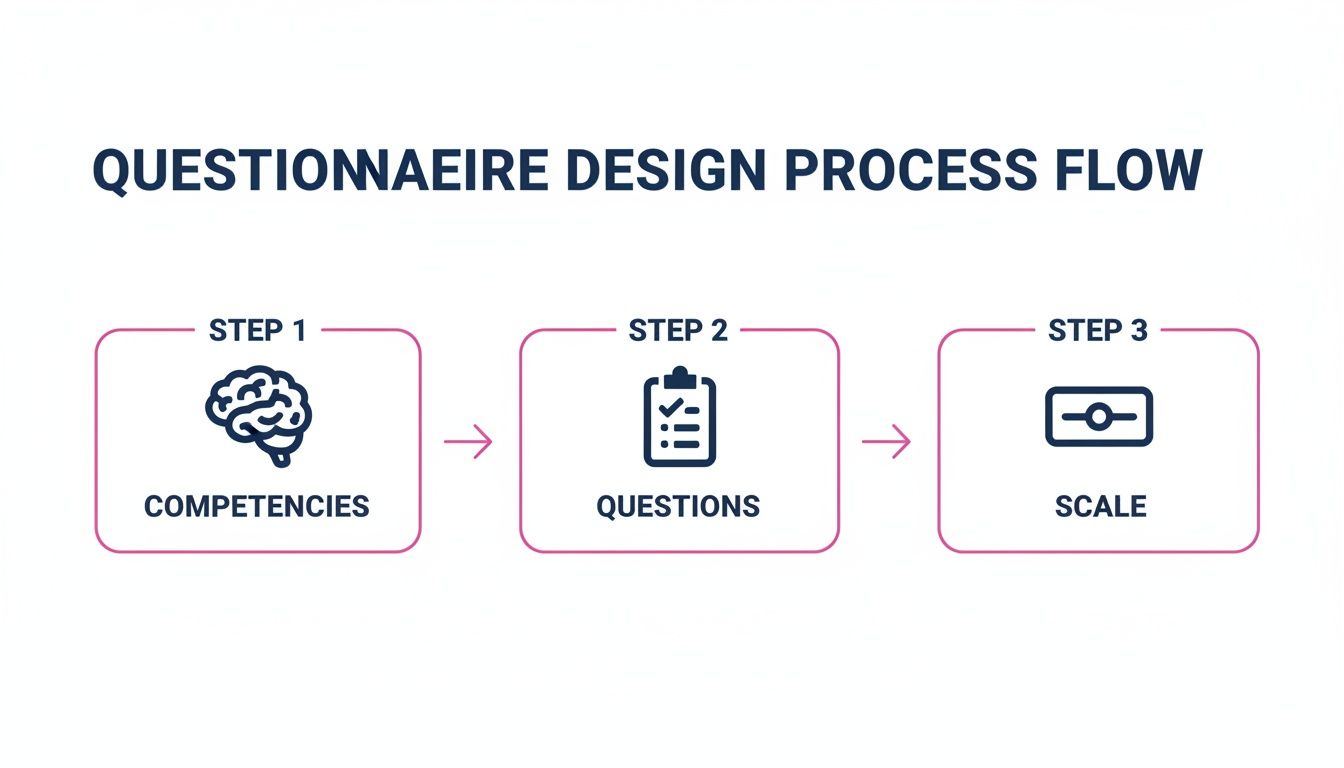
This simple flow from competencies to questions to scale keeps your process consistent and fair.
Here’s exactly what you need to communicate to all participants:
Your pre-launch communications plan
Over-communicate. Your goal is to demystify the process and frame it as a positive, developmental tool, not a performance review in disguise. If you're looking for ways to build an environment where this kind of information flows more freely, it's worth exploring how to improve workplace communication at a foundational level.
Your communication plan should include a sequence of emails.
Using modern tools is a lifesaver here, especially for managing logistics and ensuring data is handled securely and anonymously.
Turning feedback data into actionable growth plans
Collecting the 360 feedback is the easy part. The real work is turning raw data into a clear story that helps your leaders grow. A dense, confusing report is a waste of time.
The goal is a report that’s easy to digest and points to clear actions. You need to visualise the data simply, pull out key themes from written comments, and highlight the gap between self-perception and how others see them.
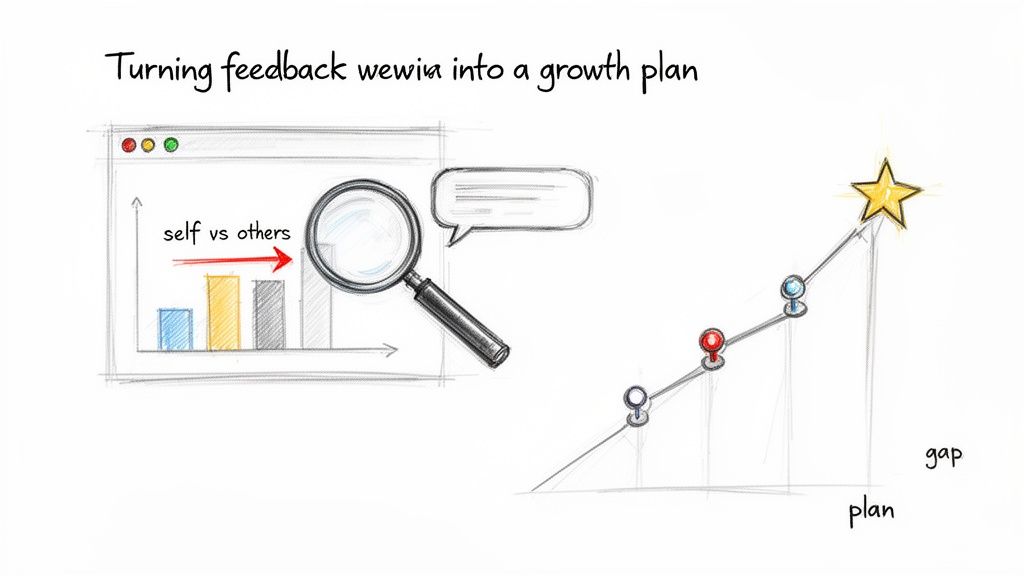
This perception gap is where the magic happens. Highlighting it helps a leader see their blind spots without feeling attacked.
Building a report that leaders will actually use
Your report needs to be a tool, not a novel. Clarity and brevity are your best friends. A good report has a clear structure that guides the reader from the big picture down to specific details.
Think of it as telling a story with data.
First, start with the big picture. Open with a summary of the key themes. What are the 2-3 standout strengths and 2-3 most significant development areas? Give them the headlines upfront.
Next, visualise the ratings. Simple bar charts are perfect for comparing a leader's self-rating against the average scores from their manager, peers, and direct reports. This is the fastest way to spot crucial perception gaps.
Finally, group qualitative comments by theme. Don't just dump a list of anonymous quotes. Group comments by competency (e.g., "Communication," "Strategic Thinking") to provide context. This turns a random stream of comments into a coherent narrative.
The most effective reports guide the leader towards self-discovery. The report should prompt reflection by asking questions like, "What might explain the difference between how you see your communication style and how your direct reports experience it?"
Coaching leaders through their results
Handing over a 360 report without a proper debrief session is a massive mistake. The conversation you facilitate is where the feedback truly lands. Your role isn't to judge. It's to help the leader process everything constructively.
A simple framework for this session works best. The "What? So What? Now What?" model is direct, memorable, and action-oriented.
Creating a strong development plan
The output of any 360 process is a simple, focused development plan. This should not be a long list of weaknesses to fix. A great plan hones in on one or two high-impact areas and outlines concrete steps for improvement.
A strong plan includes:
This kind of structured follow-up is essential. To help formalise this, you can adapt parts of our Performance Handbook Template to create a simple development planning document.
Finally, look for organisational trends. By aggregating anonymised data from all reports, you can spot wider issues. If "cross-functional communication" keeps popping up as a common development theme for multiple leaders, that's not just an individual problem. It's an organisational one you need to address.
Calculating the cost and ROI for your startup
As a People Leader in a startup, every pound counts. You can't afford to throw money at initiatives that don't move the needle. Let’s get real about the costs and tangible returns of a 360 feedback programme.
This is a strategic investment in the leadership muscle your company needs to scale. We'll break down typical pricing from modern providers and connect the cost to business outcomes you care about, like retention and performance.
Breaking down the costs
Running 360 feedback doesn't have to break the bank. Most modern providers have ditched clunky enterprise contracts for flexible pricing that scales with you.
You'll typically see two pricing models:
As a benchmark, some modern providers start their pricing around £99 per person for a small batch. That cost can drop to as low as £60 per person when you buy in larger volumes.
So, for a scale-up running feedback for 25 leaders, you could be looking at a total software cost of around £1,750 by taking advantage of bulk rates.
Connecting your investment to tangible ROI
The real value is in the improved performance, higher engagement, and better retention that comes from building stronger leaders. The ROI of your 360 programme is directly linked to its impact on key business metrics.
A well-executed 360 process can directly reduce leadership turnover. Replacing a senior leader can cost anywhere from 150-200% of their annual salary. Retaining just one key person through better development easily pays for the entire programme.
To build a rock-solid business case, connect the feedback process to financial outcomes. To properly quantify the impact, learning how to build an ROI calculator can give you a solid framework for your pitch.
Think about the impact in these areas:
Presenting this isn’t about just asking for a budget. It's about showing how a modest investment in your people's growth is one of the smartest financial decisions a scaling company can make. For a complete guide on this, check out our playbook on proving the ROI on your people initiatives.
Got questions about 360 feedback?
If you’re rolling out 360 feedback for the first time, you probably have questions. Let’s get you some direct, no-fluff answers so you can sidestep the usual traps.
Here’s a quick-fire round on the most common queries we hear.
How often should we run 360 reviews?
For your senior leadership team, running a 360 review once a year is a great rhythm. It creates a predictable cadence for deep, developmental feedback without overwhelming everyone.
For high-potential talent or new managers, you might consider a lighter check-in every six to nine months after their first big review. The most important thing is consistency. Never make it a one-off event. It should be part of your talent development cycle, but always keep it separate from salary or promotion talks. This ensures it remains a pure growth tool.
What's the ideal number of reviewers?
The sweet spot is between 8 and 12 reviewers for each person. This range is big enough to guarantee anonymity and gather balanced perspectives, but not so big it becomes an admin nightmare.
A solid mix of reviewers typically includes:
Let the person being reviewed have some say in who their reviewers are. This small gesture builds trust and makes it feel like a collaborative process.
What’s the biggest mistake to avoid?
A lack of follow-up.
Handing someone a detailed feedback report and walking away is only half the job. If you do that, you're breeding cynicism about the whole process. People will wonder why they bothered.
You must resource the follow-up and coaching phase properly. Make sure every participant gets a structured debrief session to help them make sense of the feedback. They should walk away with one to three clear actions they’re committed to working on.
Should 360 feedback be anonymous?
Yes, mostly. For peers and direct reports, feedback must be anonymous and aggregated. This is non-negotiable if you want candid input. The only feedback that isn’t anonymous is from the person’s manager.
Be crystal clear with everyone about the rules of confidentiality from the outset. Explain that comments will be presented in themes and attributed to groups, like 'Your peers said...' or 'Your direct reports noted...'. They will never be traced back to an individual. This protects psychological safety while delivering actionable insights.
At Open Org, we build practical playbooks and tools to help you accelerate your work. Our Content Pass gives you instant access to our entire library of resources, plus an AI-powered co-pilot to help you execute faster. Get the resources you need to build a high-performing startup.
