






A 30 60 90 day plan is a simple roadmap. It spells out a new hire's priorities for their first three months. For a startup, this is not a corporate checkbox exercise. It's a critical tool for getting new team members dialled into aggressive company goals from day one.
Why Your Startup Needs a 30 60 90 Day Plan
In a fast-moving startup, ambiguity is the enemy of progress. Without clear direction, new hires can spend weeks just figuring out where they fit, what really matters, and how they can start making an impact. This uncertainty slows them down and ramps up the risk they'll churn.
A solid 30 60 90 day plan cuts right through that noise.
This is about giving your new people a clear path to contribution. It is not just handing them a laptop and a welcome pack. A structured plan takes a new joiner from confusion to confident execution. That shift is essential when every single hire has to count.
Drive Focus and Alignment
A well-crafted plan acts as a North Star for your new employee. It breaks down what can feel like a big, intimidating role into manageable, focused chunks of work over the first three months.
Days 1-30: The focus is on learning. This means absorbing information, soaking up the culture, and meeting the key people they'll be working with.
Days 31-60: The shift moves towards contribution. They’ll start applying that new knowledge to smaller projects and getting some early wins.
Days 61-90: The final phase is about moving towards independence and owning outcomes. This is where they start driving their own work forward.
This structure makes sure their energy is directed at the right things at the right time. It creates a clear line of sight between their day-to-day tasks and the wider company objectives. This shows them exactly how their work contributes to the startup's success. This is a core part of building a high-performance culture, something you can map out with a strategic people roadmap.
Boost Confidence and Reduce Churn
The first 90 days are the most vulnerable period for a new hire. A plan provides psychological safety by setting clear, achievable expectations right from the start. It gives them a framework for asking smart questions and a tangible way to measure their own progress.
This strategic planning tool is especially crucial for effectively onboarding C-level executive assistants and ensuring their rapid integration and impact. In the UK tech startup scene, a 30 60 90 day plan is proven to drive independent output, boosting retention by 40%. Teams using them avoid the common 25% early churn rate often seen in UK startups that lack structured plans.
A great 30 60 90 day plan is not a performance management tool. It's a communication and alignment tool. It tells a new hire exactly what winning looks like in their first quarter, so they can get there faster.
The Open Org 30 60 90 Day Plan Template
Most templates feel like they were made for a bank in the 90s. They’re rigid, generic, and completely out of touch with the speed and ambiguity of a startup. That’s why we designed our 30 60 90 days plan template specifically for the high-growth environment. It's built for action, not just ticking boxes.
You can grab the template and start using it today.
Get Your 30 60 90 Day Plan Template Here
Think of this as more than just a document. It’s a framework for having the right conversations and a tool for seeing real progress from day one. It helps you channel a new hire’s initial excitement into focused, early impact.
The visual below shows how this simple plan is a core part of startup survival. It creates clarity, drives alignment, and ultimately boosts retention.
This shows that a structured onboarding plan is not an HR afterthought. It's an operational tool that keeps new hires engaged and productive when it matters most.
Breaking Down the Template Sections
We've organised our template into five core sections. Each one builds on the last, creating a natural flow from learning the ropes to owning outcomes. It’s also flexible enough to work for any role, whether you’re hiring a software engineer or your first Head of Sales.
Let’s walk through what’s inside.
Core Responsibilities: This part grounds the entire plan in reality. What are the 2-3 primary functions this person was hired for? Pull these straight from the job description. This section acts as the ‘why you’re here’ anchor for everything else.
Key Relationships: Nobody in a startup succeeds in a silo. Here, you'll map out the key people the new hire needs to connect with. We're talking direct team members, crucial cross-functional partners, and any other key stakeholders. It’s a simple step that proactively builds the internal network they need to get things done.
From Learning to Performing
The next part of the template is where we shift from understanding the role to executing within it. This is where the plan transforms into a proper roadmap for their first quarter.
The goal is to move a new hire from being a consumer of information to a producer of value. This template structures that journey, one month at a time.
Here's how it breaks down.
Learning Goals: What does the new hire need to know to be effective? This could be anything from getting to grips with the tech stack to understanding the sales playbook or mastering the brand voice. The first 30 days are always heavily weighted towards learning.
Performance Goals: These are the tangible outputs. What will they actually do or produce? These goals need to be specific and measurable, like ‘ship one minor bug fix’ or ‘co-author two blog posts’.
Personal Objectives: This is a crucial space for the new hire to add their own development goals. It encourages ownership and makes the plan a two-way street. Maybe they want to get better at public speaking or learn a new piece of software that the team uses.
By combining these elements, the 30 60 90 days plan template creates a shared language for success between a manager and their new team member. It cuts through ambiguity, focuses energy on what really matters, and gives a new hire a clear path to start adding value from the get-go.
The First 30 Days: Mastering the Fundamentals
The first month for any new hire is about immersion, not immediate impact. Forget about shipping massive features or closing huge deals right out of the gate. The real goal is to absorb information, build foundational relationships, and get a feel for the rhythm of the business.
This is the learning and alignment phase. A new hire's main job is to listen, ask smart questions, and start connecting the dots. Your 30 60 90 day plan template needs to reflect this by focusing on inputs, not just outputs. They need to get to grips with the company culture, the product, the customers, and the tools they’ll be using every day.
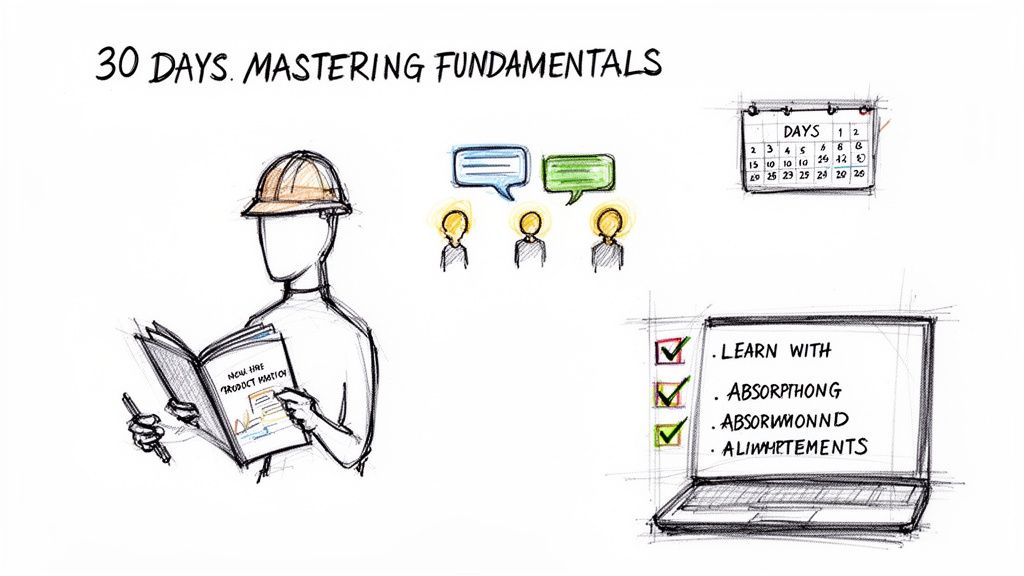
For new team members, especially in remote setups, a solid plan is the best defence against feeling adrift. A 30 60 90 day plan provides the structure they need for mastering the remote onboarding process and integrating into the team without getting lost.
Structuring the First Month for Action
This period is all about laying a solid foundation. Your template should guide the new hire toward specific, achievable learning goals. Think of it as providing a curated list of things they absolutely need to understand before they can become truly effective.
This plan should be a living document, not some rigid checklist to be ticked off. It's there to set expectations and give the new hire a clear framework for their first few weeks. This proactive approach is a cornerstone of great onboarding, something we dive deep into in our Open Onboarding Cookbook.
Let's look at some tactical examples for different roles to see what this looks like in practice.
For a new Software Engineer.
Get their local development environment fully set up by the end of week one.
Successfully push a minor, non-critical documentation fix to production.
Schedule 30-minute introductory chats with every other engineer on the team.
Read and summarise the top three most relevant technical architecture documents.
For a new Product Marketer.
Shadow three customer support calls and pull out key pain points.
Review the last six months of marketing performance data and identify one key trend.
Meet with the Heads of Sales, Product, and Customer Success to understand their priorities.
Write a one-page summary of the top three competitors’ messaging.
Notice the pattern? These tasks are not about delivering massive value on day five. They're designed to force learning, build context, and establish those crucial internal connections.
What Good Looks Like at Day 30
By the end of the first month, a successful new hire should be shifting from pure absorption to initial synthesis. They're starting to build the muscle memory needed for their role.
The real win at day 30 is a new hire who can confidently explain what the company does and for whom. They should know who to go to with different types of questions and feel psychologically safe enough to ask them.
They've likely had a small, tangible win. That documentation fix or the customer insight summary. This isn't just about their output. It's a huge confidence booster that proves they can navigate the systems and contribute. It’s a signal that the foundation is solid, ready for them to accelerate into the next phase.
Key Focus Areas for the First 30 Days
When you're filling out the template for this first phase, concentrate on these four areas. It's the best way to ensure the new hire’s time is spent on the most valuable activities for their long-term success.
People and Relationships. Map out exactly who they need to meet. This is not just their immediate team. Include key cross-functional partners who will be critical to their success. The goal is to build a human map of the organisation.
Product and Customer Knowledge. Make sure they get direct exposure to the product and the people who use it. No role is too technical or too internal to benefit from understanding the customer's world. This builds the empathy and context that informs all future work.
Processes and Tools. This is the practical, hands-on stuff. How do we ship code? What’s our content approval process? Which Slack channels are essential? Documenting these learning goals removes friction and gets them up to speed far faster.
Culture and Communication. How does the team actually communicate? Is it async-first? What do meetings feel like? These unwritten rules are vital. Set a goal for them to observe different team rituals to understand the company’s unique way of working.
Focusing the first 30 days on these fundamentals sets your new hire up for a successful transition from learning to meaningful contribution in the next part of their plan.
Days 31 to 60: From Learning to Contributing
The first month was about soaking things up. Now it's time for your new hire to start putting that knowledge to work. This second month is a crucial transition period. It moves them from observing and learning to actively contributing. The focus pivots from inputs to outputs.
This is where your 30 60 90 day plan proves its worth as a roadmap for making an impact. The goals for this phase need to feel more collaborative and results-focused. It's time to shift from "understanding the process" to "improving the process."
The main objective here is to get your new hire properly involved in active projects. This does not mean throwing them into the most complex, mission-critical task on day 31. It’s about finding the right entry point where they can apply their skills, get a feel for the team's workflow, and start building momentum.
Identifying the First 'Quick Win'
A 'quick win' is a small, manageable project that lets a new hire deliver tangible value early on. It's a huge confidence-builder for them and a clear signal to the team that they're getting up to speed. As a manager, picking the right project is one of your most important jobs during this phase.
A great quick win usually has a few key things in common.
Low Risk. It shouldn't be a blocker for a major deadline. No pressure.
High Learning Value. It should naturally push them to interact with key systems and people.
Clear Scope. It needs a well-defined beginning, middle, and end.
Visible Outcome. The result should be something the team can see and acknowledge.
This isn’t just about ticking a box. It’s about strategically choosing an activity that plugs them into the team’s rhythm and lets them show what they can do.
What Contribution Looks Like in Practice
The performance goals for this phase need to be specific and action-oriented. They must connect directly to broader team or company objectives. All that ambiguity from the first 30 days should be replaced with much clearer expectations.
Let's look at how this plays out for different roles.
For a Sales Development Representative (SDR).
Take full ownership of a small list of inbound leads.
Co-host one discovery call with a senior team member.
Hit a target of booking 5 qualified meetings.
For a Customer Support Specialist.
Independently resolve 20 tier-one support tickets.
Write one new article for the internal knowledge base.
Get a positive customer satisfaction score on at least 85% of their interactions.
For a People Ops Coordinator.
Manage the onboarding logistics for one new starter from start to finish.
Process the monthly payroll with supervision.
Gather and summarise feedback on the first 30 days from the last three new hires.
Each of these examples is a clear step up from the learning goals of the first month. They require the new hire to get their hands dirty and actively participate in the core work of their team.
In the 31-60 day period, the goal is to shift the new hire's primary question from "What do I need to know?" to "How can I help?". The plan should guide them toward the right answers.
Building Deeper Connections
Active contribution is the fastest way to build real relationships. As new hires get involved in projects, they move from introductory chats to genuine, work-based collaboration. This is where the trust and rapport that power high-performing teams are forged.
Your plan should formalise this by setting goals for relationship-building and asking for feedback.
Seeking Feedback. Prompt your new hire to proactively ask for feedback on their first pieces of work. A goal could be: "Schedule a 15-minute feedback session with the project lead after my first code contribution is merged." This normalises feedback as a tool for growth, not a critique.
Cross-Functional Collaboration. Identify a key stakeholder outside of their immediate team they'll need to work with. For an engineer, this might be a product manager. For a marketer, someone in sales. The goal is to build the cross-functional bridges they will need to be effective long-term.
By day 60, your new hire should feel like an integrated part of the team's workflow. They’ve moved past the initial learning curve, scored a tangible win, and are actively contributing to shared goals. They're no longer just learning how the team works. They are part of how the team works.
Days 61 to 90: Driving Independent Impact
We're now in the final phase of the plan, and it's all about one word: ownership. Your new hire has spent two months learning the ropes and getting their hands dirty on projects. Now it’s time for them to start driving their own work forward, operating with far less direct supervision.
The goals in your 30 60 90 days plan template need to reflect this shift towards autonomy and initiative. It's the moment we move from assigned tasks to owned outcomes. Your new hire should be proactively spotting problems and suggesting solutions, not just ticking off a predefined to-do list.
By day 61, they have the context. They know the people, the product, and the processes. This is when they really start to earn the team's trust by delivering consistent, measurable results that tie directly to their role's core key performance indicators (KPIs).
Defining Goals for Autonomy and Initiative
In this final stretch, the goals you set should be less about how to do the work and more about what needs to be achieved. You're giving your new hire the space to apply their unique skills and experience to solve real business challenges.
This is the point where the plan graduates from a simple onboarding tool to a foundational piece of their performance management. For practical guidance on structuring this, our performance handbook template offers a solid framework. The focus now is squarely on delivering tangible value.
Let's look at some role-specific examples to see how this shift plays out in practice.
For a Product Manager.
Take full ownership of the product backlog for one specific feature.
Independently run a customer interview session and present the findings back to the team.
Write and present a mini-product requirements document for a new feature proposal.
For a Sales Executive.
Independently manage a small pipeline of five to ten qualified leads.
Successfully close one new business deal without direct manager involvement.
Develop a personalised outreach strategy for a specific target account.
For a Content Marketer.
Pitch, write, and publish one long-form blog post from start to finish.
Analyse the performance of the last quarter's content and propose three new topic ideas.
Take ownership of the company's LinkedIn account for one week, including scheduling and engagement.
Notice the theme? Each of these goals requires the new hire to take the lead. They are no longer shadowing or co-authoring. They are owning the entire process and its outcome.
What Good Looks Like at Day 90
By the end of the first three months, your new hire should feel like a fully integrated and proactive member of the team. They shouldn't just be executing tasks but actively thinking about how to improve things.
The ultimate goal by day 90 is for the new hire to be adding more value than they are consuming in terms of management overhead. They should be a net positive contributor to the team's capacity and output.
They understand the "why" behind their work and can connect their daily activities to the company's bigger goals. They should be comfortable navigating the organisation, leading conversations in their area of expertise, and taking calculated risks.
Looking Beyond the First 90 Days
The end of the plan is not the end of their development journey. This final phase is also the perfect time to start planting seeds for their long-term growth and discussing future career aspirations.
Here are a few ways to structure this conversation.
Identify Stretch Projects. What's a problem or opportunity just outside their current comfort zone? Assigning a small, low-risk "stretch" goal for the next quarter can be a powerful motivator.
Discuss Career Paths. Have an open conversation about what they want to achieve in the next 6-12 months. How can the company support that growth? This shows you're invested in them beyond their initial onboarding.
Formalise the Feedback Loop. Transition from frequent onboarding check-ins to a more regular performance conversation cadence. The 90-day mark is a natural point to set clear expectations for the next quarter.
At the end of this period, the 30 60 90 days plan template has done its job. It has successfully guided someone from being an outsider to a fully contributing team member, ready to make a lasting impact.
Common Mistakes to Avoid When Using the Plan
A great template is only half the battle. How you actually use the 30 60 90 day plan is what separates a genuinely useful alignment tool from a document that just gathers digital dust.
Even with the best intentions, it's surprisingly easy to fall into a few common traps that drain the plan of its power.
One of the biggest mistakes is treating the template as a rigid, one-size-fits-all document. You can't just copy and paste the same set of goals for a software engineer and a sales lead. That’s a non-starter. Each plan has to be tailored to the specific role, the individual's experience level, and the team’s most pressing priorities.
Another classic error is the 'set and forget' approach. The plan gets created with enthusiasm during week one, shared with the new hire, and then never looked at again. This completely misses the point. The plan should be a living document and a conversation starter that’s built to be tweaked along the way.
Setting Unrealistic Expectations
It’s easy to get carried away by the excitement of a new hire and overload their plan with wildly ambitious goals. This happens a lot in startups where everyone is already stretched thin. Packing the first 30 days with huge, output-focused targets is a recipe for anxiety and burnout, not success.
Remember, the first month is all about learning and integration. A new team member is still figuring out who’s who, how to navigate your tech stack, and where the virtual coffee machine is.
Setting a goal like ‘launch a new marketing campaign’ in the first 30 days is unrealistic. A much better goal would be ‘analyse the performance of the last three campaigns and present your findings’. One is about pressure. The other is about learning.
The purpose of the plan is not to test a new hire's ability to perform miracles. It's to give them a structured, achievable path to becoming a fully contributing member of the team.
Neglecting Regular Check-Ins
Without consistent follow-up, the plan quickly becomes meaningless. If you aren’t regularly discussing progress, the new hire has no idea if they are on track. You have zero visibility into what might be blocking them. This is where the plan so often falls apart in practice.
The solution is simple but completely non-negotiable.
Schedule Weekly Reviews. Put a recurring 30-minute check-in in the calendar specifically to go over the plan. Protect this time.
Focus on Progress and Blockers. The conversation should centre on two simple questions. What progress did you make against the plan this week? And what’s getting in your way?
Adjust as Needed. The startup world moves fast. A priority from week one might be irrelevant by week five. Use these check-ins to adjust the plan in real-time so it always reflects current reality.
This consistent feedback loop turns the plan from a static document into a dynamic management tool. It lets you spot issues early, provide support where needed, and make sure your new hire feels guided and aligned every step of the way.
Got Questions? We've Got Answers
Putting a 30 60 90 day plan into practice always sparks a few questions, especially in a fast-moving startup. Here are some of the most common ones we hear.
How Do I Adapt This for a Fully Remote New Hire?
When your new hire is remote, you have to be much more intentional about building connections. It won’t happen by the water cooler.
I'd recommend adding specific, measurable goals to their plan around building a network. Something like "schedule five virtual coffees with key people outside of your immediate team" can make a huge difference. Tech and system access also need to be front and centre in the first 30 days to get rid of any early friction. Most importantly, regular video check-ins to review the plan are completely non-negotiable.
Should the New Hire Help Create Their Own Plan?
Absolutely. A 30 60 90 day plan should never feel like it's being handed down from on high.
The hiring manager should always create the first draft, mapping out the core expectations and linking them to company goals. But on day one or two, sit down and review it together with your new hire. This simple act transforms it into a shared document. It gives them a chance to add their own personal development goals, which massively boosts their sense of ownership and commitment to the plan.
What If a New Hire Isn't Hitting Their Goals?
Think of the plan as your early-warning system. If someone is falling behind, it’s not a signal to punish. It's a signal to step in and help. Immediately.
Use your weekly check-ins to dig into the 'why'. Is it a lack of resources? Are the expectations unclear? Is there a skill gap that slipped through the net during hiring? Get to the root cause and adjust the plan accordingly. This template helps you spot and solve these issues in the first 90 days, not six months down the line when they’re much harder to fix.
A great 30 60 90 day plan helps new hires succeed, but what about the rest of your People Ops work? With Open Org, you get the playbooks, templates, and AI-powered support to build a high-performing startup, faster. Stop reinventing the wheel and start executing today. Find out more at https://www.openorg.fyi.
